



Citrus aurantium flower oil: properties, uses, pros, cons, safety
Citrus Aurantium Flower Oil, also known as neroli oil or bitter orange flower essential oil, is an essential oil obtained from the flowers of Citrus aurantium (Rutaceae). In cosmetics it is used mainly as a perfuming ingredient, therefore with a primarily sensory and olfactory function. Its typical profile is floral, citrus, green, sweet, neroli-like, slightly bitter, and aromatic, highly valued in perfumery, skin care, cleansing products, and hair products.
From the European regulatory standpoint, Citrus Aurantium Flower Oil is among the fragrance allergens to be declared on the label above threshold. Regulation (EU) 2023/1545 includes flower oils of Citrus aurantium amara and dulcis in Annex III, entry 350: their presence must be indicated as “Citrus Aurantium Flower Oil” when it exceeds 0.001% in leave-on products and 0.01% in rinse-off products. From July 31, 2026, products not compliant with the new provisions may no longer be placed on the EU market; products already placed on the market before the deadline may be made available until July 31, 2028.
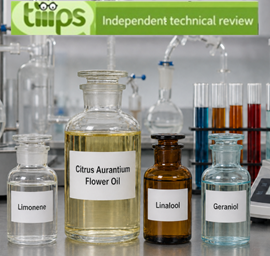
Description
Citrus Aurantium Flower Oil is a complex natural mixture of volatile molecules, not a single substance. It must be distinguished from other derivatives of the same tree: peel oil comes from the fruit epicarp, petitgrain oil comes mainly from leaves and twigs, while Citrus Aurantium Flower Oil comes from the flowers. This distinction is important because composition, odor, phototoxic risk, and regulatory profile are not identical among the different plant parts.
In perfumery it is considered a precious raw material: it gives brightness, freshness, floral roundness, and a softer citrus character than peel oils. In cosmetics, however, its role should not be interpreted as therapeutic or dermatological: the main function is perfuming, meaning to fragrance the product and contribute to its sensory pleasantness.
Composition can vary greatly according to geographical origin, cultivar, harvest, distillation method, storage, and batch authenticity. Recurring components include linalool, limonene, linalyl acetate, geraniol, nerol, nerolidol, α-terpineol, methyl anthranilate, geranyl acetate, neryl acetate, and farnesol, but percentages may change significantly from one oil to another.
Production process
The most typical production method is steam distillation of fresh flowers of Citrus aurantium (Rutaceae). Steam passes through the plant material, carries the volatile fraction, and, after condensation, allows separation of the essential oil from the aromatic aqueous phase. This production method distinguishes it from citrus oils expressed from the peel, where non-volatile fractions may be more relevant.
After distillation, the usual steps include separation, filtration, possible rectification, and analytical controls on color, odor, density, refractive index, optical rotation, GC-MS profile, allergens, peroxides, oxidation, and adulteration. Authenticity control is particularly important because genuine neroli oil is expensive and may be replaced or diluted with less valuable fractions or aromatic reconstructions.
Main compounds present
Citrus Aurantium Flower Oil may contain, in variable proportions:
linalool;
limonene;
linalyl acetate;
geraniol;
nerol;
nerolidol;
α-terpineol;
methyl anthranilate;
neryl acetate;
geranyl acetate;
farnesol;
other minor odorant monoterpenes, sesquiterpenes, and esters.
GC-MS studies on essential oils from Citrus aurantium flowers show profiles that may differ considerably: in one neroli oil sample, limonene, nerolidol, α-terpineol, α-terpinyl acetate, and farnesol were reported among the main components, while other works indicate linalool, limonene, and linalyl acetate as characteristic neroli components. For this reason, in a professional assessment, composition must be verified on the actual batch, not only on the INCI name.
From an allergological standpoint, the most important components to monitor are mainly Linalool, Limonene, Geraniol, Linalyl Acetate, Geranyl Acetate, Farnesol, Citral, and any other fragrance allergens present in the mixture. Regulation (EU) 2023/1545 expanded the fragrance allergen labeling framework, including both individual odorant molecules and certain natural mixtures.
Identification data and specifications
| Characteristic | Value | Note |
|---|---|---|
| INCI name | Citrus Aurantium Flower Oil | cosmetic designation |
| Common names | neroli oil; oil of orange flowers; bitter orange flower essential oil | commercial designations |
| Botanical name | Citrus aurantium | bitter orange / sour orange |
| Botanical family | Rutaceae | citrus family |
| Part used | flowers | not peel, not leaves, not twigs |
| Chemical/material category | essential oil / natural volatile mixture | not a single molecule |
| Molecular formula | not applicable | complex natural mixture |
| Molecular weight | not applicable | complex natural mixture |
| CAS | 8016-38-4 / 72968-50-4 | references reported for the raw material |
| EC | - / 277-143-2 | references reported for the raw material |
| CosIng Ref. | 41390 | reference reported by INCI databases |
| Main cosmetic function | perfuming | fragrance ingredient |
| Characteristic components | limonene, linalool, geraniol, linalyl acetate, methyl anthranilate, nerol | indicative, variable composition |
| EU restriction | Annex III, entry 350 | declaration “Citrus Aurantium Flower Oil” above threshold |
| Leave-on threshold | 0.001% | mandatory label indication above threshold |
| Rinse-off threshold | 0.01% | mandatory label indication above threshold |
| Food use | aroma/flavouring in specific contexts | aromatic use, not nutritional |
Indicative physicochemical properties
| Characteristic | Indicative value | Note |
|---|---|---|
| Appearance | mobile liquid | typical of essential oils |
| Color | pale yellow to light amber | depends on origin, distillation, and storage |
| Odor | floral, citrus, neroli, sweet, green | characteristic profile |
| Water solubility | very low / insoluble | requires solubilization or fragrance phase |
| Alcohol solubility | good | useful in perfumery |
| Oil solubility | good | compatible with lipophilic phases |
| Volatility | high | volatile odorant ingredient |
| Stability | sensitive to oxygen, light, and heat | oxidation risk |
| Key analyses | GC-MS, allergens, peroxides, authenticity | essential for costly natural oils |
| Main technical risk | fragrance allergens, oxidation, adulteration | depends on batch and storage |
Some technical sheets for natural neroli report indicative density values around 0.866-0.888, refractive index around 1.452-1.478, and a characteristic floral/fresh odor; these data are useful as guidance, but they do not replace the specification of the purchased batch.
Food
In the food sector, neroli/bigarade oil may be connected to the world of flavourings, but it has no nutritional value. Its food value is therefore sensory, linked to floral-citrus notes, not health-related. If intended for foods or beverages, food grade, purity, dosage, flavouring compliance, and specific documentation are required. Cosmetic or perfumery grade should not be considered automatically suitable for consumption.
In a cosmetic ingredient report, the food focus remains secondary: the prevailing use is perfuming/sensory, not nutritional.
Cosmetics
In cosmetics, Citrus Aurantium Flower Oil is used mainly as a perfuming ingredient. It may be present in perfumes, eau de toilette, creams, cleansers, soaps, shampoos, conditioners, deodorants, body products, bath products, hair products, and “natural fragrance” formulas where a floral-citrus neroli note is desired.
The central regulatory point is Annex III, entry 350. The presence of the substance or substances must be indicated as “Citrus Aurantium Flower Oil” in the ingredient list when the concentration exceeds:
0.001% in leave-on products;
0.01% in rinse-off products.
In addition, the individual allergens naturally present in the essential oil must be assessed separately. Components such as Linalool, Limonene, Geraniol, Linalyl Acetate, Geranyl Acetate, or Farnesol may require individual declaration if they exceed their respective thresholds.
Pros
It has a precious, floral, citrus, and natural olfactory profile.
It is very useful as a perfuming ingredient in cosmetics, perfumes, cleansers, and hair products.
It can add roundness and brightness to floral, citrus, green, and powdery notes.
It is a natural essential oil obtained from flowers, different from peel oils.
It is a recognizable and valued raw material in quality perfumery.
It may also be used as an aromatic component in specific food contexts, if of suitable grade.
EU regulation provides a clear threshold for mandatory indication as Citrus Aurantium Flower Oil.
Cons
It is not a nutritional food ingredient: in food it has only possible aromatic function.
In cosmetics it is subject to declaration above threshold under Annex III/350.
It naturally contains fragrance allergens, especially Linalool, Limonene, Geraniol, and other odorant components.
It may oxidize when exposed to air, light, and heat, increasing irritant or sensitizing risk.
Composition varies greatly according to origin, harvest, distillation, and storage.
Because it is an expensive raw material, possible adulteration must be carefully checked.
It should not be confused with peel oil, petitgrain oil, or orange flower water, which have different compositional and regulatory profiles.
Safety, regulatory aspects, and environment
From a cosmetic standpoint, Citrus Aurantium Flower Oil must be managed as a natural fragrance ingredient with allergological relevance. European legislation does not prohibit it, but requires label declaration above threshold as “Citrus Aurantium Flower Oil”. The applicable entry is Annex III, No. 350, with thresholds of 0.001% for leave-on products and 0.01% for rinse-off products.
CIR assessed citrus flower- and leaf-derived ingredients. In the report, Citrus Aurantium Amara Flower Oil, described as neroli oil, was not sensitizing in an HRIPT at 4% in petrolatum; Citrus Aurantium Dulcis Flower Oil was not irritating or sensitizing at 0.4% in a face/neck product. These data are useful, but they do not remove the need to assess the finished product.
The most realistic risk concerns irritation, fragrance sensitization, oxidation, and tolerability on sensitive skin. A natural essential oil may become more problematic if oxidized, poorly stored, used at high concentrations, or combined with other essential oils rich in the same allergens.
For correct cosmetic use, it is advisable to request from the supplier:
updated SDS;
certificate of analysis;
batch GC-MS;
allergen declaration;
IFRA certificate;
content of Linalool, Limonene, Geraniol, Linalyl Acetate, Geranyl Acetate, Farnesol, and other allergens;
data on peroxides and oxidation;
botanical and geographical origin;
extraction method;
authenticity/adulteration declaration;
declaration of compliance with the EU Cosmetics Regulation;
verification of the finished-product concentration against Annex III/350.
From an environmental standpoint, neroli oil is a plant raw material, but its yield is low and production requires large quantities of flowers. Real sustainability depends on cultivation, harvesting, distillation yield, energy consumption, water use, transport, storage, and social conditions in the supply chain. Natural origin is a favorable element, but it is not sufficient on its own to demonstrate overall sustainability.
Conclusion
Citrus Aurantium Flower Oil is a precious and highly distinctive essential oil, used mainly as a perfuming ingredient. Its main value is olfactory: it offers a floral-citrus, green, sweet, and luminous neroli note, useful in perfumes, cleansers, skin care, hair care, and body products.
Professional assessment must, however, be rigorous. The central point is compliance with Annex III, entry 350, with mandatory indication as “Citrus Aurantium Flower Oil” above 0.001% in leave-on products and 0.01% in rinse-off products. In addition, the individual allergens naturally present must be assessed and declared when required.
In a well-designed formula, with authentic, fresh, and documented raw material, it can be a favorable ingredient of high sensory value. The points to control are GC-MS, authenticity, oxidation, peroxides, allergens, IFRA certificate, SDS, COA, concentration in the finished product, product category, storage, and compliance with the European Cosmetics Regulation.

