



Sodium methyl lauroyl taurate: properties, uses, pros, cons, safety
Sodium Methyl Lauroyl Taurate is an anionic surfactant belonging to the taurate family, used mainly in cosmetics as a cleansing, foaming, and surfactant-cleansing ingredient, as also indicated in the attached CosIng screenshot. It is mainly found in rinse-off cleansing products, such as facial cleansers, shampoos, shower gels, mild cleansers, and washing formulas where foam, cleansing capacity, and good formulation tolerability are required.
Description
This is a technical-cosmetic raw material, not a food ingredient. From a chemical standpoint, it is the sodium salt of the amide formed between lauric acid and N-methyl taurine. Its structure contains a lipophilic portion derived from the C12 lauroyl chain and an anionic sulfonated head linked to the taurine nucleus. This architecture allows it to reduce surface tension, disperse sebum and dirt, support rinsing, and contribute to foam formation.
Compared with more aggressive anionic surfactants, such as some classic sulfates used at high concentrations, taurates are often appreciated for a more mild profile, good foam, and a less degreasing feel. However, it should not be considered automatically “gentle” in every formula: real tolerability always depends on concentration, pH, co-surfactants, contact time, application area, and the finished product.
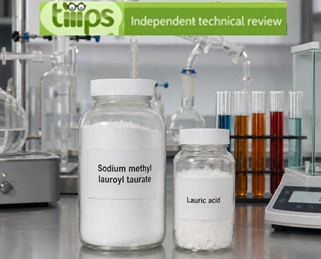
Taurates are surfactants with properties such as good biodegradability, low toxicity, and excellent foaming capacity; for Sodium Methyl Lauroyl Taurate the functions are cleansing, foaming, and surfactant-cleansing.
Production process
Industrially, Sodium Methyl Lauroyl Taurate is produced by reacting a lauroyl source, such as lauric acid, lauroyl chloride, or activated derivatives, with N-methyl taurine or its sodium salt. The result is a taurine amide with a sodium counterion, which is then purified, neutralized, and standardized.
The lauroyl fraction may derive from plant sources such as coconut or palm kernel, or from synthetic or mixed supply chains. For this reason, it is not correct to automatically infer vegetable, palm-free, vegan, or sustainable origin from the INCI name alone: these aspects must be confirmed by the supplier’s technical sheet and declaration.
After synthesis, the usual controls include active matter content, pH, color, odor, moisture, residual salts, free lauric acid, residual N-methyl taurine, heavy metals, microbiological load where relevant, particle size if in powder form, and formulation compatibility. CIR describes Sodium Methyl Lauroyl Taurate as the sodium salt of the amide of lauric acid with N-methyl taurine and links it to the function of surfactant-cleansing agent.
Main compounds present
In the pure grade, the main compound is Sodium Methyl Lauroyl Taurate. Commercial grades may contain small amounts of:
free lauric acid;
residual sodium methyltaurate;
inorganic salts;
residual water;
C12-C14 fatty fractions if the lauroyl raw material derives from natural cuts;
solvents or processing aids;
minor impurities related to synthesis and purification.
It is therefore important to distinguish between the INCI name, the reference chemical substance, and the actual commercial grade. A high-active powder, paste, aqueous solution, or blend with other surfactants may have different formulation behavior and a different practical safety profile.
Identification data and specifications
| Characteristic | Value | Note |
|---|---|---|
| INCI name | Sodium Methyl Lauroyl Taurate | cosmetic designation |
| Alternative name | Sodium Lauroyl Methyl Taurate | frequent synonymic form |
| Descriptive chemical name | sodium 2-[methyl(1-oxododecyl)amino]ethanesulphonate | description reported in CosIng-derived databases |
| Chemical category | anionic surfactant / alkyl taurate amide | lauroyl derivative of N-methyl taurine |
| Molecular formula | C15H30NNaO4S | compound formula |
| Molecular weight | about 343.46 g/mol | theoretical value |
| CAS | 4337-75-1 | reported in the attached screenshot |
| Alternative CAS reported | 115049-64-4 | reported in some CIR sources |
| EC | 224-388-8 | reported in the attached screenshot |
| CosIng functions | cleansing; foaming; surfactant-cleansing | from the attached screenshot |
| Visible specific cosmetic restrictions | not highlighted in the attached screenshot | always verify the updated database and regulation |
| Technical origin | synthetic / vegetable depending on grade | to be verified on supplier SDS/COA |
| Food use | not relevant | not a common food additive |
Indicative physicochemical properties
| Characteristic | Indicative value | Note |
|---|---|---|
| Appearance | powder, crystals, granules, paste, or solution | depends on commercial grade |
| Color | white, off-white, or very pale yellow | according to purity and form |
| Odor | mild, characteristic | typical of surfactants |
| Ionic nature | anionic | sulfonated head |
| Water solubility | good / soluble | according to CIR data for the compound |
| Use pH | compatible with mildly acidic to neutral cleansers | depends on the formula |
| Foam | good | foaming function |
| Cleansing | good but adjustable | depends on concentration and surfactant blend |
| Compatibility | good with amphoteric and non-ionic surfactants; to be checked with cationics | test in the final formula |
| Formulation sensitivity | pH, salts, co-surfactants, water hardness | requires stability testing |
| Main technical risk | skin/eye irritation if concentrated or poorly formulated | typical of cleansing surfactants |
CIR reports for Sodium Methyl Lauroyl Taurate a solid crystalline form, color from white to slightly yellow, faint characteristic odor, and water solubility.
Cosmetics
In cosmetics, Sodium Methyl Lauroyl Taurate is used mainly as an anionic cleansing surfactant. It may appear in facial cleansers, shampoos, shower gels, body cleansers, hand cleansers, formulas for sensitive skin, foaming cleansers, hair products, and cleansing systems where good foam is desired without necessarily relying on traditional sulfates.
The cleansing function indicates the ability to clean skin, hair, or teeth. The foaming function indicates the ability to form foam. The surfactant-cleansing function indicates surfactant activity specifically oriented toward cleansing. COSMILE reports these three functions for the ingredient.
From a formulation standpoint, it can be used alone or in combination with amphoteric, non-ionic, or other anionic surfactants to adjust foam, viscosity, cleansing power, and tolerability. It is particularly interesting in “sulfate-free” systems or formulas where a softer cleansing profile is desired, but it remains a washing surfactant and must be correctly balanced.
Pros
It is an effective anionic surfactant for cleansing.
It offers good foaming capacity.
It can be useful in sulfate-free formulas.
It is generally perceived as milder than some classic sulfates.
It is especially suitable for rinse-off products such as shampoos and facial/body cleansers.
It can be combined with amphoteric and non-ionic surfactants to improve tolerability and sensory profile.
It is water-soluble and fairly versatile in cleansing systems.
The taurate family is described as having good biodegradability, low toxicity, and excellent foaming properties.
Cons
As an anionic surfactant, it may contribute to irritation or dryness if used at high concentrations or in poorly balanced formulas.
It may irritate the eyes, especially as a concentrated raw material or in products that have not been properly tested.
Formulation performance depends on pH, salts, co-surfactants, water hardness, and preservative system.
Not all grades are equivalent: powders, pastes, solutions, and blends may have very different active matter levels.
Vegetable, palm-free, vegan, or biodegradable origin must be documented by the supplier, not inferred from the INCI name.
It is generally less relevant in leave-on products than in rinse-off products.
Safety, regulatory aspects, and environment
From a cosmetic standpoint, Sodium Methyl Lauroyl Taurate is generally a manageable and favorable ingredient in well-designed cleansing formulas. However, safety must be assessed on the finished product, because concentration, pH, presence of other surfactants, area of use, application frequency, and contact time significantly affect tolerability.
CIR assessed alkyl taurate amides and taurate salts, including Sodium Methyl Lauroyl Taurate among the ingredients considered. The CIR document indicates that these ingredients are structurally related by the taurate nucleus and function mainly as surfactant-cleansing agents. PubChem also links to the final CIR assessment, with a safety conclusion under the considered practices of use and concentration when formulated to be non-irritating.
The most realistic cosmetic risk is irritation, especially for eyes, mucous membranes, or compromised skin. In the CIR material, some data on related ingredients show ocular irritation under concentrated test conditions, while Sodium Methyl Cocoyl Taurate was not sensitizing in the cited test; these data should not be automatically transferred to every formula, but they confirm that surfactants must be formulated to be non-irritating.
No specific provisions appear in the “Cosmetics Regulation provisions” line of the attached CosIng screenshot. CosIng Checker also does not link the entry to direct annex restriction records, but the absence of a direct link does not replace verification on the updated official source before formulation and labeling.
From an environmental standpoint, the profile depends on the origin of the lauroyl fraction, production process, actual biodegradability of the commercial grade, impurities, use concentration, and product destination. Since it is mainly used in rinse-off products, wastewater fate and the aquatic profile of the finished product should also be assessed.
For correct cosmetic use, it is advisable to request from the supplier:
updated SDS;
certificate of analysis;
active matter content;
pH;
moisture;
residual salts;
free lauric acid;
residual N-methyltaurine;
heavy metals and impurities;
origin of the fatty fraction;
vegan, palm-free, or bio-based declarations if claimed;
biodegradability data, if claimed;
EU cosmetic compliance declaration;
skin/eye tolerability testing on the finished product.
Conclusion
Sodium Methyl Lauroyl Taurate is a very useful technical cosmetic ingredient as an anionic cleansing surfactant, with cleansing, foaming, and surfactant-cleansing functions. Its main value emerges in rinse-off products, where it can provide good foam, effective cleansing, and a softer sensory profile than some more aggressive anionic systems.
Professional assessment must be precise. It is not a food ingredient, not a dermatological active, and not automatically gentle under all conditions. The decisive point is the finished formula: pH, concentration, surfactant combination, presence of emollients, tolerability testing, and quality of the commercial grade determine real safety.
In a well-designed formula, with documented raw material and mainly rinse-off use, Sodium Methyl Lauroyl Taurate is generally a favorable and functional ingredient. The points to control are SDS, COA, active matter content, purity, pH, residual salts, origin of the lauroyl fraction, formulation compatibility, skin/eye tolerability, and behavior of the finished product.

