



Ultra-processed foods: what they are and what the science says
The term “ultra-processed” is increasingly used to describe certain industrial food products. The definition has a scientific basis, but it must be interpreted correctly: describing a food as ultra-processed does not automatically mean that it is harmful or nutritionally poor.
What does “ultra-processed” mean?
The concept mainly derives from the NOVA classification, developed in the academic field to classify foods according to the nature, extent and purpose of the processing they undergo.
The classification distinguishes four groups:
unprocessed or minimally processed foods;
processed culinary ingredients;
processed foods;
ultra-processed foods.
Ultra-processed foods therefore belong to the fourth group and are generally industrial formulations obtained by combining various ingredients, food-derived substances and other substances used to modify characteristics such as flavour, texture, colour, shelf life or convenience of consumption.
Depending on their formulation, this category may include soft drinks, snacks, confectionery products, some breakfast cereals, industrial baked goods, ready meals, desserts, flavoured beverages and many other packaged foods.
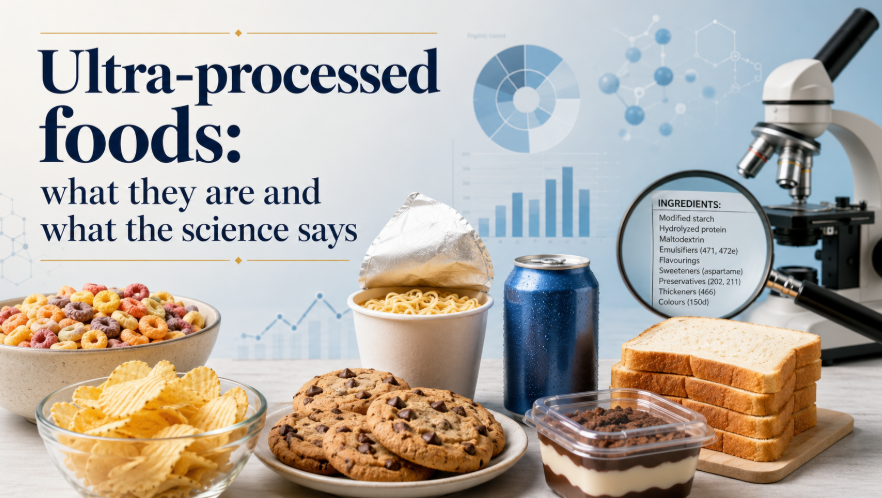
What scientific studies show
Numerous observational studies have found that a high consumption of ultra-processed foods is associated with a higher incidence of several health problems, including obesity, type 2 diabetes and cardiovascular disease.
These associations are sufficiently consistent to make the habitual consumption of large amounts of ultra-processed foods an important topic in nutritional research.
Some controlled experimental studies have also shown that a diet consisting mainly of ultra-processed foods may encourage a higher spontaneous calorie intake compared with a diet based on less processed foods.
Possible explanations include greater energy density, the speed at which some products can be eaten, their texture, high palatability and combinations of fats, carbohydrates and other components that may encourage greater energy intake.
Ultra-processed does not automatically mean harmful
One of the main limitations of the classification is that the ultra-processed category includes products that can be very different from one another.
A sugar-sweetened soft drink, a snack high in fat and salt and an industrial wholegrain bread may, under certain circumstances, belong to the same NOVA category despite having very different nutritional characteristics.
The same applies to some yogurts, fortified cereals, industrially formulated plant-based foods or products intended for specific nutritional needs.
For this reason, the simple fact that a food is ultra-processed is not sufficient, by itself, to establish whether it has a favourable or unfavourable nutritional profile.
Processing and nutritional quality are different concepts
To assess a food correctly, it is useful to consider at least two aspects separately:
Degree of processing: indicates how far the product has been transformed from the original food and the types of industrial processes used.
Nutritional quality: concerns the content of energy, saturated fat, sugars, salt, fibre, protein and other nutrients.
A food may therefore be highly processed while still having a relatively balanced nutritional composition. Conversely, a minimally processed food may nevertheless contain high amounts of sugars, fats, salt or calories.
The degree of processing is therefore useful information, but it should not replace an assessment of the food’s nutritional composition.
The role of additives
The presence of additives is often associated with the concept of ultra-processed food, but generalisations should also be avoided in this area.
Preservatives, emulsifiers, stabilisers, colourings, flavourings, sweeteners and other additives may be used for different technological purposes.
Their mere presence does not make it possible to conclude that a food is harmful. The safety of authorised additives is assessed separately and depends on the substance used, the quantities involved and the consumer’s overall exposure.
From this perspective as well, it is more appropriate to assess individual ingredients and the formulation of the product rather than automatically assigning a negative judgement to the entire category of ultra-processed foods.
How the term should be interpreted
The indication “ultra-processed food” can be useful to consumers because it provides information about the extent and characteristics of industrial processing.
However, it should not be interpreted as an absolute health judgement.
A more scientifically accurate wording is:
“Product classifiable as ultra-processed according to the NOVA system.”
Automatic conclusions such as the following should instead be avoided:
“It is ultra-processed, therefore it is harmful.”
The quality of a food should be assessed by considering its formulation, nutritional profile, ingredients, the quantities normally consumed and the role of the product within the overall diet.
The weak point of the term “ultra-processed”
The problem is that NOVA places very different products within the same broad category.
For example, it may include:
a sugar-sweetened soft drink;
potato chips;
biscuits;
industrial wholegrain bread;
some fortified cereals;
a yogurt containing certain flavourings/additives;
some plant-based meat substitutes.
And there is no convincing evidence that all these foods carry the same level of risk. SACN has found that sugar-sweetened beverages and some categories of ultra-processed meat products show fairly consistent adverse associations, whereas for bread and cereals, dairy products, plant-based substitutes and several other categories, the results are mixed or sometimes show no negative associations.
A 2025 critical review likewise concluded that the heterogeneity within the UPF category is one of the main limitations of using the NOVA classification in a binary way.
Conclusions
The concept of ultra-processed food has a genuine scientific basis and is widely used in epidemiological and nutritional research.
Available evidence indicates that diets characterised by a very high consumption of ultra-processed products are generally associated with less favourable health outcomes.
However, it is not scientifically correct to consider all ultra-processed foods equivalent or to automatically assign a negative judgement to every product in this category.
The degree of processing should therefore be considered one of the useful elements in assessing a food, alongside analysis of its nutritional composition and ingredients.
In other words, “ultra-processed” primarily describes how a food has been formulated and produced; by itself, it does not determine how healthy or unhealthy that food is.

