



Acer rubrum bark extract: properties, uses, pros, cons, safety
Acer Rubrum Bark Extract is a plant extract obtained from the bark of Acer rubrum, commonly known as red maple or American red maple. In cosmetics it is used mainly as a skin conditioning ingredient, meaning a component intended to help maintain the skin in good condition. The COSMILE database reports ACER RUBRUM BARK EXTRACT with the cosmetic function skin conditioning.
Description
Acer rubrum is a deciduous tree native to North America, belonging to the botanical family Sapindaceae. It is known as red maple because of the red color of its leaves, buds, or other plant parts at different times of the year. The bark can be used to obtain botanical extracts rich in phenolic compounds, particularly tannins and galloylated derivatives. Botanical sources such as NC State Extension describe Acer rubrum as red maple, belonging to the family Sapindaceae.
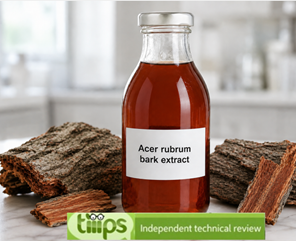
From a cosmetic standpoint, red maple bark extract is a botanical raw material, not a single molecule. Its formulation interest is mainly linked to the presence of polyphenols, tannins, gallotannins, and other plant compounds that may contribute to the extract’s antioxidant profile. However, it should not automatically be presented as an anti-aging, brightening, anti-inflammatory, or curative active: any claims must be demonstrated on the finished product.
It is important to distinguish Acer Rubrum Bark Extract from other similar ingredients, such as Acer Rubrum Leaf Extract, Acer Saccharum Extract, Acer Saccharum Sap Extract, or generic maple extracts. Bark, leaves, sap, and buds have different compositions and formulation meanings.
Production process
The production process starts from the bark of Acer rubrum, which is collected, cleaned, dried, and reduced into fragments or powder. Extraction may be carried out with water, glycerin, glycols, ethanol, hydroalcoholic mixtures, or other solvents allowed in cosmetics, depending on the type of extract desired.
After extraction, the usual steps include filtration, concentration, possible decolorization or stabilization, microbiological control, standardization of dry matter or polyphenol content, and addition of preservatives or vehicles if necessary. In a glycerin or glycol extract, for example, the commercial material may be a mixture of cosmetic solvent, water, and active botanical fraction.
The most important technical point is standardization: a simple INCI name does not say how much real extract is present, which solvent was used, what the drug/extract ratio is, or what the polyphenol content is. For correct assessment, the technical data sheet, SDS, COA, solvent, preservatives, pH, microbiology, and, when available, analytical profile of phenolic compounds are therefore necessary.
Main compounds present
Extracts of Acer rubrum bark may contain several classes of plant compounds, particularly:
gallotannins;
maplexins;
rubrumosides;
gallic acid and galloylated derivatives;
other phenolic compounds;
hydrolyzable tannins;
flavonoids or minor phenolic fractions;
sugars, salts, and water-soluble compounds, depending on the solvent used.
A study on red maple bark isolated new gallotannins called maplexins F-I, two new phenolic glycosides, rubrumosides A-B, and other known compounds. Other studies on extracts from different parts of Acer rubrum, including branch bark and stem bark, evaluated phenolic content and radical-scavenging capacity, confirming the interest of the species as a source of polyphenols.
Identification data and specifications
| Characteristic | Value | Note |
|---|---|---|
| INCI name | Acer Rubrum Bark Extract | cosmetic designation |
| Common name | red maple bark extract | practical designation |
| Botanical name | Acer rubrum | red maple |
| Botanical family | Sapindaceae | red maple family |
| Part used | bark | bark |
| Chemical/material category | botanical extract | complex natural mixture |
| Molecular formula | not applicable | not a single molecule |
| Molecular weight | not applicable | complex plant extract |
| CAS | not clearly unique in the public sources consulted | verify on supplier SDS/COA |
| EC | not clearly unique in the public sources consulted | verify on supplier SDS/COA |
| Cosmetic function | skin conditioning | according to COSMILE |
| Characteristic components | polyphenols, tannins, gallotannins | depends on extraction and standardization |
| Food use | not relevant as a common ingredient | should not be confused with maple sap or maple syrup |
| Visible specific cosmetic restrictions | not highlighted in the sources consulted | finished product assessment remains mandatory |
Indicative physicochemical properties
| Characteristic | Indicative value | Note |
|---|---|---|
| Appearance | liquid, solution, dry extract, or powder | depends on commercial grade |
| Color | yellow-brown to reddish-brown | typical of polyphenol-rich extracts |
| Odor | mild, vegetal, woody, or almost absent | depends on solvent and concentration |
| Water solubility | variable, often good if aqueous/glycolic extract | depends on solvent |
| Oil solubility | generally low | requires emulsion or indirect solubilization |
| pH | variable, often weakly acidic | to be verified in technical sheet |
| Dry matter | variable | key parameter of the commercial grade |
| Total polyphenols | variable | possible supplier standardization |
| Stability | sensitive to oxidation, light, heat, and microbiology | depends on solvent/preservatives |
| Main technical risk | botanical variability, microbiology, impurities, unsupported claims | complete documentation is needed |
Cosmetics
In cosmetics, Acer Rubrum Bark Extract is used as a skin conditioning agent. It may be included in creams, lotions, serums, masks, face products, botanical formulas, anti-pollution products, or formulations where a polyphenol-rich plant extract is to be highlighted. COSMILE clearly reports the skin conditioning function for this ingredient.
Its practical interest may be linked to the presence of polyphenols and tannins, but the real concentration in formula is often low. Consequently, it is more prudent to describe it as a botanical ingredient supporting the formula, not as the main active ingredient. Studies on polyphenolic extracts from the bark of Canadian forest species, including Acer rubrum, evaluated potential activities related to lipid peroxidation, radical species, and cosmeceutical applications, but these data are experimental and do not automatically translate into cosmetic claims for the finished product.
In an aqueous or hydro-glycolic cosmetic formulation, the extract may influence color, odor, pH, microbiological stability, and interactions with other actives. The presence of tannins may also affect sensory profile, astringency, and compatibility with proteins, polymers, or metal salts.
Pros
It is an interesting and recognizable botanical ingredient.
It derives from the bark of Acer rubrum, a species rich in phenolic compounds.
COSMILE reports the cosmetic function skin conditioning.
It can enhance botanical, natural, or forest-extract-inspired formulas.
Red maple bark has been studied as a source of gallotannins and phenolic glycosides.
It may contribute to the antioxidant profile of the raw material, if the extract is properly standardized.
It is not an essential oil and is not automatically subject to the same issues as fragrance allergens.
Cons
It is not a common food ingredient and has no direct nutritional value.
It is not a strong dermatological active: the documented function is mainly skin conditioning.
Composition can vary greatly according to origin, bark used, solvent, extraction ratio, and batch.
Anti-aging, antioxidant, soothing, or anti-pollution claims must be demonstrated on the finished product.
Aqueous/glycolic botanical extracts may present microbiological preservation issues.
The presence of tannins may influence color, odor, astringency, and formulation compatibility.
Bark extraction requires attention to sustainability, because bark removal can damage the tree if not properly managed.
Safety, regulatory aspects, and environment
From a cosmetic standpoint, Acer Rubrum Bark Extract may be considered an ingredient with expected low concern when used in suitable cosmetic grades, properly preserved, and at low concentrations. However, safety must be assessed on the finished product, because the INCI name alone does not define solvent, concentration, preservatives, pH, microbiology, impurities, and polyphenol content.
From the sources consulted, no specific cosmetic restrictions emerge that are comparable to those for fragrance allergens, preservatives, or UV filters. The function documented by COSMILE is skin conditioning. This does not remove the obligation to perform a safety assessment under the European Cosmetics Regulation: the assessor must consider concentration, product category, exposure, purity, contaminants, and interactions with other ingredients.
From a practical toxicological standpoint, the main risks are those typical of botanical extracts:
microbiological contamination;
residual solvent;
pesticides or environmental contaminants;
heavy metals;
compositional variability;
plant impurities;
formulation incompatibilities;
unsupported claims.
Studies on isolated compounds or polyphenol-rich extracts should not be automatically transferred to the finished cosmetic product. For example, the literature reports the presence of gallotannins and phenolic glycosides in the bark of Acer rubrum, but the commercial grade used in a cream may have a very different concentration, solvent, and profile.
From an environmental standpoint, bark can be an interesting resource if it derives from forest by-products or controlled supply chains. However, bark removal from living trees can be harmful if not professionally managed. For this reason, origin, traceability, forest certifications, use of by-products, harvesting method, and impact on the plant population should be verified.
For correct cosmetic use, it is advisable to request from the supplier:
updated SDS;
certificate of analysis;
extraction solvent;
drug/extract ratio;
dry matter;
pH;
preservatives present;
microbiological load;
pesticides and heavy metals;
possible polyphenol standardization;
botanical and geographical origin;
bark harvesting method;
cosmetic compliance declaration;
stability testing and challenge testing of the finished product.
Conclusion
Acer Rubrum Bark Extract is a botanical cosmetic extract of interest mainly as a skin conditioning agent. Its main value derives from its plant origin and from the possible content of polyphenols and tannins from American red maple bark. It is suitable for botanical formulas, skin care, masks, and products where a forest or North American extract is to be highlighted.
Professional assessment must be cautious: it is not a food ingredient, not a drug, not a strong dermatological active, and should not automatically be turned into anti-aging or antioxidant claims. Scientific data on Acer rubrum bark support the phytochemical interest of the raw material, but the finished cosmetic product must be assessed with its own data.
In a well-designed formula and with complete supplier documentation, it can be a favorable ingredient. The points to control are botanical identity, Sapindaceae family, part used, solvent, dry matter, polyphenols, microbiology, pesticides, heavy metals, SDS, COA, harvesting sustainability, and compatibility with the finished product.

