



Citrus aurantium dulcis fruit juice: properties, uses, pros, cons, safety
Citrus Aurantium Dulcis Fruit Juice, also indicated as Citrus Aurantium Dulcis Juice, is the juice obtained from the fruit of sweet orange. In INCI/CosIng terminology, the entry is connected to ingredients derived from sweet orange, while COSMILE reports CITRUS AURANTIUM DULCIS JUICE as a plant preparation with the cosmetic function skin conditioning.
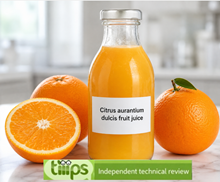
Description
This is a plant-derived ingredient obtained from the fruit of sweet orange, belonging to the botanical family Rutaceae. In cosmetics it must be distinguished from other apparently similar citrus ingredients: Citrus Aurantium Dulcis Peel Oil is the essential oil from the peel, Citrus Aurantium Dulcis Fruit Extract is an extract of the fruit, Citrus Aurantium Dulcis Fruit Water is a fruit-derived aqueous ingredient, while Citrus Aurantium Dulcis Juice is the juice expressed from the fruit pulp. CIR describes Citrus Aurantium Dulcis (Orange) Juice as the liquid expressed from orange pulp.
From a cosmetic standpoint, it is mainly a skin conditioning ingredient, meaning a component that can help maintain the skin in good condition, but it should not be interpreted as a strong dermatological active. Its usefulness is more botanical, sensory, and formulation-related than therapeutic..
Production process
The production process starts from ripe sweet orange fruits. The fruit is selected, washed, squeezed or pressed, and the juice is then separated from seeds, coarse fibers, and solid parts. In cosmetic use, the juice may be filtered, clarified, stabilized, possibly concentrated, or incorporated into aqueous blends with preservatives, cosmetic solvents, or other supporting ingredients.
When intended for cosmetics, the juice must be handled as an aqueous and biologically sensitive raw material: microbiological control, pH, preservation, possible pasteurization or stabilizing treatment, and control of sugars, organic acids, pesticide residues, and contaminants are required. CIR emphasizes that citrus fruit-derived ingredients are complex botanicals and that the industry should use good manufacturing practices to limit impurities present in botanical ingredients.
Compared with an essential oil, the juice has a lower concentration of lipophilic odorant fractions, but greater relevance for microbiology, aqueous stability, fermentation, oxidation of water-soluble compounds, and compatibility with the preservative system of the formula.
Main compounds present
Citrus Aurantium Dulcis Fruit Juice is a complex aqueous matrix. The main components may include:
water, as the predominant fraction;
natural sugars, mainly sucrose, glucose, and fructose;
citric acid and other organic acids;
vitamin C / ascorbic acid, in variable amounts;
mineral salts, especially potassium;
flavonoids and phenolic compounds in variable amounts;
traces of natural aromatic compounds;
soluble fibers or residual pectins, if the juice is not fully clarified.
From a cosmetic standpoint, the most important data are not so much the individual compound, but the quality of the raw material: pH, microbiological load, any added preservatives, sugars, agricultural residues, color, odor, and stability. In aqueous cosmetic products, a poorly stabilized plant juice may become a critical point for preservation.
Identification data and specifications
| Characteristic | Value | Note |
|---|---|---|
| Practical INCI name | Citrus Aurantium Dulcis Fruit Juice | designation used in many ingredient lists |
| COSMILE name | Citrus Aurantium Dulcis Juice | COSMILE entry consulted |
| Common name | sweet orange juice | practical designation |
| INCI botanical name | Citrus aurantium dulcis | sweet orange according to cosmetic nomenclature |
| Botanical family | Rutaceae | citrus family |
| Part used | fruit / pulp | not peel, not flower, not leaves |
| Type of preparation | fruit juice / vegetable sap | according to COSMILE |
| Chemical/material category | aqueous plant matrix | not a single molecule |
| Molecular formula | not applicable | complex natural mixture |
| Molecular weight | not applicable | complex natural mixture |
| CAS | not clearly unique in the public sources consulted for the “juice” entry | verify on supplier SDS |
| EC | not clearly unique in the public sources consulted for the “juice” entry | verify on supplier SDS |
| Cosmetic function | skin conditioning | according to COSMILE |
| Food use | food juice, if food grade | distinct from cosmetic grade |
| Visible specific cosmetic restrictions | not reported in the COSMILE sheet consulted | finished product assessment remains necessary |
Indicative physicochemical properties
| Characteristic | Indicative value | Note |
|---|---|---|
| Appearance | aqueous liquid, clear or cloudy | depends on filtration and residual pulp |
| Color | yellow-orange | variable according to fruit and process |
| Odor | citrus, sweet, fresh | weaker than essential oil |
| Water solubility | miscible | aqueous matrix |
| Oil solubility | not miscible | requires emulsion or indirect solubilization |
| pH | acidic | mainly due to citric acid |
| Sugars | naturally present | may influence microbiological stability |
| Vitamin C | variable | sensitive to oxygen, light, and heat |
| Microbiological stability | critical | requires adequate preservation |
| Main technical risk | fermentation, contamination, instability, and oxidation | depends on commercial grade |
Food
In the food sector, orange juice is a common food and may provide water, natural sugars, potassium, folates, and vitamin C. Values vary greatly according to variety, ripening, squeezing, pasteurization, concentration, dilution, and storage. Nutritional databases based on USDA FoodData Central indicate for raw orange juice approximately 45 kcal per 100 g and about 50 mg of vitamin C per 100 g, but these values must be considered indicative and do not replace the nutritional label of the commercial product.
From a nutritional standpoint, the main advantage is its vitamin C contribution. In the EU, there is an authorized claim stating that vitamin C contributes to normal collagen formation for the normal function of skin, but the claim may be used only for foods that are at least a source of vitamin C according to the conditions of Regulation (EC) No 1924/2006.
However, juice is not equivalent to the whole fruit: it contains less fiber, is easier to consume in large amounts, and provides natural sugars in liquid form. For a food assessment, therefore, the judgment is favorable as a source of vitamin C if the product is 100% juice and unsweetened, but with attention to portion size, sugars, and frequency of consumption.
Cosmetics
In cosmetics, Citrus Aurantium Dulcis Fruit Juice / Citrus Aurantium Dulcis Juice is used mainly as skin conditioning. It may be included in cleansers, creams, lotions, masks, body products, facial products, “fruit-based” formulas, mild exfoliating products, and cosmetics that highlight citrus plant ingredients. COSMILE describes it as a plant-derived preparation with skin conditioning function.
Its contribution may be linked to the natural presence of organic acids, sugars, water-soluble compounds, and botanical fruit fractions. However, it should not automatically be presented as an exfoliating, brightening, antioxidant, or anti-aging ingredient unless these functions are demonstrated in the finished product.
From a formulation standpoint, orange juice may influence pH, odor, color, microbiological stability, and compatibility with preservatives. In aqueous products, an adequate preservative system is essential and, when necessary, a challenge test on the finished product is required.
Pros
It is a recognizable plant ingredient appreciated by consumers.
It can contribute to the skin conditioning function.
It has a citrus, fresh, and natural sensory profile.
It is an aqueous matrix and therefore can be easily incorporated into many water-based formulas.
It can enhance botanical, fruit-based, or naturally inspired cosmetic formulas.
It is different from peel essential oil and is generally less problematic in terms of phototoxicity.
In the food sector, if food grade, orange juice can be an interesting source of vitamin C.
Cons
It is not a strong dermatological active: its cosmetic function is mainly botanical, sensory, and skin conditioning.
Since it is an aqueous matrix rich in sugars, it can create microbiological stability problems if not properly preserved.
It can modify the pH of the formula and may require correction or buffering.
The natural vitamin C in the juice is sensitive to oxygen, light, heat, and time.
Composition varies greatly according to variety, ripening, origin, process, and storage.
Antioxidant, exfoliating, or brightening claims must be demonstrated in the finished product.
If used as food, the juice contains natural sugars and should not be considered equivalent to the whole fruit.
It may contain agricultural residues or contaminants if the supply chain is not controlled.
Safety, regulatory aspects, and environment
From a cosmetic standpoint, Citrus Aurantium Dulcis Fruit Juice is generally to be considered a low-concern ingredient when the commercial grade is suitable, microbiologically controlled, and used in properly preserved formulas. The main risk is not systemic, but formulation-related: microbiological contamination, fermentation, instability, alteration of pH, odor, or color.
CIR assessed citrus fruit-derived ingredients as a group and indicated that they frequently function as fragrances and/or skin-conditioning agents; it also emphasized that citrus botanicals may contain many constituents and that formulators should avoid potentially problematic levels of constituents shared among multiple botanicals in the same formula.
For juice specifically, the issue related to furocoumarins is normally less central than for expressed peel essential oils, but safety should not be inferred automatically from this difference. For a real formula, supplier data are needed, including any documentation on agricultural residues, contaminants, added preservatives, and purity profile.
For allergen labeling, fruit juice should not automatically be treated as a perfuming essential oil; however, if the formula contains fragrances, essential oils, or regulated odorant components, individual allergens must be assessed according to the thresholds established by Regulation (EU) 2023/1545. That regulation confirms the obligation to indicate fragrance allergens above 0.001% in leave-on products and 0.01% in rinse-off products.
For correct cosmetic use, it is advisable to request from the supplier:
updated SDS;
certificate of analysis;
pH;
microbiological load;
any preservatives present;
dry matter / Brix, if relevant;
color and odor;
pesticide residues;
heavy metals, if relevant;
botanical and geographical origin;
production and stabilization method;
cosmetic compliance declaration;
stability testing and challenge testing of the finished product.
From an environmental standpoint, orange juice may derive from a broad agricultural supply chain and, in some cases, from by-products or fractions of citrus processing. Its real profile depends on cultivation, irrigation, pesticides, transport, processing energy, refrigerated storage/pasteurization, packaging, and waste management. Plant origin is a favorable element, but it is not enough on its own to demonstrate overall sustainability.
Conclusion
Citrus Aurantium Dulcis Fruit Juice is an aqueous plant ingredient derived from sweet orange, useful mainly as a skin conditioning component and as a botanical/sensory element in cosmetics. It is very different from peel essential oil: juice is an aqueous matrix from the fruit, while peel oil is a volatile lipophilic fraction much richer in terpenes.
Professional assessment must focus on correct INCI identification, microbiological quality, pH, preservation, stability, agricultural residues, and compatibility with the formula. It should not automatically be presented as antioxidant, exfoliating, or anti-aging simply because it derives from orange; any claims must be supported by data on the finished product.
In a well-designed formula, with controlled raw material and an adequate preservative system, Citrus Aurantium Dulcis Fruit Juice can be a favorable ingredient. The points to control are SDS, COA, pH, microbiology, preservatives, stability, botanical origin, residues, concentration in the finished product, and distinction from essential oil, extract, and fruit water.

