



Sodium stearate: properties, uses, pros, cons, safety
Sodium Stearate is the sodium salt of stearic acid, belonging to the family of fatty acid soaps. In cosmetics it is used mainly as a cleansing agent, cleansing surfactant, emulsifying surfactant, and viscosity controlling agent, as also indicated in the attached CosIng screenshot. It is a very common ingredient in solid soaps, sticks, deodorants, make-up products, cleansers, creams, and formulations where structure, spreadability, emulsification, or cleansing capacity are required.
Description
Sodium Stearate is a technical-cosmetic raw material and, in a broader food context, may fall within the family of sodium, potassium, and calcium salts of fatty acids, identified as E470a. From a cosmetic standpoint, however, it is more accurately considered an anionic soap: a molecule with a long lipophilic fatty chain and a hydrophilic sodium carboxylate head.
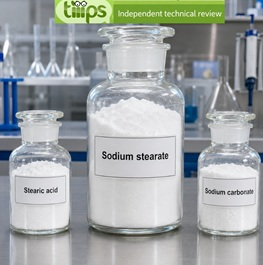
This structure explains its main functions. The fatty portion interacts with oils, sebum, and lipophilic dirt; the ionic portion allows dispersion in water and supports removal during rinsing. In aqueous environments it can therefore behave as a cleansing surfactant, while in solid or semi-solid systems it can also act as a structuring agent and viscosity modifier.
However, it should not be confused with an inherently mild surfactant. Like many alkaline soaps, it can be more degreasing or drying than modern surfactants formulated at physiological pH. Tolerability depends greatly on pH, concentration, presence of emollients, product type, and frequency of use.
Production process
Sodium Stearate is produced mainly by neutralizing stearic acid with a sodium base, such as sodium hydroxide or sodium carbonate. It can also be obtained indirectly by saponification of fats and oils containing stearic fractions, followed by purification and standardization.
The starting stearic acid may derive from vegetable, animal, or mixed sources. For this reason, in cosmetics, vegetable, vegan, or sustainable origin should not be automatically inferred from the INCI name alone: these aspects must be confirmed by the technical sheet and supplier declaration.
After the reaction, the usual steps include drying, milling or granulation, assay control, free alkalinity, moisture, color, odor, fatty acid composition, heavy metals, impurities, and rheological characteristics. In grades intended for soaps, sticks, or solid deodorants, the ability to form structure and gels is particularly important.
Main compounds present
In the pure grade, the main compound is Sodium Stearate. Commercial grades may also contain small amounts of:
free stearic acid;
sodium palmitate or other C16-C18 fatty acid salts;
residual water;
inorganic salts;
traces of free base;
glycerin, if the material derives from saponification and is not fully separated;
impurities related to the fatty source and production process.
This variability is normal because commercial stearic acid is often a technical fatty fraction and may contain proportions of palmitic acid or other saturated fatty acids. For correct formulation assessment, assay, fatty acid profile, free alkalinity, moisture, and supplier specification are therefore necessary.
Identification data and specifications
| Characteristic | Value | Note |
|---|---|---|
| INCI name | Sodium Stearate | cosmetic designation |
| Common name | sodium stearate | common designation |
| Chemical name | sodium octadecanoate | sodium salt of octadecanoic acid |
| Chemical category | fatty acid salt / anionic soap | surfactant and structuring agent |
| Molecular formula | C18H35NaO2 | compound formula |
| Molecular weight | about 306.5 g/mol | theoretical value |
| CAS | 822-16-2 | reported in the attached CosIng screenshot |
| EC | 212-490-5 | reported in the attached CosIng screenshot |
| CosIng functions | cleansing; surfactant-emulsifying; surfactant-cleansing; viscosity controlling | from the attached screenshot |
| Related food additive | E470a | sodium, potassium, and calcium salts of fatty acids |
| Technical origin | vegetable, animal, synthetic, or mixed | depends on starting stearic acid |
| Main use | cosmetics, soaps, sticks, cleansers, technical formulations | cleansing/structuring function |
Indicative physicochemical properties
| Characteristic | Indicative value | Note |
|---|---|---|
| Appearance | powder, granules, flakes, or waxy mass | depends on commercial grade |
| Color | white or off-white | typical of purified grades |
| Odor | mild, fatty, or almost absent | depends on purity and fatty source |
| Water solubility | limited in cold water, better in hot water | typical behavior of C18 soaps |
| Ionic nature | anionic | sodium carboxylate salt |
| pH in solution/dispersion | alkaline | depends on concentration and grade |
| Compatibility with oils | good as structuring/emulsifying agent | useful in sticks and semi-solid systems |
| Behavior in hard water | may form insoluble salts with calcium/magnesium | risk of residue or “soap scum” |
| Cleansing function | good, but potentially degreasing | depends on formula |
| Rheological function | viscosity increase, gelation, structure | useful in deodorants, soaps, and sticks |
Food
In the food sector, the reference is not always the single cosmetic Sodium Stearate, but the family E470a, namely sodium, potassium, and calcium salts of fatty acids. The European Commission Food and Feed portal identifies this family as E470a, authorized as a food additive in specific categories.
The food function is technological, not nutritional. Fatty acid salts may be used as emulsifiers, stabilizers, anti-caking agents, or release agents, depending on the food category and applicable regulation. EFSA reassessed E470a and E470b and concluded that, at the reported uses and levels, no safety concerns emerged; however, this assessment does not turn these salts into “health-promoting” ingredients.
For a food report, therefore, the assessment is: technological use, not nutritional use. If it appears in a food product, it should be evaluated as an additive of the E470a family and not as a useful source of stearic acid or sodium.
Cosmetics
In cosmetics, Sodium Stearate is used mainly in solid soaps, cleansers, deodorant sticks, make-up products, creams, lotions, shaving products, depilatory products, sunscreen sticks, lip balms, and systems where structure, cleansing, emulsification, or viscosity control is needed.
The cleansing function derives from its anionic soap nature: it helps remove sebum and dirt. The surfactant-cleansing function indicates its surfactant cleansing activity; the surfactant-emulsifying function indicates its ability to support dispersion of fatty and aqueous phases; the viscosity controlling function is linked to its ability to modify consistency, structure, and rheology of the formula.
In sticks and solid deodorants, Sodium Stearate can form a structuring network, often in hydroalcoholic or glycolic systems. In solid soaps it contributes to hardness, foam, and cleansing power. In emulsions it can help stabilization, but it must be managed carefully because its alkaline and anionic character can influence pH, compatibility, and sensory profile.
Pros
It is a very functional ingredient as a cleanser and anionic surfactant.
It contributes to emulsification, structure, and viscosity control.
It is useful in solid soaps, deodorant sticks, shaving products, make-up, and semi-solid formulations.
It is relatively simple, inexpensive, and well known industrially.
It may derive from fatty acids of vegetable origin, if certified by the supplier.
In solid formulas it can improve hardness, stability, and product hold.
The related food family E470a is regulated as a technological additive.
Cons
It is not a nutritional food ingredient.
In cleansers it may be degreasing and potentially drying if the formula is not balanced.
The pH of stearate-based soaps may be alkaline and not ideal for very sensitive skin.
In hard water it can form insoluble salts with calcium and magnesium, leaving residues.
It is not automatically vegetable or vegan: the origin of the stearic fraction must be documented.
It may be incompatible with some cationic systems or with formulas requiring acidic pH.
As a powdered raw material, it may require attention due to dustiness and mechanical irritation of eyes and respiratory tract.
Safety, regulatory aspects, and environment
From a cosmetic standpoint, Sodium Stearate is generally considered a low-concern ingredient when used in correctly designed formulas. Its safety must nevertheless be assessed in the finished product, because pH, concentration, product type, frequency of use, and the presence of other surfactants can greatly change tolerability.
The main risk is irritation, especially in alkaline cleansers, strongly degreasing soaps, or products used frequently. It is not a fragrance allergen and has no perfuming function. The most common practical issue is skin dryness or a “tight” skin feeling, more likely in formulas low in emollients or on already compromised skin.
The CIR review on fatty acids and soaps considers fatty acid salts as substances that may dissociate in the formula; this approach is useful because Sodium Stearate, in water, is linked to sodium and stearate ions, with behavior dependent on pH and formulation matrix.
From a food standpoint, if assessed as part of the E470a family, the reference is additive regulation and EFSA evaluation. EFSA reassessed sodium, potassium, calcium, and magnesium salts of fatty acids and concluded that there were no safety concerns at the reported uses and levels.
From an environmental standpoint, Sodium Stearate is a fatty acid soap and is therefore generally more understandable and biodegradable than many persistent synthetic molecules. However, its real profile depends on the origin of stearic acid, vegetable or animal supply chain, possible palm/palm kernel origin, production process, purity, product discharge, and the overall impact of the formula. It is not enough to say “fatty acid salt” to automatically guarantee sustainability.
For correct cosmetic use, it is advisable to request from the supplier:
updated SDS;
certificate of analysis;
assay and purity;
free alkalinity;
moisture;
fatty acid profile;
vegetable/animal/synthetic origin;
possible vegan or palm-free declaration, if relevant;
heavy metals and impurities;
cosmetic compliance declaration;
stability and tolerability testing on the finished product.
Conclusion
Sodium Stearate is a classic and very useful cosmetic ingredient, with cleansing, surfactant-cleansing, surfactant-emulsifying, and viscosity controlling functions. Its main value is technical: cleansing, structure, foam, hardness, emulsification, and consistency control.
Professional assessment must distinguish between the single cosmetic ingredient and the food family E470a. In cosmetics it is an effective anionic soap, but it can be alkaline and degreasing if the formula is not well balanced. In food it has a technological function, not a nutritional one.
In a well-designed formula, with controlled pH and concentration, Sodium Stearate is generally a favorable and functional ingredient. The points to control are origin of the fatty fraction, purity, free alkalinity, pH of the finished product, formulation compatibility, skin tolerability, SDS, COA, and behavior in the presence of hard water or other surfactants.
References________________________________________________________________________
Li Y, He R, Cui Y, Ge X. Molecular Basis of the Reinforced Effect of Berberine against Cutinase from Colletotrichum capsisi by Supplying Sodium Stearate as Dispersant. ACS Appl Bio Mater. 2022 Feb 21;5(2):691-699. doi: 10.1021/acsabm.1c01120.
Abstract. Berberine (BBR) is a promising botanical pesticide that can reduce the enzyme activity of secreted cutinase from fungal pathogens. However, only less than 15% of total activity was prohibited. Herein we researched BBR's self-aggregation in water via molecular dynamics simulations, and further investigated the effect of dispersant on blocking the aggregation together with the impact on cutinase. Strong hydrophobic interactions were found between adjacent BBR molecules, and these molecules formed clustered conformations at different BBR concentrations. Interestingly, one of the tested dispersants, sodium stearate (ST), is able to insert into BBR clusters and form stable interaction until the end of simulation, resulting in decreased hydrophobic strength in the BBR-ST cluster. More importantly, supply of ST with BBR resulted in BBR's reinforced hydrophobic interactions between BBR and the catalytic center of cutinase, which led to the inactivated mode of cutinase. Finally, wet experiments demonstrated that combined application of BBR and ST indeed resulted in a synergy-like effect on reducing the activity of cutinase. Overall, our findings revealed the mechanism of the reinforced effect of BBR against cutinase when supplying ST as dispersant, suggesting an undiscovered role of ST in enhancing the efficiency of this botanical pesticide.
Bujake Jr, J. E. (1968). Creep properties of sodium stearate. Journal of Colloid and Interface Science, 27(2), 229-234.
Abstract. Creep compliances of sodium stearate containing 19.7% to 35.7% water were measured over a temperature range of 5° to 60°C using a simple shear creep apparatus. The data indicated that the viscoelastic behavior of sodium stearate was linear up to shear strains of 0.7%. The creep curves were separated into three components: an instantaneous elastic compliance, a retarded elastic compliance, and viscous flow; at 25°C, sodium stearate with 19.7% water gave values of about 5 × 10⁻⁹ and 7 × 10⁻⁸ cm2/dyne and 1.5 × 10¹¹ poise, respectively. An activation energy for viscous flow of 11.7 kcal/mole was calculated. The effect of three orthogonal orientations of the stearate samples on the compliances and viscosity was determined, and the extent of orientation was estimated by light transmission experiments. Steady-state compliance data indicated a network structure in sodium stearate tighter than that of amorphous polymers.
Capelle, H. A., Britcher, L. G., & Morris, G. E. (2003). Sodium stearate adsorption onto titania pigment. Journal of colloid and interface science, 268(2), 293-300.
Abstract. The interaction of sodium stearate with titania pigment particles from aqueous suspension has been investigated using thermal analysis and infrared spectroscopy combined with electrochemical studies. Thermogravimetric analysis (TGA) was used both to determine the adsorption isotherm and to investigate the interaction behavior. Monolayer coverage is determined to be 0.95 mg/m2; however, unlike the case with organic solvents, multilayer adsorption occurs. Diffuse reflectance infrared Fourier transform (DRIFT) spectroscopy, combined with TGA, revealed that the surface monolayer is chemically bound. DRIFT spectroscopic data also indicated that the stearate bridged across two aluminum atoms. Subsequent stearate layers were physisorbed to the stearate monolayer and were readily removed with acetone washing.
Brouwer, H. W., & Skoda, W. (1969). Calorimetric, dilatometric and microscopic investigations of the system sodium stearate-stearic acid. Kolloid-Zeitschrift und Zeitschrift für Polymere, 234(2), 1138-1147.
Summary. AT-x phase diagram of the system sodium stearate (NaSt)-stearic acid (HSt) has been determined by DTA. It shows the existence of five defined association compounds, three of them (2 NaSt · 3 HSt, NaSt · HSt and 3 NaSt · 2 HSt) with an incongruent melting point and the others (5 NaSt · 2 HSt and 5 NaSt · HSt) with a congruent melting point. The latter two compounds pass through various mesomorphic phases before melting. The components do not form solid solutions and are even non-miscible in the mesomorphic state below 200 °C. Mutual miscibility is only observed above this temperature in the subneat and neat region, occurring in the HSt composition range from 0 to 15 and from 0 to 5 mole% respectively. The existence of molecular associations in the liquid state is very probable, particularly in the composition range between 30 and 40 mole% stearic acid. This might result in a liquid structure similar to that present in the melt of anhydrous soaps.

