



Isoeugenyl acetate: properties, uses, pros, cons, safety
Isoeugenyl Acetate is an aromatic ester derived from isoeugenol, used mainly as a fragrance ingredient in perfumery, cosmetics, detergency, and flavourings. It has a typically spicy, floral, carnation-like, clove-like, powdery, balsamic, and slightly woody olfactory profile. In cosmetics, the function reported in the attached CosIng sheet is perfuming, while the main regulatory point is its inclusion in Annex III, entry 370, with mandatory label declaration above threshold.
Description
Isoeugenyl Acetate is an odorant substance belonging to the family of phenylpropanoid derivatives. It is closely related to Isoeugenol, from which it derives by acetylation. This relationship is important because Isoeugenyl Acetate can be considered, from an allergological standpoint, an esterified derivative of a substance already known for its relevance among fragrance allergens.
From a formulation standpoint, it is used almost exclusively to provide or reinforce carnation, spicy, floral, clove-like, balsamic, and powdery notes. It is not a dermatological active and should not be presented as a functional skin-care ingredient: its role is essentially sensory/olfactory.
The most delicate point is that the SCCS reports Isoeugenyl Acetate among the esters that may be hydrolyzed in the skin by esterases, generating the related parent alcohol/phenol, namely isoeugenol. For this reason, assessment should not be limited to the esterified molecule alone, but should also consider its possible relationship with isoeugenol and skin sensitization.
Production process
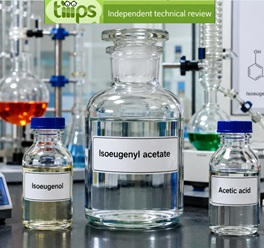
Industrially, Isoeugenyl Acetate is obtained mainly by acetylation of isoeugenol, using acetic acid, acetic anhydride, or other acetylating systems, followed by purification. The starting isoeugenol may be obtained by isomerization of eugenol, which in turn is often derived from or linked to essential-oil supply chains rich in eugenol, such as clove oil.
After synthesis, the usual controls include purity, color, odor, melting point, acid value, isomers, process residues, solvents, stability, and impurity profile. For grades intended for perfumery and cosmetics, regulatory documentation is also essential: SDS, certificate of analysis, allergen declaration, and IFRA certificate.
Quality does not depend only on chemical assay, but also on olfactory refinement, purity of the isomeric profile, stability during storage, and absence of residues or impurities that could affect the material’s safety and classification.
Main compounds present
In the pure grade, the main compound is Isoeugenyl Acetate. In commercial grades or materials derived from isoeugenol, small amounts may be present, including:
Isoeugenol residue;
E/Z isomers;
eugenol or related derivatives;
residues of acetic acid or acetylating agents;
residual solvents;
minor aromatic impurities;
degradation or hydrolysis products.
The distinction between Isoeugenyl Acetate, Isoeugenol, Eugenyl Acetate, and Eugenol is important because they are related but not identical substances. From a regulatory and allergological standpoint, however, the relationship between esters and parent compounds must be carefully considered.
Identification data and specifications
| Characteristic | Value | Note |
|---|---|---|
| INCI name | Isoeugenyl Acetate | cosmetic designation |
| Annex III chemical name | 2-Methoxy-4-prop-1-enylphenyl acetate | name reported in the restriction entry |
| Synonyms | Isoeugenol acetate; Acetisoeugenol; Acetyl isoeugenol; 4-Acetoxy-3-methoxy-1-propen-1-ylbenzene | technical synonyms |
| Chemical category | aromatic ester / phenylpropanoid derivative | acetate of isoeugenol |
| Molecular formula | C12H14O3 | compound formula |
| Molecular weight | about 206.24 g/mol | theoretical value |
| CAS | 93-29-8 | reported in CosIng and Annex III |
| EC | 202-236-1 | European reference |
| FEMA | 2470 | flavouring use |
| JECFA | 1262 | flavouring use |
| FLAVIS | 09.030 | flavouring reference |
| CosIng function | perfuming | from the attached CosIng sheet |
| EU restriction | Annex III, entry 370 | fragrance allergen to be declared above threshold |
| Leave-on threshold | 0.001% | mandatory label declaration above threshold |
| Rinse-off threshold | 0.01% | mandatory label declaration above threshold |
Indicative physicochemical properties
| Characteristic | Indicative value | Note |
|---|---|---|
| Appearance | white crystals / crystalline powder | according to JECFA specifications |
| Color | white or almost white | depends on purity and storage |
| Odor | spicy, carnation, clove-like, powdery | typical profile |
| Water solubility | insoluble | requires adequate solubilization |
| Oil solubility | soluble | useful in fragrances and lipophilic phases |
| Ethanol solubility | soluble | useful in perfumery |
| Melting point | about 80 °C | JECFA data |
| Minimum flavouring purity | 98% | JECFA specification |
| Acid value | maximum 2 | JECFA specification |
| Stability | protect from heat, light, and extreme conditions | verify supplier SDS |
| Main technical risk | sensitization / hydrolysis to isoeugenol | relevant in cosmetic assessment |
JECFA specifications describe Isoeugenyl Acetate as white crystals with a spicy clove-like aroma, insoluble in water, soluble in oil and ethanol, with minimum purity of 98% and a melting point around 80 °C.
Food
In the food sector, Isoeugenyl Acetate may be used as a flavouring, not as a nutrient. Its value is linked to its ability to provide spicy, carnation-like, clove-like, floral, and slightly balsamic notes. JECFA identifies it as flavouring No. 1262, while FEMA reports it as No. 2470.
From a nutritional standpoint, it does not provide direct benefits. Food assessment must refer to food-grade quality, purity, dosage, flavouring compliance, and overall exposure. In a report intended for Tiiips, the food assessment is therefore: aromatic use, not health-related use.
Cosmetics
In cosmetics, Isoeugenyl Acetate is used as a perfuming ingredient. It may appear in perfumes, scented waters, cleansers, soaps, shampoos, conditioners, creams, body products, deodorants, and fragrance compositions where spicy, floral, carnation-like, clove-like, or powdery notes are desired.
The cosmetic function indicated in the attached CosIng sheet is PERFUMING. The related restriction entry is III/370, referring to the substance 2-Methoxy-4-prop-1-enylphenyl acetate.
Regulation (EU) 2023/1545 included Isoeugenyl Acetate in Annex III, entry 370: its presence must be indicated in the ingredient list when its concentration in the finished product exceeds:
0.001% in leave-on products;
0.01% in rinse-off products.
This provision is not a ban, but a transparency obligation on the label for sensitized or allergic consumers.
Pros
It has a spicy, floral, carnation-like, and clove-like olfactory profile that is very useful in perfumery.
It can contribute powdery, balsamic, vanillic, and slightly woody notes.
It is effective at low concentrations as a fragrance ingredient.
It is also recognized as a flavouring agent in the food sector.
It can be obtained from isoeugenol through a relatively direct synthesis.
EU regulation is clear: above threshold, it must be declared on the label.
In well-designed formulas it can provide an elegant and persistent sensory contribution.
Cons
It is not a nutritional food ingredient: in food it has only an aromatic function.
In cosmetics it is a fragrance allergen to be declared above threshold.
It is closely related to isoeugenol, a substance relevant to fragrance sensitization.
It may be hydrolyzed in the skin and generate isoeugenol, increasing its allergological relevance.
It is insoluble in water and requires correct solubilization in the fragrance or formula.
Quality depends on purity, isomers, isoeugenol residue, acid value, and stability.
In formulas with several spicy or phenolic ingredients, it may contribute to cumulative exposure to fragrance allergens.
Safety, regulatory aspects, and environment
From a cosmetic standpoint, Isoeugenyl Acetate must be managed as a fragrance ingredient with allergological relevance. The European Cosmetics Regulation does not prohibit it, but requires its specific indication in the ingredient list above the thresholds established in Annex III. The applicable entry is III/370, with thresholds of 0.001% for leave-on products and 0.01% for rinse-off products.
The most important toxicological point is skin sensitization. The SCCS notes that esters of important contact allergens may be activated by hydrolysis in the skin; among the examples, it specifically mentions isoeugenol acetate, together with eugenyl acetate and geranyl acetate. The same document indicates that isoeugenyl acetate can be hydrolyzed by skin esterases to generate isoeugenol.
This information is important in practice: it is not enough to say that the molecule is “only an ester”. In a professional cosmetic dossier, the following should be assessed:
actual concentration in the fragrance;
concentration in the finished product;
possible simultaneous presence of Isoeugenol;
possible presence of Eugenol, Eugenyl Acetate, Geraniol, Geranyl Acetate, or other related allergens;
product use category;
application frequency;
leave-on or rinse-off use;
exposed skin area.
As a concentrated raw material, it may require attention for skin, eyes, and the environment, according to the supplier SDS. This does not mean that the finished cosmetic automatically has the same risk profile, but it makes assessment of the complete formula and actual concentration essential.
For correct cosmetic use, it is advisable to request from the supplier:
updated SDS;
certificate of analysis;
allergen declaration;
IFRA certificate;
data on purity and isomeric profile;
residual isoeugenol content;
acid value;
data on stability and storage;
actual concentration in the fragrance;
declaration of compliance with the EU Cosmetics Regulation;
verification of the finished-product concentration against Annex III thresholds.
From an environmental standpoint, Isoeugenyl Acetate is an organic odorant substance used at low concentrations. Its real profile depends on raw material origin, production process, biodegradability, amount used, product category, and environmental fate. In rinse-off products, release into wastewater should be considered; in leave-on products, the main issue remains skin exposure and allergen labeling.
Conclusion
Isoeugenyl Acetate is an ingredient of strong olfactory interest, useful mainly for spicy, carnation-like, clove-like, floral, powdery, and balsamic notes. Its main role is as a perfuming ingredient, while in food it can only have an aromatic function.
Professional assessment must, however, be cautious. The central point is its inclusion in Annex III, entry 370, with mandatory declaration above 0.001% in leave-on products and 0.01% in rinse-off products. In addition, its relationship with isoeugenol is particularly relevant because the ester may be hydrolyzed in the skin, generating a substance known for its sensitizing potential.
In a well-designed formula, with complete supplier documentation and controlled concentration, it can be a useful and functional ingredient. The points to control are purity, isomers, isoeugenol residue, solubilization, SDS, COA, IFRA certificate, allergen declaration, concentration in the finished product, and compliance with Annex III of the European Cosmetics Regulation.
PubChem: identifies Isoeugenyl acetate and reports the main chemical data for the compound.

