



Organic whole grain oats: properties, uses, pros, cons, safety
Definition
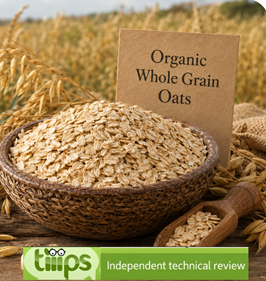
Organic whole grain oats consist of the whole dehulled caryopsis of oats (Avena sativa, botanical family Poaceae), in which the endosperm, bran, and germ are retained in their natural proportions.
Unlike rolled oats, whole grain oats may be supplied as whole oat groats, cut grains, or coarsely milled oats, without necessarily undergoing rolling. The hard, inedible outer hull is removed, while the nutritionally relevant parts of the caryopsis are retained.
The term organic refers to the cultivation, processing, control, and certification methods used throughout the supply chain under the applicable organic production and labelling rules. It does not automatically imply a higher content of beta-glucans, vitamins, or minerals than an equivalent conventional product.
Oats contain their own storage proteins known as avenins. Although uncontaminated oats are tolerated by many people with celiac disease, suitability for a gluten-free diet requires a specifically controlled supply chain because contamination with wheat, barley, or rye is common.
Production process
The production process generally includes:
- Selection and cleaning of the grains to remove dust, foreign seeds, and foreign bodies.
- Dehulling to remove the inedible outer hulls.
- Separation of damaged or non-compliant grains.
- Possible heat treatment/stabilization to inactivate lipolytic enzymes.
- Possible grading, cutting, or coarse milling.
- Cooling and moisture control.
- Packaging in materials providing a barrier against moisture, oxygen, and pests.
Stabilization is particularly important because oats contain a relatively high lipid fraction compared with many other cereals. Unless lipases are inactivated, they may rapidly promote fat hydrolysis and the development of rancid flavors and odors.
The main controls include:
- moisture;
- grain integrity and size;
- microbiological load;
- cereal-chain contaminants;
- oxidative stability;
- absence of pests and foreign bodies;
- organic compliance;
- possible gluten contamination.
Codex Alimentarius has a specific standard for oats, including general identity, quality, contaminant, and hygiene requirements.
Key constituents
Organic whole grain oats are a cereal matrix composed mainly of starch, proteins, lipids, and dietary fiber, including characteristic beta-glucans.
- Starch: the main energy component.
Favorable aspect: provides energy and contributes to body, consistency, and viscosity in cooked preparations.
Less favorable aspect: glycemic response depends on milling degree, cooking, grain structure, associated ingredients, and portion size. - Beta-glucans: soluble fibers characteristic of oats.
Favorable aspect: increase matrix viscosity in the digestive tract and, under the conditions established for the relevant claim, contribute to the maintenance of normal cholesterol concentrations. EFSA has positively assessed a daily amount of at least 3 g of oat beta-glucans for this effect.
Less favorable aspect: a rapid increase in intake may cause bloating, gas, and changes in bowel regularity. - Insoluble fiber: present mainly in the bran.
Favorable aspect: contributes to satiety, stool bulk, and bowel regularity.
Less favorable aspect: may be poorly tolerated by people with particular gastrointestinal sensitivity. - Oat proteins, including avenins:
Favorable aspect: contribute to the overall protein value and structure of preparations.
Less favorable aspect: they do not form a breadmaking gluten network comparable to that of wheat; additionally, a minority of people with celiac disease may react to avenins. - Predominantly unsaturated lipids: present at higher levels than in many refined cereals.
Favorable aspect: contribute to nutritional and sensory quality.
Less favorable aspect: increase sensitivity to oxidation and rancidity. - Avenanthramides: phenolic compounds characteristic of oats.
Favorable aspect: contribute to the phytochemical and antioxidant profile of the matrix.
Less favorable aspect: content and stability depend on cultivar, environment, processing, and storage. - Phenolic acids and flavonoids: present mainly in the outer layers.
Favorable aspect: contribute to the phytochemical complexity of the whole grain.
Less favorable aspect: amounts are variable and may decrease during severe processing and prolonged storage. - Tocols — tocopherols and tocotrienols:
Favorable aspect: contribute to antioxidant protection of the lipid fraction.
Less favorable aspect: they are sensitive to oxygen, light, and heat. - Phytosterols: natural components of the lipid fraction.
Favorable aspect: enrich the compositional profile of oats.
Less favorable aspect: a normal food serving provides smaller amounts than specifically enriched products. - Minerals, including phosphorus, magnesium, manganese, iron, and zinc:
Favorable aspect: contribute to the micronutrient profile of the whole cereal.
Less favorable aspect: bioavailability may be partly reduced by phytates. - B vitamins: partly concentrated in the outer layers and germ.
Favorable aspect: contribute to energy metabolism and the nutritional profile.
Less favorable aspect: some may decrease during heat treatment and storage. - Phytates: natural compounds of the whole grain.
Favorable aspect: have chelating properties and contribute to the antioxidant matrix.
Less favorable aspect: may decrease the absorption of some minerals within the meal.
Important technical note
The structure of the whole grain generally slows hydration and digestion compared with more finely milled or rolled products. However, prolonged cooking, fine milling, or processing into instant flours and preparations may increase starch accessibility.
Identification data and specifications
| Characteristic | Value | Note |
|---|---|---|
| Ingredient name | Organic whole grain oats | Whole dehulled organic oat grains |
| Botanical name | Avena sativa | Botanical family: Poaceae |
| Plant part | Dehulled caryopsis | Endosperm, bran, and germ retained |
| Nature | Whole cereal grain | Whole, cut, or coarsely milled |
| Farming method | Certified organic | According to applicable regulations |
| Key components | Starch, proteins, lipids, fiber, beta-glucans, avenanthramides | Variable by cultivar and process |
| Allergen | Oats; possible gluten contamination | Verify certification for gluten-free use |
| Energy value | Indicatively about 360–400 kcal/100 g | Depends on moisture and composition |
| Molecular formula | Not applicable | Complex food mixture |
| Molecular weight | Not applicable | Complex food mixture |
| Key parameters | Moisture, integrity, beta-glucans, microbiology, oxidative stability, gluten | Quality and compliance drivers |
Indicative physicochemical properties
| Characteristic | Indicative value | Note |
|---|---|---|
| Physical state | Dry dehulled grains | Whole or cut |
| Color | Cream → beige/pale yellow | Natural variations may occur |
| Odor | Mild, cereal-like | Rancid odor indicates oxidation |
| Taste | Mild, cereal-like, slightly nutty | Depends on freshness and treatment |
| Water solubility | Not soluble | The grain absorbs water and softens during cooking |
| Water absorption | Medium–high | Slower than rolled oats |
| Cooking time | Medium–long | Depends on integrity and pretreatment |
| Preparation viscosity | Variable | Increases through release of starch and beta-glucans |
| Stability | Good if kept dry and protected | Critical: moisture, pests, and rancidity |
| Typical issues | Long cooking time, residual hardness, oxidation | Depend on processing and storage |
Main uses
Food use
Organic whole grain oats may be used in:
- soups and cereal stews;
- grain salads;
- rustic porridge;
- side dishes as an alternative to rice, spelt, or barley;
- fillings and plant-based preparations;
- sprouted grains, when the raw material is suitable and hygienically controlled;
- extruded or puffed products;
- production of flours, cut grains, and bakery preparations;
- bases for plant-based beverages.
Whole grains generally require longer hydration and cooking than flakes. Soaking and pressure cooking may reduce preparation time.
Industrial use
The main industrial drivers are:
- size uniformity;
- hydration rate;
- cooking behavior;
- beta-glucan content;
- oxidative stability;
- absence of pests;
- control of gluten contamination;
- traceability and organic compliance.
Nutrition and health
Organic whole grain oats provide complex carbohydrates, fiber, proteins, predominantly unsaturated lipids, and micronutrients. Beta-glucans are their main distinguishing nutritional component.
The whole-grain structure may contribute to more gradual digestion than highly processed oat products; however, the actual effect depends on cooking, milling, preparation, and the overall composition of the meal.
Pros
- Retain bran, germ, and endosperm.
- Good fiber content and presence of beta-glucans.
- More complete nutritional profile than refined cereal products.
- Good satiating capacity.
- Versatile in sweet and savory preparations.
- Provide avenanthramides, phenolic acids, and unsaturated lipids.
Cons
- Require longer cooking than flakes or flours.
- Possible contamination with wheat, barley, and rye.
- Not all people with celiac disease tolerate avenins.
- A rapid increase in fiber may cause bloating and gas.
- The lipid fraction increases susceptibility to rancidity.
Portion note
Portion size depends on the use and finished product. Consider:
- amount of dry oats used;
- increase in weight after cooking;
- presence of seasonings, sugars, or fats;
- actual amount of beta-glucans;
- individual energy requirements.
Safety (allergens, contraindications)
- Celiac disease: use only oats produced and controlled to avoid contamination with gluten-containing cereals. In the European Union, a “gluten-free” statement is permitted when the food sold to the final consumer contains no more than 20 mg/kg of gluten; specific conditions also apply to oats.
- Avenins: a minority of people with celiac disease may react to oat proteins.
- Oat allergy: rare but possible and distinct from celiac disease.
- Fiber: gradual introduction and adequate fluid intake may improve tolerance.
- Contaminants: mycotoxins, residues, foreign bodies, and pests must be controlled according to applicable limits.
- Home sprouting: requires particular hygiene because warm and humid conditions may promote microbial growth.
- Organic status: organic certification does not replace normal chemical, microbiological, and allergen controls.
Storage and shelf-life
Store in a cool, dry place, protected from light, heat, and moisture, in a well-closed package.
Key points:
- limit contact with oxygen;
- protect from pests;
- avoid humid environments;
- reseal carefully after opening;
- check odor and taste before use;
- apply proper stock rotation.
The presence of the germ and lipid fraction makes whole grain oats more sensitive to oxidation than highly refined cereals or flours.
Labelling
On the label, the ingredient may appear as:
- organic whole grain oats;
- organic whole oat groats;
- organic dehulled oats;
- organic whole oats.
Elements to evaluate:
- logo and information required for an organic product;
- highlighting of oats under allergen-labelling rules;
- a “gluten-free” claim only when supported by a controlled supply chain;
- any fiber or beta-glucan claims verified on the finished product;
- proper declaration of possible cross-contamination.
European Union rules on organic production and labelling are governed by Regulation (EU) 2018/848 and the related implementing acts.
Functional role and rationale for use
Organic whole grain oats are selected to combine:
- contribution of a whole-grain cereal;
- fiber and beta-glucan content;
- firm, chewy texture;
- water absorption capacity;
- mild sensory profile;
- organic and whole-grain positioning;
- versatility in hot, cold, sweet, and savory preparations.
In formulation, they may perform nutritional, structural, and sensory functions simultaneously.
Formulation compatibility
The main points are:
- Soaking: may reduce cooking time and improve hydration.
- Cooking: whole grains require longer times than rolled oats.
- Milling: increases hydration rate and starch accessibility.
- Viscosity: starch and beta-glucans may thicken preparations.
- Bakery: cooked or cut grains may be used as inclusions; oat flour alone does not replace breadmaking flour.
- Plant-based drinks: require milling, enzymatic treatment, or filtration depending on the process.
- Crispy products: residual moisture must be controlled to prevent texture loss.
Safety, regulation, and quality
GMP/HACCP management is recommended with specifications covering:
- moisture;
- grain size and integrity;
- fiber and beta-glucans;
- microbiology;
- mycotoxins and other contaminants;
- oxidative stability;
- foreign bodies and pests;
- organic certification;
- gluten control where required;
- batch traceability.
For practical quality, batch consistency, absence of rancid odors, uniform cooking behavior, and protection from moisture are crucial.
Conclusion
Organic whole grain oats (Avena sativa, botanical family Poaceae) are a whole cereal retaining bran, germ, and endosperm and providing starch, proteins, unsaturated lipids, fiber, and beta-glucans.
Their main strengths are the whole-grain profile, good satiating capacity, and versatility. The main critical issues concern possible gluten contamination, individual tolerance to avenins and fiber, cooking time, and sensitivity of the lipid fraction to oxidation.
Mini-glossary
- Caryopsis: the dry fruit typical of cereals, commonly called a grain.
- Dehulling: removal of the inedible outer hulls.
- Whole grain: product retaining bran, germ, and endosperm in their original proportions.
- Beta-glucans: soluble fibers characteristic mainly of oats and barley.
- Avenins: storage proteins naturally present in oats.
- Avenanthramides: phenolic compounds characteristic of oats.
- Stabilization: treatment that inactivates enzymes responsible for rancidity.
- GMP/HACCP: good manufacturing practices and food safety self-control system.

