



Phytelephas aequatorialis seed powder: properties, uses, pros, cons, safety
Phytelephas Aequatorialis Seed Powder is a plant powder obtained from the dried and ground seeds of Phytelephas aequatorialis, a palm also known as tagua, vegetable ivory, or Ecuadorian ivory palm. In cosmetics it is used mainly as a natural physical exfoliant, a plant-based alternative to synthetic microbeads, and as a texturizing ingredient in scrubs, cleansers, masks, body products, and some dental care applications.
Description
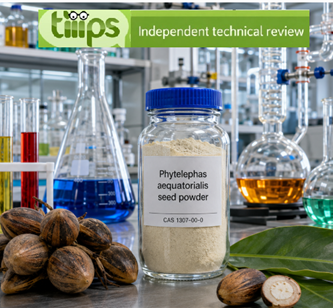
Tagua is the hard seed of a tropical palm native to Ecuador. Once mature and dried, the seed develops a white, compact, very hard structure similar to ivory; for this reason it has traditionally been used for buttons, ornamental objects, jewelry, and handcrafted items. When seed fragments or by-products are ground and sieved, a fine or granular powder suitable for cosmetic use as a botanical scrub is obtained.
From a formulation standpoint, it is not a dermatological cosmetic active, but a mechanical-functional ingredient: it acts through controlled friction on the skin or tooth surface, helping remove dead cells, superficial impurities, and residues. Efficacy and tolerability depend mainly on particle size, particle shape, hardness, concentration, application area, and method of use.
Its interest has also grown because it can replace plastic exfoliating microbeads in rinse-off products. The European restriction on microplastics concerns intentionally added synthetic polymer microparticles; natural, biodegradable, soluble, or inorganic materials are indicated as outside the scope in the context of glitter/microplastics, but compliance should still be documented for the specific commercial grade.
Production process
The production process is relatively simple and physical: mature tagua seeds are collected, dried, selected, crushed, ground, and sieved to obtain different particle sizes. Some suppliers describe the method as grinding and sieving.
Cosmetic quality depends greatly on particle-size precision and raw material cleanliness. For facial or dental use, fine, regular, and not excessively abrasive particles are needed; for body scrubs, larger particle sizes may be acceptable, but always with mechanical safety control.
After grinding, the usual controls include particle size distribution, color, odor, moisture, microbiological load, heavy metals, pesticides, foreign bodies, botanical purity, and absence of undeclared additives. More structured cosmetic grades also require SDS, technical specification, certificate of analysis, and documentation on origin.
Main compounds present
The material consists mainly of the hard plant fractions of the tagua seed. It is not a single molecule and does not have a unique chemical formula. Its functional part is linked to the plant matrix of the seed, rich in polysaccharide and structural material, with a physical behavior similar to a hard, white botanical particle.
Commercial grades may contain small amounts of moisture, fine plant fractions, powders with different particle sizes, and natural seed residues. Fillers, colorants, or additives should not be present if the grade is declared 100% pure; some suppliers indeed report powder obtained from tagua seeds with no added materials.
Identification data and specifications
| Characteristic | Value | Note |
|---|---|---|
| INCI name | Phytelephas Aequatorialis Seed Powder | cosmetic designation |
| Common name | tagua powder; powdered vegetable ivory | commercial designations |
| Botanical name | Phytelephas aequatorialis | Ecuadorian ivory palm |
| Botanical family | Arecaceae | palm family |
| Part used | seed | mature, dried, and ground seed |
| Chemical/material category | plant powder / botanical particulate | not a single molecule |
| Molecular formula | not applicable | complex plant matrix |
| Molecular weight | not applicable | natural particulate material |
| CAS | not clearly unique in the public sources consulted | verify on supplier SDS |
| COSMILE function | not reported | function not yet specified in the COSMILE sheet |
| Commercial use functions | exfoliant, scrub, abrasive, texturizer | depend on grade and particle size |
| Production method | grinding and sieving | physical processing |
| Typical origin | Ecuador | according to commercial tagua sheets |
Indicative physicochemical properties
| Characteristic | Indicative value | Note |
|---|---|---|
| Appearance | fine or granular powder | depends on particle size |
| Color | white / ivory | typical of mature tagua |
| Odor | very mild or almost absent | useful in fragrance-free formulas |
| Water solubility | insoluble | particulate ingredient |
| Oil solubility | insoluble | remains as a dispersed phase |
| Hardness | high | characteristic of vegetable ivory |
| Commercial particle size | variable; example 0.028-0.150 mm in one fine grade | to be verified on the purchased batch |
| Effect on skin | mechanical exfoliation | mild to medium depending on particle and use |
| Stability | good if dry | sensitive to moisture and microbiological contamination |
| Main technical risk | abrasiveness and microbiological control | depends on particle size and purity |
One supplier reports for a Tagua Seed Powder grade a particle size of 0.028-0.150 mm, fine powdery texture, white color, biodegradability, and recommended use in mild to medium exfoliating products; these values are indicative and do not replace the technical sheet of the grade actually purchased.
Food
Phytelephas Aequatorialis Seed Powder has no relevant food role. It is not a nutrient, not a flavouring, and not a common food additive. Although tagua is a plant seed, cosmetic powder use is technical and mechanical, not nutritional.
For food assessment, therefore, the food focus is not relevant. The powder should be considered a cosmetic or technical raw material, not an ingredient for consumption.
Cosmetics
In cosmetics, tagua powder is used mainly as a natural physical exfoliant. It may be included in facial and body cleansers, scrubs, masks, facial polishes, body polishes, soaps, bath products, and, in some cases, toothpastes or dental polishes. One supplier describes it as suitable for facial/body cleansers, facial polishes, body scrubs, masks, toothpastes, and dental polishes.
The main advantage is the possibility of modulating the effect according to particle size: finer particles are more suitable for the face and delicate formulas, while larger particles may be intended for body use. However, formulation must avoid excessive abrasiveness, especially on sensitive skin, inflammatory acne, couperose, compromised skin barrier, or mucous membranes.
It is important to distinguish between commercial function and regulatory evidence: in the COSMILE sheet, the ingredient function is listed as “not reported”; therefore, in a professional dossier, functions such as exfoliant, abrasive, or texturizer should be supported by the supplier’s technical sheet and by the actual use in the finished product.
Pros
It is a natural plant powder obtained from tagua seeds.
It can function as a physical exfoliant in scrubs, cleansers, masks, and body products.
It is a possible alternative to plastic exfoliating microbeads.
It is insoluble and mechanically stable, so it maintains its scrub function in the formula.
It may be available in different particle sizes, allowing modulation of exfoliation intensity.
It has a white/ivory color and low odor, useful characteristics in cosmetic formulas.
Some suppliers present it as biodegradable, vegan, non-GMO, and obtained from ethical supply chains, but these claims must be verified batch by batch.
Cons
It is not a food ingredient and has no nutritional value.
It is not a dermatological active: its function is mainly mechanical and formulation-related.
It may be too abrasive if particle size is high or if used on sensitive skin.
It is not automatically suitable for the eye contour, mucous membranes, inflamed skin, irritated acne, or compromised skin.
As a natural powder, it requires microbiological control and contaminant verification.
The official cosmetic function is not specified in the COSMILE sheet, so practical functions must be documented by the supplier.
The species Phytelephas aequatorialis is indicated by suppliers as Near Threatened; therefore, harvest sustainability must be carefully documented.
Safety, regulatory aspects, and environment
From a cosmetic standpoint, the main risk is mechanical irritation, not systemic toxicity. An exfoliating powder can cause microirritation, redness, or worsening of the skin barrier if particles are too large, too hard, irregular, or used too frequently. Safety therefore depends on particle size, particle shape, concentration, vehicle, method of use, treated area, and consumer instructions.
From the sources consulted, no specific cosmetic restrictions emerge that are comparable to those for fragrance allergens, preservatives, or UV filters. However, the COSMILE sheet does not assign a specific function to the ingredient and recalls that cosmetic ingredients are subject to regulation and safety assessment.
From the microplastics regulation standpoint, the advantage of tagua is that it is a natural plant material, not an intentionally added synthetic polymer microparticle. The European Commission describes the restriction as referring to synthetic polymer microparticles and clarifies, in the context of explanations on glitter, that natural, biodegradable, soluble, or inorganic materials are not considered microplastics for the purposes of the restriction. For a real formula, however, it is prudent to keep a supplier declaration on natural origin, absence of added synthetic polymers, and biodegradability.
From an environmental standpoint, tagua powder is interesting because it can valorize scraps or by-products from the processing of seeds used for buttons and handcrafted objects. Some suppliers state that the powder derives from residual fragments of artisanal production, reducing waste of plant material. However, the species is indicated as Near Threatened in commercial documentation, so it is important to verify that harvesting does not damage natural populations, habitats, or local communities.
For correct cosmetic use, it is advisable to request from the supplier:
updated SDS;
certificate of analysis;
particle size and particle-size distribution;
microbiological control;
heavy metals and pesticides;
moisture;
botanical and geographical origin;
declaration of absence of additives/fillers;
microplastic-free / non-synthetic polymer declaration;
possible COSMOS, NATRUE, FairWild, or equivalent certification;
tolerability testing on the finished product, especially for facial and dental care use.
Conclusion
Phytelephas Aequatorialis Seed Powder is a natural cosmetic ingredient of interest mainly as a plant-based physical exfoliant and alternative to abrasive plastic particles. Its main value is not biological or dermatological, but mechanical-formulation-related: it helps build scrubs and cleansers with a smoothing effect, modulated through particle size and concentration.
The key points are particle size, hardness, particle shape, purity, microbiological control, harvest sustainability, and supplier documentation. In a well-designed formula it can be a favorable ingredient, consistent with natural or microplastic-free products; if used with overly aggressive particles or without adequate supply-chain control, it may instead be irritating or poorly sustainable.

