



Propylene Glycol Stearate: properties, uses, pros, cons, safety
Propylene Glycol Stearate is an ester of propylene glycol and stearic acid. In cosmetics it is used mainly as an emollient, co-emulsifier, emulsifying surfactant and, in some classifications, also as a component with a fragrance ingredient function. From a chemical standpoint, the main reference is propylene glycol monostearate, with the indicative formula C21H42O3 and a molecular weight of about 342.56 g/mol.
Description
This is a technical raw material used mainly in cosmetics, personal care and, in regulated food-grade form, within the broader family of propylene glycol esters of fatty acids. The molecule combines a lipophilic portion, derived from stearic acid, with a more polar portion, derived from propylene glycol. This structure explains its main function: helping the dispersion and stabilization of systems containing both a fatty phase and an aqueous phase.
In cosmetics it is used in creams, lotions, hair products, make-up, creamy cleansers and formulations where softness, spreadability, emulsion stability and a more comfortable skin feel are required.
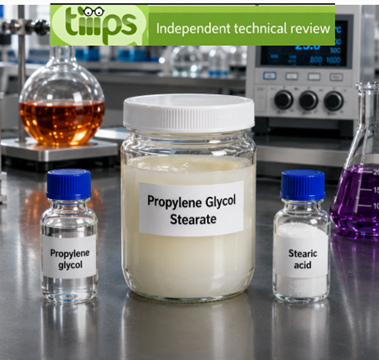
Production process
Industrially, Propylene Glycol Stearate is obtained by esterification between propylene glycol and stearic acid. Alternatively, within the broader family of propylene glycol esters of fatty acids, it can also be obtained by transesterification with oils or fats containing fatty acids.
The commercial result is not always a perfectly pure monomolecular substance: it may contain different proportions of monoester, small amounts of diester, residual stearic acid, residual propylene glycol and, depending on the fatty raw material, traces of other fatty acids such as palmitic acid. Propylene Glycol Stearate SE is instead a self-emulsifying grade, which also contains stearate salts, particularly sodium and/or potassium stearate, to improve emulsifying capacity.
Main compounds present
In cosmetic grade, the reference compound is Propylene Glycol Stearate, meaning the ester between propylene glycol and stearic acid. Commercial products may also contain propylene glycol distearate, free stearic acid, free propylene glycol, C16-C18 fatty acid fractions and minor components related to purity grade and the raw material used.
In the food-grade material related to the E477 / INS 477 family, the definition is broader: it refers to propane-1,2-diol esters of fatty acids, meaning mixtures of mono- and diesters of propylene glycol with saturated and unsaturated fatty acids derived from edible oils and fats.
Identification data and specifications
| Characteristic | Value | Note |
|---|---|---|
| INCI name | Propylene Glycol Stearate | cosmetic designation |
| Chemical name | Stearic acid, monoester with propane-1,2-diol | chemical description |
| Chemical category | propylene glycol ester with fatty acid | emollient / emulsifier |
| Indicative molecular formula | C21H42O3 | referred to the monostearate |
| Indicative molecular weight | about 342.56 g/mol | referred to the monostearate |
| Commonly reported CAS numbers | 1323-39-3 / 142-75-6 | depends on the commercial/isomeric reference |
| EC numbers | 215-354-3 / 205-557-5 | references reported in cosmetic databases |
| Cosmetic functions | skin conditioning - emollient; surfactant - emulsifying; fragrance ingredient | according to cosmetic classifications |
| Related food additive | E477 / INS 477 | family of propylene glycol esters of fatty acids |
| Technical origin | synthetic or from fatty acids of vegetable/animal origin | depends on the supplier’s supply chain |
| Commercial form | waxy solid, flakes, beads or semi-solid mass | variable according to grade and purity |
Indicative physicochemical properties
| Characteristic | Indicative value | Note |
|---|---|---|
| Appearance | white or cream waxy solid | may also appear as a plastic mass |
| Odor | mild, fatty or almost neutral | depends on the commercial grade |
| Water solubility | low / insoluble | typical of fatty esters |
| Solubility in organic solvents | good in hot ethanol and ethyl acetate | according to JECFA food specifications |
| Ionic nature | mainly non-ionic | useful in cosmetic emulsions |
| Polarity | moderate, with lipophilic prevalence | emollient and co-emulsifying effect |
| Melting point | variable, generally in the waxy-solid range | depends on purity and composition |
| Stability | good under normal formulation conditions | sensitive to strong hydrolysis under extreme conditions |
| Compatibility | good with oils, waxes, esters and emulsified systems | to be verified in the final formula |
| SE version | self-emulsifying grade | contains sodium and/or potassium stearate salts |
Food
In food, the most correct reference is not always the single cosmetic Propylene Glycol Stearate, but the family of propylene glycol esters of fatty acids, identified as E477 in Europe and INS 477 at Codex/JECFA level. These compounds are used as emulsifiers in baked goods, fat preparations, desserts, coatings, whipped products, chewing gums and other food categories where stability, aeration, texture and homogeneous fat distribution are required.
From a nutritional standpoint, they do not provide a direct benefit: their role is technological. They serve to improve structure, emulsion, softness or product stability. Food assessment must therefore refer to permitted amounts and to the overall contribution of free or bound propylene glycol in the diet.
Cosmetics
In cosmetics, Propylene Glycol Stearate is used as an emollient and co-emulsifier. It improves spreadability, helps reduce water loss through a superficial effect, contributes to product softness and can stabilize oil/water or water/oil emulsions depending on the formulation system.
It is particularly useful in creams, lotions, hair products, make-up, creamy cleansers, conditioners, body products and formulations where waxy structure, body, skin lubrication and better distribution of the fatty phase are needed. It is not a “functional” cosmetic active in a strong dermatological sense, but a formulation-support ingredient with sensory and technical effects.
Pros
It is an emollient useful for improving softness, spreadability and skin comfort.
It works as a co-emulsifier, contributing to emulsion stability.
It has good compatibility with oils, waxes, esters and cosmetic fatty phases.
It can improve the texture of creams, lotions, conditioners and make-up products.
The SE version offers greater self-emulsifying capacity thanks to the presence of alkaline stearates.
The related food family E477 / INS 477 is recognized as an emulsifier in several regulated food categories.
The CIR assessment of propylene glycol esters considers them safe as cosmetic ingredients under the evaluated practices of use and concentration.
Cons
It is not an “active” ingredient in the strict sense: its role is mainly technical-sensory.
It may not be suitable for formulations that aim to avoid propylene glycol derivatives.
Actual quality depends greatly on commercial grade, residues, acid value and monoester/diester composition.
In very rich products or on predisposed skin it may contribute to a heavier or more occlusive feel.
The food-grade version E477 should not be automatically confused with the cosmetic INCI grade: they belong to a related chemical family, but specifications may differ.
Like many emulsifiers and fatty esters, it may cause stability problems if used in poorly balanced formulation systems.
In very sensitive individuals, the complete formula may cause irritation, even though the compound itself is not considered one of the main cosmetic allergens.
Safety, regulatory aspects and environment
From the standpoint of cosmetic safety, Propylene Glycol Stearate belongs to the family of propylene glycol esters. The CIR assessment concludes that these ingredients are safe as cosmetic ingredients under the evaluated practices of use and concentration. This does not mean that every formula is automatically safe: the real assessment must always concern the finished product, concentration, type of application, skin area and overall irritancy profile.
From a food standpoint, propylene glycol esters of fatty acids are regulated as E477 / INS 477 and used as emulsifiers. JECFA reports an ADI of 0-25 mg/kg body weight expressed as propylene glycol. EFSA reassessed E477 and considered that no genotoxicity concerns emerge, but the assessment remains linked to overall exposure to propylene glycol from other additives and food sources as well.
From an environmental standpoint, the profile depends on the origin of stearic acid, the source of propylene glycol and the industrial process. The fatty portion may derive from vegetable oils, animal fats or mixed supply chains; therefore, real sustainability does not depend only on the INCI name, but on raw material traceability, production impact and supplier standards.
Conclusion
Propylene Glycol Stearate is mainly a cosmetic-formulation ingredient, useful as an emollient, co-emulsifier and support for emulsion stability. Its main value is neither nutritional nor “active” in a dermatological sense, but technical: it improves texture, softness, distribution of the fatty phase and the sensory profile of the finished product.
Correct assessment requires distinguishing between cosmetic Propylene Glycol Stearate, Propylene Glycol Stearate SE and the broader food family E477 / INS 477. In well-designed formulas it is generally a favorable and functional ingredient; the points to control are purity, residues, origin of the fatty fraction, concentration of use and compatibility with the entire formulation system.

