



Wheat vinegar (Triticum spp., botanical family Poaceae): properties, uses, pros, cons, safety
Definition
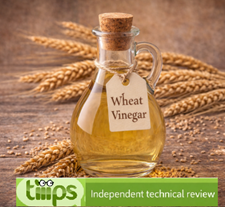
Wheat vinegar is a product obtained through alcoholic fermentation followed by acetic fermentation of wheat-based raw materials belonging to the genus Triticum (botanical family Poaceae). In practice, the starch in the cereal is first transformed into fermentable sugars, then into ethanol by yeasts, and finally into acetic acid by acetic acid bacteria.
From a commodity standpoint, wheat vinegar may be produced from:
fermented musts or distillates derived from wheat,
alcoholic bases obtained from wheat flours, semolinas, or starches,
fermentation blends intended for food or industrial use.
The final profile depends on the raw material, type of process, refining degree of the cereal base, possible filtration, maturation, and acidity standardization. Compared with other vinegars, it may have a more neutral or slightly cereal-like sensory profile, depending on the production method.
Production process
The production process of wheat vinegar generally includes:
Selection of the wheat-based raw material.
Milling and/or preparation of the starchy matrix.
Hydrolysis/saccharification of starch to obtain fermentable sugars.
Alcoholic fermentation with yeasts to produce ethanol.
Acetic fermentation with acetic acid bacteria to transform ethanol into acetic acid.
Possible filtration, clarification, and maturation.
Acidity standardization.
Packaging.
Key controls concern total acidity, residual ethanol content, sensory profile, clarity/turbidity, microbiology, absence of contaminants, and compliance of the raw material.
Key constituents
The composition of wheat vinegar depends on the process, the refining degree of the fermented base, and any maturation. In general, the most relevant components are:
Water: the main component of the matrix.
Favorable aspect: makes the product easy to dose and use in cooking and industry.
Less favorable aspect: stability still depends on the proper balance with acidity and storage.Acetic acid: the characteristic component of vinegar.
Favorable aspect: defines acidity, preservative function, and typical sensory profile.
Less favorable aspect: at high concentrations it may be sensorially aggressive and requires proper dilution/use.Secondary organic acids (in variable amounts):
Favorable aspect: contribute to gustatory complexity.
Less favorable aspect: their contribution strongly depends on the fermentation method.Residual ethanol traces: may be present in small amounts, within technologically compatible limits.
Favorable aspect: indicate continuity of the controlled fermentation process.
Less favorable aspect: the residue must remain low and compliant with the specification.Volatile aromatic compounds: derive from the starting cereal and from the fermentations.
Favorable aspect: contribute to the aromatic profile and the typical character of the product.
Less favorable aspect: they are variable and sensitive to process and storage.Minerals (traces/variable amounts):
Favorable aspect: contribute to matrix complexity.
Less favorable aspect: practical nutritional impact is generally limited, given the low consumption per serving.Phenolic compounds (generally modest and variable):
Favorable aspect: may contribute to the overall complexity of the product.
Less favorable aspect: in a standard wheat vinegar they are generally not the main component.
Important technical note
In a food-technical sheet, it is advisable to distinguish between:
main matrix components: water and acetic acid;
secondary components: minor organic acids, aromatic compounds, possible fermentative residues.
In wheat vinegar, the most important parameter is not so much compositional richness, but rather the quality of the fermentation process, purity, and acidity stability.
Identification data and specifications
| Characteristic | Value | Note |
|---|---|---|
| Ingredient name | Wheat vinegar | Product obtained from fermentation of wheat-based raw materials |
| Botanical origin | Triticum spp. | Botanical family: Poaceae |
| Plant part | Caryopsis | Cereal used as fermentable starchy base |
| Nature | Acidic liquid | Aqueous matrix acidified by fermentation |
| Key components | Water, acetic acid, secondary organic acids, aromatic compounds | Variable profile depending on process |
| Allergen | Wheat/gluten: to be evaluated according to process and applicable regulations | In labeling, the finished product and allergen management matter |
| Calories | Generally low per 100 ml | Depend on residues and formulation |
| Key parameters | Total acidity, pH, clarity, residual ethanol, microbiology | Quality and compliance drivers |
Indicative physicochemical properties
| Characteristic | Indicative value | Note |
|---|---|---|
| Physical state | Liquid | Generally clear, sometimes slightly hazy |
| Color | Colorless → pale straw | Depends on raw material and process |
| Odor | Acetic, sometimes slightly cereal-like | Varies with fermentation and maturation |
| Taste | Acidic, sharp | May be more or less rounded depending on the production method |
| pH | Acidic | Central parameter for stability and taste perception |
| Total acidity | Variable according to commercial specification | Fundamental technical parameter |
| Water solubility | Completely miscible | Easily dilutable and incorporable |
| Stability | Good if properly packaged | Critical points: contamination, sensory alterations, evaporation |
| Typical issues | Excessive sensory aggressiveness, turbidity, aromatic changes | Depend on process and storage |
Main uses
Food use
Wheat vinegar is used in different areas:
Seasoning for salads, vegetables, and cold preparations.
Ingredient for marinades and sauces.
Acidity regulator in food formulations.
Acidic base in preserves, pickles, and gastronomic preparations.
Ingredient in processed products where a cleaner acidity and a less marked aromatic profile than more characterful vinegars are desired.
Industrial use
The main industrial drivers are:
constant acidity,
controlled aromatic profile,
clarity and stability,
predictability in formulation,
compatibility with standardized food processes.
Nutrition and health
Wheat vinegar is not an ingredient to be evaluated as a significant source of macronutrients, but rather as a seasoning and acidifying functional component. Its nutritional impact almost always depends on the actual amount used, which is generally limited.
Pros
Ingredient with low caloric contribution in normal serving sizes.
Useful for providing acidity and balancing the sensory profile of dishes.
Good versatility in cooking and formulation.
Cons
High acidity: may be aggressive if used in excess.
Less rich sensory profile than more aromatic or matured vinegars, if the process is highly standardized.
The allergen/gluten issue must always be evaluated on the finished product and on the producer’s specification.
Portion note
Portion should be evaluated based on actual use as a seasoning or technological ingredient. In general, small amounts are used, so direct caloric and nutritional impact is modest.
Safety (allergens, contraindications)
Allergens: since it is derived from wheat, it is advisable to verify the producer’s specification and the applicable regulations on the finished product, especially for subjects with celiac disease or gluten sensitivity.
Celiac disease: high caution; evaluation should not be based only on the raw material, but on the finished product, the transformation, and declared compliance.
Gastric sensitivity: high acidity may be poorly tolerated by subjects sensitive to acidic products.
Microbiological safety: depends on proper fermentation, filtration, packaging, and hygienic management.
Storage and shelf-life
Store in a tightly closed container, in a cool, dry place, protected from light and heat sources.
Key points:
close well after use;
avoid contamination during dispensing;
protect from sensory alterations due to improper storage.
Under correct conditions, vinegar generally has good commercial stability.
Labelling
On the label it may appear as:
wheat vinegar
vinegar obtained from wheat
equivalent wording according to regulations and formulation
Elements to evaluate:
correct commodity designation,
possible management of allergen information,
consistency between declared raw material and finished product,
any presence of other added ingredients or flavors.
Functional role and rationale for use
Wheat vinegar is chosen to combine:
effective acidification,
generally clean aromatic profile,
good compatibility in cooking and industrial formulation,
ease of use as a technical ingredient or seasoning.
In many cases it is used when a more neutral acetic note is desired compared with more strongly characterized vinegars.
Formulation compatibility
The main points are:
dosage: strongly affects acidity and sensory perception;
final pH: central for stability and taste;
interaction with salt, sugars, and flavors in the formulation;
compatibility with emulsions, sauces, and preserves;
possible impact on allergen declaration of the finished product.
Safety, regulation, and quality
GMP/HACCP management is recommended with control of:
total acidity,
pH,
residual ethanol,
microbiology,
clarity and stability,
raw material traceability,
correct documentary management on allergens and compliance.
For practical quality, batch consistency, coherent sensory profile, and predictability in use are crucial.
Conclusion
Wheat vinegar (Triticum spp., botanical family Poaceae) is a versatile acidic ingredient, useful mainly for providing acidity, sensory balance, and technological functionality in cooking and food formulations. Its main technical drivers are acidity, purity of the fermentation process, product stability, and proper management of information related to the cereal raw material.
Mini-glossary
Alcoholic fermentation: transformation of sugars into ethanol by yeasts.
Acetic fermentation: transformation of ethanol into acetic acid by acetic acid bacteria.
Total acidity: parameter expressing the overall acid content, mainly acetic acid.
Residual ethanol: small amount of alcohol possibly still present after acetic fermentation.
GMP/HACCP: good manufacturing practices and food safety self-control system.

