



Whole millet flour: properties, uses, pros, cons, safety
Definition
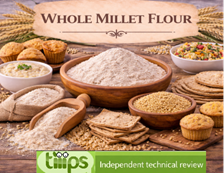
Whole millet flour is produced by milling the caryopsis of millet (Panicum miliaceum, family Poaceae) while retaining, to a significant extent, the outer fractions and the germ. Compared with more refined millet flours, it generally provides more fibre and a higher mineral fraction (ash), with a more pronounced “cereal” sensory profile and sometimes a slightly nutty note. It is naturally gluten-free, but “gluten-free” suitability depends on the supply chain and cross-contamination control with gluten-containing cereals.
Production process
The process includes cleaning and sorting, optional partial dehulling (to reduce husk/impurities), possible thermal stabilisation to improve shelf-life, then milling (roller or stone) and sieving to define particle size. Key controls include moisture, microbiological load, foreign bodies, particle size, and storage stability (rancid odour/oxidation), especially when germ fraction is relevant.
Key constituents
The matrix contains starch, millet proteins, fibre (higher in whole flour), germ-associated lipids and variable micronutrients.
Starch: main energy source. Potential downside: in heavily cooked or highly processed foods, starch availability can increase and contribute to a faster glycaemic response if not balanced by the meal.
Fibre (insoluble + a smaller soluble fraction): supports satiety and bowel regularity; technologically increases water absorption and “body”. Potential downside: rapid increases can cause bloating in sensitive individuals; effect depends on dose and portion.
Millet proteins: contribute to protein content; benefit: useful in gluten-free diets; downside: they do not form an elastic network, so leavened gluten-free products require blends and binders for structure and volume.
Germ lipids (variable): improve nutritional completeness versus refined flours; downside: increase susceptibility to oxidation/rancidity and require better storage management.
Minerals (e.g., magnesium, phosphorus; variable): higher in less refined flours; benefit: micronutrient contribution; downside: practical impact depends on inclusion level and portion size.
B-group vitamins (variable): present at variable levels; benefit: supports micronutrient profile; downside: sensitive to processing and storage.
Phenolic compounds (trace): linked to outer fractions; benefit: potential antioxidant contribution; downside: batch variability and losses under severe processing.
Phytates (variable): present in outer fractions; benefit: matrix chelating/antioxidant roles; downside: may reduce mineral bioavailability within the meal context, especially in marginal diets.
For more information: Millet
Identification data and specifications
| Parameter | Value | Note |
|---|---|---|
| Ingredient name | Whole millet flour | From milled whole millet |
| Botanical name | Panicum miliaceum | Family: Poaceae |
| Plant part | Caryopsis (endosperm + outer layers + germ) | Whole = more fibre and minerals |
| Nature | Starch–protein–fibre flour | Darker than refined flours |
| Key parameters | Moisture, particle size, fibre, ash, microbiological load, oxidative stability | Performance and consistency drivers |
| Allergen | No (intrinsic) | Beware gluten cross-contamination in the supply chain |
| Caloric value | Typically ~340–380 kcal/100 g | Depends on moisture and variety |
Physico-chemical properties (indicative)
| Property | Indicative value | Note |
|---|---|---|
| Physical state | Powder | Fine → medium |
| Colour | Straw-yellow → beige/brown | Darker with higher whole fraction |
| Odour | Cereal | Rancid notes indicate oxidation |
| Water solubility | Insoluble | Forms dispersions; starch gelatinises on heating |
| Water absorption | Medium–high | Increases with fibre and fineness |
| Stability | Good if kept dry | Critical: moisture and rancidity (germ) |
| Typical criticalities | Grittiness (if coarse), lumping, rheology variability | Driven by particle size and batch |
Main uses
Food
Used in gluten-free recipes (bread, cakes, biscuits/cookies, pancakes, flatbreads/crackers) and as a component in porridge mixes and extruded products. In gluten-free leavened goods it is often used in blends with starches and binders (fibres, hydrocolloids) to improve structure and softness, because it does not form a gluten network. In biscuits/shortcrust products it can deliver a more “rustic” profile and a warmer colour.
Industrial use
Gluten-free mixes, snacks, extruded products and bakery: industrial drivers include consistent particle size, predictable water absorption and management of oxidative stability over shelf-life.
Nutrition and health
Compared with refined flours, whole millet flour tends to provide more fibre and micronutrients, potentially supporting satiety and a better nutritional profile of the finished product. However, it remains starch-based: the overall outcome depends on recipe (added sugars/fats) and portion size.
Pros
It is naturally gluten-free (with controlled supply chain) and can increase fibre compared with more refined flours. It adds sensory variety and supports “whole grain” positioning in gluten-free formulations.
Cons
It can be more prone to rancidity due to germ presence and requires good storage management. In gluten-free leavened products, it requires more complex formulation to achieve satisfactory volume and structure. In sensitive individuals, rapid fibre increases may cause bloating.
Serving note
Serving size depends on the finished product. For evaluation, consider the percentage of whole millet flour in the recipe, added sugars/fats and pairing with protein/fibre sources in the meal.
Safety (allergens, contraindications)
Not a typical intrinsic allergen. For “gluten-free” claims, supply-chain control and, where needed, analytical verification are essential. Main criticalities are quality-related (moisture, oxidation) and gastrointestinal tolerance to fibre in sensitive individuals.
Storage and shelf-life
Store in a cool, dry place, tightly closed and protected from light and heat. Germ presence increases rancidity susceptibility: barrier packaging, stock rotation and lower temperatures improve shelf-life.
Labelling
Declare “whole millet flour”. “Gluten-free” wording is appropriate only if supported by controlled supply chain and coherent verification. Any “whole grain” and “source of fibre” claims must match the finished product and applicable thresholds.
Functional role and rationale for use
Provides a starch base and adds body and water absorption through fibre. In gluten-free systems it is a base and “whole grain identity” ingredient, while leavened structure must be built with blends and binders. Particle size is a key driver to control gritty mouthfeel and sensory performance.
Formulation compatibility
In gluten-free bakery it performs well in blends with starches and hydrocolloids. Hydration must be tuned because fibre binds water and can thicken doughs/batters. In creams/porridges it must be dispersed properly to avoid lumps; prolonged heating can increase viscosity and alter texture. Oxidation management matters in long-shelf-life products.
Safety, regulatory and quality
GMP/HACCP management supports traceability, contaminant control, microbiology and batch consistency. Clear specifications for moisture, particle size and oxidative stability reduce variability and complaints (rancid odour, inconsistent performance).
Conclusion
Whole millet flour (Panicum miliaceum) is a naturally gluten-free flour oriented to a more “whole grain” profile (more fibre and micronutrients) and is useful in blends for gluten-free bakery. Key drivers are particle size, hydration management and oxidation/rancidity control during storage; real nutritional value depends on the finished product and portion size.
Mini-glossary
Whole grain: ingredient retaining outer fractions and germ, with higher fibre and minerals than refined versions.
Starch gelatinisation: starch transformation with water and heat that increases viscosity and structure.
Rancidity: oxidative lipid degradation causing rancid notes and quality loss.
Particle size: particle distribution; affects hydration and gritty mouthfeel.
GMP/HACCP: good manufacturing practices (GMP) and the hazard analysis and critical control points (HACCP) system for food safety.

