



Arnica D2: properties, uses, pros, cons, safety
Definition
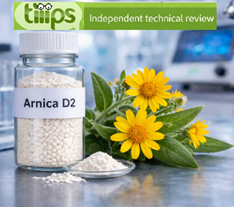
Arnica D2 refers to an arnica preparation in homeopathic decimal dilution 2 (D2), i.e., a 1:100 dilution versus the starting material (mother tincture/initial extract, depending on the pharmacopoeia/supplier). The species most commonly associated is Arnica montana (family Asteraceae). In practice, Arnica D2 is a highly diluted form intended to reduce exposure to the more reactive constituents of arnica while maintaining a recognisable botanical “signal”. The most typical use is topical (cosmetic or para-pharmaceutical) in products positioned for comfort sensation on skin and areas subject to mechanical stress.
Production process
The process starts from a botanical raw material (typically flower heads) extracted to obtain a tincture or extract (often hydroalcoholic). The D2 preparation is obtained through sequential dilutions according to protocol (1:10 → D1, then 1:10 of D1 → D2), with optional agitation/homogenisation between steps. The final carrier may be hydroalcoholic, glycerinated, or another solvent system depending on intended use and formulation compatibility. Key controls include botanical identity, carrier quality, microbiology (especially where water phase is relevant), and consistency of the dilution specification.
Key constituents
In a D2 preparation, absolute levels of characteristic constituents are greatly reduced compared with an undiluted extract; this does not eliminate sensitisation considerations but reduces exposure. Typical arnica phytochemical groups (upstream) include:
Sesquiterpene lactones (e.g., helenalin and derivatives): associated with the more “active” fraction of arnica in traditional terms; a favourable aspect (in topical-use logic) is support of perceived local comfort, while an unfavourable aspect is higher likelihood of sensitisation/contact dermatitis and irritation, especially on reactive skin or with prolonged use. In D2 exposure is lower but not “zero”.
Flavonoids: polyphenolic compounds with potential antioxidant roles within the matrix; in cosmetics they may support an oxidative-stress protection narrative. Potential downside: limited stability under light/oxygen exposure and non-optimal pH.
Phenolic acids: contribute to antioxidant profile and sensory stability of the extract; potential downside: batch variability and degradation over time.
Essential oil/terpenes (trace): contribute to characteristic odour; potential downside: some volatile fractions can be irritating/sensitising in predisposed individuals and are oxidation-sensitive.
Identification data and specifications
| Parameter | Value | Note |
|---|---|---|
| Ingredient name | Arnica D2 | Diluted preparation (1:100) |
| Botanical name | Arnica montana | Family: Asteraceae |
| Plant part | Typically flowers/flower heads | Supplier specification dependent |
| Nature | Diluted solution/extract | Carrier often hydroalcoholic or hydroglyceric |
| Key parameters | Dilution grade (D2), carrier (% alcohol/glycerin), botanical identity, microbiology, odour/colour, stability | Quality and repeatability drivers |
| Allergen | Not a typical “food allergen”, but sensitisation possible | Higher risk in people sensitive to Asteraceae |
| Caloric value | Not meaningful at use levels | Relevant only in atypical food uses |
Physico-chemical properties (indicative)
| Property | Indicative value | Note |
|---|---|---|
| Physical state | Liquid | Sometimes supplied on a support (gel/cream) in finished products |
| Colour | Colourless → pale yellow/light brown | Depends on carrier and starting material |
| Odour | Mild herbaceous | Stronger with hydroalcoholic carrier and intense starting material |
| Water solubility | Variable | High in aqueous/hydroalcoholic systems; composition-dependent |
| Stability | Medium | Sensitive to light/oxygen; carrier affects stability |
| Typical criticalities | Sensory drift, compatibility with polymers/preservatives, precipitates | pH- and system-dependent |
Main uses
Cosmetics
Used in comfort gels and creams, massage products, after-activity formulations, and products positioned for wellbeing sensation on stressed areas. The D2 dilution is chosen when an “arnica” positioning is desired with potentially higher tolerability than concentrated extracts, while acknowledging individual variability.
INCI functions. Skin conditioning; soothing (depending on product type and substantiated claim).
Pharmaceutical/homeopathic
Arnica D2 is also a common designation in homeopathic preparations. In these contexts, dilution protocol, carrier quality and conformity to manufacturer specifications are central.
Industrial use
Diluted botanical semi-finished products for gel/cream bases, where repeatable odour/colour and compatibility with preservatives and thickeners are important.
Health aspect
For topical use, the practical target is perceived comfort. D2 dilution reduces exposure to more reactive constituents, but does not automatically make the ingredient suitable for everyone: individual sensitivity remains relevant.
Pros
A “softer” profile than non-diluted arnica extracts, with potentially improved tolerability in leave-on formulas and good positioning as a botanical support for comfort products.
Cons
Possible sensitisation (especially in reactive individuals or those sensitive to Asteraceae). If used on irritated skin or in very occlusive products, discomfort risk can increase. Perceived effect depends strongly on the overall formula (carrier, alcohol, fragrance, preservatives).
Serving note
Not applicable: for topical use, what matters is amount per application and use frequency of the finished product.
Safety (allergens, contraindications)
Not a typical food allergen, but arnica is known for potential contact dermatitis in predisposed individuals. Avoid application on broken skin, mucosa, or highly irritated areas, and use caution with a history of sensitivity to Asteraceae. For oral use, arnica is generally not considered a safe choice outside specific, controlled contexts; the most coherent use remains topical.
Storage and shelf-life
Store tightly closed, protected from light and heat. Minimise air exposure to limit oxidation and sensory drift. Shelf-life depends on carrier (alcohol/glycerin), packaging and incorporation into the finished product (preservation system).
Labelling
The wording may appear as “Arnica” with the dilution (D2) in homeopathic contexts, or as a specification reference in semi-finished materials. In cosmetics, ingredient naming depends on the form used (extract/tincture) and supplier nomenclature; naming and claims must be consistent with technical documentation and the finished-product safety assessment.
Functional role and rationale for use
Arnica D2 is used to deliver a botanical contribution oriented to comfort and sensory “support”, reducing the intensity of more reactive constituents versus concentrated extracts. The technical rationale is improved compatibility and tolerability in leave-on formulas while keeping a recognisable ingredient identity.
Formulation compatibility
In gels and O/W emulsions, incorporation is generally straightforward if the carrier is compatible (hydroalcoholic/hydroglyceric). Key points: alcohol level (can be drying/irritating), interactions with thickening polymers, and stability at extreme pH. In fragranced products, the combination “arnica + fragrance” can increase sensitisation risk in predisposed individuals, so overall irritancy potential should be managed carefully.
Safety, regulatory and quality
GMP/HACCP management across the extraction chain supports traceability, contaminants control, microbiology and carrier consistency. Clear specifications for D2 dilution, botanical identity and stability reduce variability and non-conformity risk.
Conclusion
Arnica D2 (Arnica montana) is a diluted (1:100) preparation used mainly in topical comfort-oriented applications. Key drivers are starting material quality, dilution consistency, carrier compatibility and management of individual sensitisation, with particular attention to reactive individuals and Asteraceae sensitivity.
Mini-glossary
D2 (decimal dilution): homeopathic dilution 1:100 versus the starting material.
Sesquiterpene lactones: arnica-typical compound class, associated with both functional interest and sensitisation risk.
Contact dermatitis: inflammatory skin reaction linked to irritants or sensitisers.
Asteraceae: botanical family that includes arnica; some individuals may be sensitive to plants in this family.
GMP/HACCP: good manufacturing practices (GMP) and the hazard analysis and critical control points (HACCP) system for safety and contamination prevention.

