



Shea butter: properties, uses, pros, cons, safety
Definition
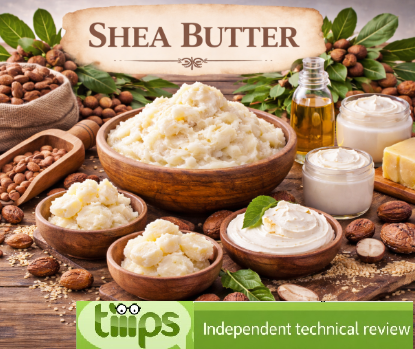
Shea butter is a vegetable fat obtained from the seeds (nuts) of Vitellaria paradoxa (family Sapotaceae). At room temperature it is solid/semi-solid with a melting range close to skin temperature, a feature that makes it particularly useful as an emollient and structuring agent in cosmetics. Quality and sensory profile depend strongly on extraction method, degree of refining, and the level of the unsaponifiable fraction.
Production process
The supply chain includes fruit collection, seed separation and washing, drying and crushing. Lipid extraction can be performed using traditional methods (kneading and separation in hot water) or industrial processes (pressing and/or solvent extraction). This is followed by filtration and, if required, refining (deodorisation/bleaching) to reduce odour and colour and improve standardisation. Process parameters influence oxidative stability, aroma profile and unsaponifiable content.
Key constituents
Shea butter consists mainly of triglycerides containing long-chain fatty acids. The most representative are oleic acid and stearic acid, with variable contributions from palmitic and linoleic acids. The unsaponifiable fraction (variable by origin and processing) includes compounds such as tocopherols and other minor constituents that affect stability and cosmetic performance.
Practical note: exposure to heat, light and oxygen can accelerate oxidation and cause odour/colour changes, especially in less refined grades.
For more information: Shea
Identification data and specifications
| Parameter | Value | Note |
|---|---|---|
| Ingredient name | Shea butter | Often supplied as “shea butter” |
| Botanical name | Vitellaria paradoxa | Family: Sapotaceae |
| Plant part | Seeds (nuts) | Raw material: seed lipids |
| Nature | Solid/semi-solid vegetable fat | Consistency linked to oleic/stearic ratio |
| Key parameters | Fatty acid profile, unsaponifiables, peroxide value, acidity, melting range, odour/colour | Quality and consistency drivers |
| Allergen | Not typical | Possible individual sensitisation; assess purity and contaminants |
| Caloric value | Typically ~880–900 kcal/100 g | Indicative for fats/lipid foods |
Physico-chemical properties (indicative)
| Property | Indicative value | Note |
|---|---|---|
| Physical state | Solid/semi-solid | Softens with heat |
| Colour | Ivory → pale yellow | Lighter if refined |
| Odour | Neutral → characteristic | More pronounced if unrefined |
| Water solubility | Insoluble | Lipophilic |
| Melting range | Indicatively ~30–40 °C | Depends on lipid profile |
| Stability | Good if protected from oxygen and heat | Key risk: oxidative rancidity |
| Typical criticalities | Graininess/crystallisation, sensory variation | Driven by thermal history and batch |
Main uses
Cosmetics
Used as an emollient, moderate occlusive and consistency agent in face/body creams, body butters, lip sticks/balms, hair products and anhydrous formulations. It helps reduce the sensation of dryness by improving slip and sensory feel. In leave-on products, compatibility depends on the overall oil phase and the balance between fluid oils and more structuring butters.
INCI functions. Emollient; skin conditioning; viscosity increasing (in anhydrous systems or W/O/O/W depending on the formula).
Food
In some contexts it is used as an edible fat, but use depends on quality specifications, applicable regulations and the supply chain. In everyday European practice, it is more commonly a cosmetic ingredient than a food ingredient.
Industrial use
Can be used as a lipid base in soaps and technical products where a fat with controlled melting behaviour and good workability is required.
Health aspect
In cosmetics, the key “health” focus is skin tolerability and suitability for dry or dehydrated skin, considering inter-individual variability and the full formula context.
Pros
Supports emollience and skin comfort, useful in dryness-oriented formulations. It can improve structure and sensory feel while reducing reliance on harsher structuring agents.
Cons
In some individuals or body areas it may feel heavy/occlusive, with potential for sensory dislike or blemish-prone outcomes if the formula is too rich. Batch variability and refining grade can affect odour, colour and performance, requiring tighter specifications.
Serving note
Not applicable in a nutritional sense for cosmetic use; for food applications, any evaluation depends on the recipe and portion of the finished product.
Safety (allergens, contraindications)
It is not considered a “typical” food allergen like tree nuts, but individual sensitisation is possible. Practical contraindications mainly concern very reactive skin or prior reactions to specific raw materials: in such cases, it is advisable to prefer products with high purity and stable sensory specification (often refined grades) and to evaluate the full formula compatibility. In industrial contexts, contaminants control, traceability and quality management remain central.
Storage and shelf-life
Store in a cool, dry place, away from light and heat, tightly closed and with oxygen barrier protection. Avoid repeated thermal cycling that can promote crystallisation and texture changes (graininess). Shelf-life depends on initial peroxide value, packaging and warehouse conditions.
Labelling
In cosmetics, it is typically declared as Butyrospermum Parkii (Shea) Butter (or equivalent INCI naming depending on supplier practice). Any fragrance allergens must be declared where applicable in the finished product. For food use, naming and requirements depend on the applicable regulations and product category.
Functional role and rationale for use
Shea butter acts as a lipid structurant and emollient: it contributes body to the oil phase, improves spreadability, and can increase the perception of protection. The unsaponifiable fraction and fatty acid profile are key determinants of rheology, stability and sensory performance.
Formulation compatibility
In O/W emulsions it is often combined with more fluid oils to avoid excessive heaviness; in anhydrous systems (butters, balms, sticks) it is a core ingredient to modulate hardness and melting behaviour. Thermal history (melting/cooling) should be controlled to reduce recrystallisation and graininess. In hair products, dosage should be tuned to limit build-up while maintaining manageability.
Safety, regulatory and quality
Implementation of GMP/HACCP (as good practices and quality control across the supply chain) supports traceability, contaminants control and batch consistency. For cosmetic use, compliance depends on supplier specifications and the safety assessment of the finished product.
Conclusion
Shea butter (Vitellaria paradoxa) is a lipid ingredient with a key role as an emollient and structuring agent in cosmetics. Performance depends on lipid profile, unsaponifiables level and refining grade. Critical points are oxidation management, texture control (crystallisation), and specification consistency, along with appropriate handling of individual tolerability and the full formula context.
Mini-glossary
Unsaponifiable: fraction that does not form soap during saponification; includes minor compounds that affect performance and stability.
Triglycerides: main lipids in vegetable fats, made of glycerol and fatty acids.
Oxidation: lipid degradation leading to rancid notes and odour/colour changes.
Crystallisation: lipid organisation into crystals; can cause graininess if thermal history is not controlled.
GMP/HACCP: good manufacturing practices (GMP) and the hazard analysis and critical control points (HACCP) system for safety and contamination prevention.

