



Puffed rice: properties, uses, pros, cons, safety
Definition
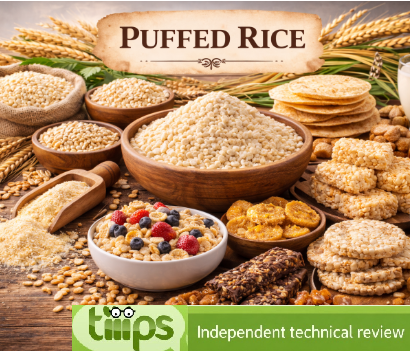
Puffed rice is an ingredient obtained from rice kernels (Oryza sativa, family Poaceae) subjected to a thermo-mechanical treatment that causes expansion of the grain (“puffing”). The result is a light, crisp product with low bulk density, a delicate flavour profile, and a variable toasted note. It is naturally gluten-free, but “gluten-free” compliance depends on supply-chain control and potential cross-contact.
Production process
Industrial methods vary (pressure puffing, extrusion/expansion, controlled toasting), but typically follow a common logic: rice hydration/conditioning, partial starch gelatinisation through heat, then rapid decompression or thermal expansion that “opens” the internal structure. This is followed by drying and moisture stabilisation, possible sieving to remove broken pieces, and packaging in moisture/oxygen barrier materials (important to preserve crispness).
Key constituents
The matrix is dominated by starch (carbohydrates), with smaller amounts of rice proteins and trace lipids. Compared with whole-grain rice, many commercial puffed rice products are made from refined rice and therefore have lower fibre content; whole-grain puffed rice versions also exist, with higher fibre and micronutrient contribution. Heat processing can generate mild toasted notes and modify starch digestibility (often making it more rapidly available).
Identification data and specifications
| Parameter | Value | Note |
|---|---|---|
| Ingredient name | Puffed rice | Available as puffed grains, spheres, or “crispies” |
| Botanical name | Oryza sativa | Family: Poaceae |
| Plant part | Caryopsis (grain) | From refined or whole-grain rice |
| Nature | Expanded cereal, crisp | Low bulk density |
| Key parameters | Moisture, bulk density, expansion level, broken fraction, colour, microbiological load | Texture and consistency drivers |
| Allergen | No (intrinsic) | Attention to gluten cross-contact risk |
| Caloric value | Typically ~360–400 kcal/100 g | Depends on moisture and added ingredients |
Physico-chemical properties (indicative)
| Property | Indicative value | Note |
|---|---|---|
| Physical state | Expanded grains/particles | Fragile, easily broken |
| Colour | White → ivory (or darker) | Depends on toasting and type (whole grain is darker) |
| Odour | Mild cereal, toasted | Variable intensity |
| Water solubility | Insoluble | Softens rapidly by absorption |
| Water uptake | High and fast | Due to porous structure |
| Stability | Good if kept dry | Key issue: loss of crispness with moisture |
| Typical criticalities | Softening, dust/breakage | Depends on moisture and handling |
Main uses
Food
Used in breakfast cereals, bars and snacks, toppings for yogurt and desserts, confectionery (e.g., crunchy inclusions), “light” baked goods, and as a texturising component in mixes. Its main contribution is immediate crispness and lightness, with a neutral taste that pairs well with cocoa, honey, nuts and flavourings.
Industrial use
Widely used as an inclusion in compounds, bars and puffed/extruded cereals, where consistent expansion, moisture control, and resistance to breakage during transport and mixing are critical.
Nutrition and health
Nutritionally, puffed rice is primarily a source of carbohydrates (starch). In many refined-rice versions, fibre and micronutrients are relatively limited; whole-grain puffed rice improves fibre and some mineral contribution at similar calorie levels. The expansion/heat process tends to make starch more “ready” for absorption, so glycaemic impact can be more pronounced than less processed grains, especially if consumed alone.
Pros
Puffed rice is light, easy to portion, and useful for adding crispness with very low intrinsic fat content. It is naturally gluten-free and is often well tolerated in diets that prioritise ingredient simplicity.
Cons
It is a starch-based ingredient with fibre often limited (if made from refined rice) and may be less favourable for glycaemic control if consumed without protein, fats or fibre. In finished products (cereals, bars), nutritional quality depends strongly on added sugars and fats in the formulation.
Serving note
Serving size depends on the application (cereal, bar, topping). For a more balanced profile, it is often useful to consume it with a protein component (milk/yogurt) and/or with nuts or seeds, depending on individual needs.
Safety (allergens, food safety)
It is not a specific allergen, but for a gluten-free claim, supply-chain segregation and controls are essential to prevent cross-contact. The most common quality issue is moisture uptake leading to loss of crispness, and potential off-odours if stored poorly. In high-temperature industrial processing, correct process control is relevant to minimise undesired thermal by-products, following industry good practices.
Storage and shelf-life
Store in a cool, dry environment in tightly sealed containers. Moisture is the critical factor: even brief exposure to humid air can rapidly reduce crispness. Barrier packaging and proper stock rotation are key.
Labelling
On-pack, it is declared as “puffed rice” (or equivalent). Any gluten-free statement must be supported by coherent requirements and controls. In composite products, note that sugars, flavours, cocoa or other ingredients can materially change the nutrition profile and allergen list.
Functional role and rationale for use
Puffed rice is primarily a texture modifier: it adds volume, crispness and lightness with a mild flavour. In bars and inclusions, it improves bite perception and can reduce density and hardness of sugary or chocolate matrices. However, its high porosity makes it sensitive to moisture and aggressive mixing steps.
Formulation compatibility
It is compatible with many sweet and semi-sweet matrices, but requires control of free water: in yogurt, creams and moist batters it softens quickly. In bars, binder choice (syrups, chocolate, compounds) and contact time with the “wet” phase determine how long crispness lasts. In coatings, a lipid barrier can improve texture stability.
Safety, regulatory and environmental aspects
For quality and compliance, implementation of GMP/HACCP is central to control contamination, traceability, pests and finished-product stability. For “gluten-free” positioning, management of cross-contact risk is a critical system point. Environmental impact mainly depends on agricultural supply and energy efficiency of the expansion process and packaging, but it is not typically a primary technical driver within the ingredient specification.
Conclusion
Puffed rice (Oryza sativa) is a functional ingredient focused on crispness and lightness, with a neutral flavour and broad versatility in cereals, snacks and bars. Key technical drivers are moisture control, mechanical integrity (breakage), and consistent expansion. Nutritionally, it is mainly a starch source: the “health” profile depends on the full recipe context and pairing with fibre, protein and fats.
Mini-glossary
Puffing: rapid grain expansion driven by heat and decompression, creating a porous structure.
Bulk density: mass per unit volume “occupied” by the product, including air in the structure; lower means lighter product.
Starch gelatinisation: starch transformation in the presence of water and heat that changes viscosity and digestibility.
Crispness: sensory property linked to brittle fracture and low moisture.
GMP/HACCP: good manufacturing practices (GMP) and the hazard analysis and critical control points (HACCP) system for food safety.

