



Whole corn flour: properties, uses, pros, cons, safety
Definition
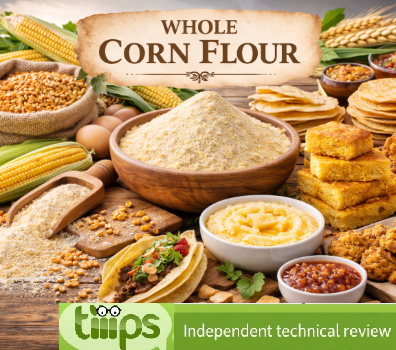
Whole corn flour is obtained by milling the corn kernel (Zea mays, family Poaceae) while retaining a significant share of the outer fractions (pericarp/“bran”) and, in part, the germ. Compared with more refined corn flour, it generally contains more fibre, a slightly higher lipid content (linked to the germ), and a more pronounced sensory profile. It is naturally gluten-free, but it may be contaminated by gluten-containing cereals if the supply chain is not dedicated.
Production process
The typical process includes cleaning and sorting the corn, possible partial or absent degermination (depending on the desired “whole” profile), then milling (stone-milled or roller-milled) and sifting to achieve the target particle size (fine flour, bramata/coarse meal, whole “fioretto”, etc.). In industrial settings, critical controls include moisture, oxidative stability (more sensitive when the germ is well represented), microbiological load, and pest prevention. For products intended for coeliac consumers, dedicated gluten-free handling of equipment and storage is central, supported by specific analytical controls.
Key constituents
The matrix mainly contains starch (dominant component), a fraction of corn proteins, dietary fibre (higher due to the outer fractions), and lipids in variable amounts linked to the germ. Trace minerals (e.g., magnesium, phosphorus, potassium) and natural pigments (carotenoids) are also present, especially in yellow varieties.
Practical note: higher lipid content (when the germ is well represented) can increase the risk of rancidity if storage and packaging do not limit oxygen and heat exposure.
Identification data and specifications
| Parameter | Value | Note |
|---|---|---|
| Ingredient name | Whole corn flour | Commercial naming may vary by particle size |
| Botanical name | Zea mays | Family: Poaceae |
| Plant part | Whole caryopsis (endosperm + outer fractions + variable germ) | The “whole” degree depends on processing |
| Nature | Starch–protein–fibre powder | Colour and aroma depend on variety and milling |
| Key parameters | Moisture, particle size, ash, lipids, microbiological load, oxidative stability | Quality and shelf-life drivers |
| Allergen | No (intrinsic) | Attention to possible gluten cross-contact in the supply chain |
| Caloric value | Typically ~340–380 kcal/100 g | Depends on moisture and lipid fraction |
| Molecular formula | Not applicable | Complex mixture |
| Molecular weight | Not applicable | Complex mixture |
Physico-chemical properties (indicative)
| Property | Indicative value | Note |
|---|---|---|
| Physical state | Powder | From fine to granular/coarse meal |
| Colour | Pale yellow → deep yellow (or white) | Depends on variety and pigments |
| Odour | Sweet cereal, “corn-like” | Rancid notes indicate oxidation |
| Water solubility | Insoluble | Forms suspensions; starch gelatinises on heating |
| Water absorption | Medium | Increases with fibre and finer particle size |
| Stability | Good if dry and protected | Key issues: oxidation (germ), moisture uptake |
| Typical criticalities | Caking, rancidity, yield variability | Depends on batch and storage |
Main uses
Food
Used in polenta and related preparations, gluten-free baked goods (bread in blends, focaccia, biscuits/cookies), breading and batters, thickening of soups and sauces, and in traditional regional recipes. Corn starch provides structure and “body”, but the absence of gluten means whole corn flour is often used in blends with other gluten-free flours and with hydrocolloids/starches to improve cohesion and softness in leavened products.
Industrial use
Used in ready mixes for polenta and bakery, breadings, and extruded snacks. Key drivers are consistent particle size, moisture control, and flavour stability over time.
Serving note
Serving size depends on the finished product (polenta, bread, biscuits/cookies, etc.). Practically, it contributes mainly carbohydrates (starch) and, in the whole version, a higher share of fibre than refined corn flour.
Safety (allergens, food safety)
Corn flour is naturally gluten-free, but “gluten-free” compliance depends on the supply chain. If intended for coeliac consumers, dedicated facilities or segregation protocols are essential, along with analytical verification of gluten. As with all flours, hygiene, pest control, and moisture management are important to limit deterioration and sensory defects.
Storage and shelf-life
Store in a cool, dry place, tightly closed, preferably in barrier packaging. Whole flours—if richer in germ—can be more sensitive to oxidation: stock rotation and protection from heat and light help prevent rancid notes.
Labelling
On labels, state “whole corn flour” and, when applicable, claim “gluten-free” only when supported by appropriate requirements and controls. If cross-contact risk exists, any precautionary statements (“may contain…”) should be managed consistently with risk assessment and applicable rules.
Functional role and rationale for use
It provides structure and texture via starch (gelatinisation during heating) and contributes characteristic corn colour and flavour. The “whole” fraction increases fibre and sensory character, but can reduce perceived fineness in some sweet applications if particle size is coarse. In gluten-free leavened products, formulation typically needs structural support (blends and rheology management) to compensate for the absence of a gluten network.
Formulation compatibility
In polenta, performance depends on particle size and water-to-flour ratio; in gluten-free bakery, blends are often preferred to improve cohesion and reduce crumbliness. In breadings, the whole fraction can deliver a more “rustic” crunch and stronger colour. If the flour is germ-rich, reducing storage time/temperature and increasing oxygen protection can help limit oxidation.
Pros and cons
Pros: naturally gluten-free (if supply chain is controlled), suitable for many gluten-free formulations.
Pros: characteristic corn sensory profile and good versatility (polenta, breadings, bakery).
Pros: whole version with higher fibre content than refined corn flour.
Cons: does not develop gluten-like structure in breadmaking; often requires blends and technological supports.
Cons: potential rancidity risk if germ is present and storage is suboptimal.
Cons: yield and texture variability linked to particle size and batch.
Safety, regulatory and environmental aspects
Allergen: none intrinsic, but attention to cross-contact with gluten-containing cereals.
Contraindications: none specific for the general population; for coeliac disease it is essential to verify a controlled “gluten-free” supply chain.
Quality and compliance: implementation of GMP/HACCP to control contamination, traceability, pests, moisture and quality parameters.
Conclusion
Whole corn flour (Zea mays) is a starch-based ingredient with a characteristic sensory profile and—when whole—higher fibre content than refined corn flour. It is naturally gluten-free, but suitability for coeliac targets depends on supply-chain control. The main drivers are particle size, moisture and oxidative stability (especially when the germ is well represented), plus formulation tuning in gluten-free baked applications.
Mini-glossary
Whole (whole grain): flour retaining a significant share of the kernel’s outer fractions and, in part, the germ.
Starch gelatinisation: starch transformation in the presence of water and heat that increases viscosity and structure (basis for polenta and thickening).
Particle size: distribution of particle dimensions; affects water absorption, texture and yield.
Oxidation: reactions that can lead to rancid notes, more likely when lipid fraction is higher (germ).
GMP/HACCP: good manufacturing practices (GMP) and the hazard analysis and critical control points (HACCP) system to manage hazards and critical points in food safety.

