



Whole grain wheat (Triticum aestivum)
Definition
In food-ingredient terms, whole grain wheat refers to the cereal Triticum aestivum (family Poaceae) used with all kernel fractions: endosperm, bran, and germ. In practical food use, the most common ingredient form is whole wheat flour, obtained by milling the entire kernel (or by controlled recombination of the fractions after milling). Compared with more refined flours, it generally contains more dietary fibre, a slightly higher lipid fraction (linked to the germ), and a more pronounced flavour profile. It is a cereal containing gluten.
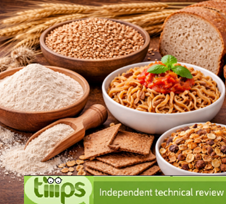
Uses by field
In food: breads and “rustic” leavened products, pizza/focaccia in blends, biscuits/cookies and shortcrust products, pancakes/waffles, crackers, breakfast items, pasta (more often in blends), coatings/breading and “coarser” thickening. In industrial use: dry mixes and bakery semi-finished products, bases for standardised whole grain items. In cosmetics: rare use (e.g., particulate in scrubs) only if the raw material is suitable and microbiologically controlled. In medical/pharmaceutical: indirect use through foods.
Production process
The typical flow includes cleaning and sorting the grain, optional conditioning to controlled moisture, then milling (stone-milling or roller milling). For a “whole” product, the process aim is to retain (or controlledly reincorporate) bran and germ, setting particle size distribution and batch-to-batch consistency. Key controls include moisture, oxidative stability (more critical due to the germ), microbiological load, potential pests, and suitability of oxygen/moisture barrier packaging.
Key constituents
The matrix mainly contains starch (structuring and gelatinising in baking), wheat proteins (including fractions linked to gluten), dietary fibre (largely in bran), a higher share of lipids than refined flours (germ), and micronutrients. Qualitatively, B vitamins (variable), vitamin E (more associated with the germ), and minerals such as magnesium, phosphorus, potassium, iron, and zinc are typically present (levels depend on variety and extraction rate).
Practical note: the presence of the germ increases susceptibility to oxidation and “rancid” notes if storage and oxygen barrier are inadequate.
Identification data and specifications
| Parameter | Value | Note |
|---|---|---|
| Ingredient name | Whole grain wheat / whole wheat flour | On labels often “whole wheat flour” |
| Botanical name | Triticum aestivum | Family: Poaceae |
| Plant part | Whole caryopsis | Endosperm + bran + germ |
| Nature | Food mixture in powder form (if flour) | Starch–protein–fibre matrix |
| Key parameters | Protein, gluten quality, ash, moisture, particle size, enzymatic activity | Technological drivers and consistency |
| Allergen | Yes: gluten (cereals containing gluten) | Not suitable for gluten-free diets |
| Caloric value | Typically ~340 kcal/100 g | Depends on moisture and extraction |
| Molecular formula | Not applicable | Complex mixture |
| Molecular weight | Not applicable | Complex mixture |
Physico-chemical properties (indicative)
| Property | Indicative value | Note |
|---|---|---|
| Physical state | Powder (if flour) | Variable particle size (fine → “rustic”) |
| Colour | Beige → brown | Increases with bran fraction |
| Water solubility | Insoluble | Forms suspensions/dough; starch gelatinises on heating |
| Water absorption | Medium–high | Increases with fibre and particle size |
| Stability | Good if dry and protected | More critical for oxidation (germ) |
| Typical criticalities | Denser doughs, reduced loaf volume, oxidative notes | Depends on batch, storage and process |
Main uses
Food
Whole wheat flour is used for baked goods with a more pronounced flavour and a “fuller” structure. In breadmaking, fibre can interfere with gluten network development and gas retention, reducing volume and open crumb when used at 100%. In practice this is managed with higher hydration, longer rests (autolyse/maturation), careful dough handling and, often, blends with stronger flours to balance structure and softness.
In biscuits/cookies and shortcrust products, whole wheat tends to yield a more friable texture and a stronger cereal note; formulas are often adjusted (fats, sugars, hydration) to maintain machinability and target texture.
Industrial use
It is common in bakery mixes and semi-finished products where rheological consistency, moisture control and flavour stability over shelf-life are critical. In standardised manufacturing, specifications on particle size and enzymatic parameters are used to reduce batch-to-batch variability.
Serving note
Serving size depends on the finished product (bread, biscuits/cookies, pizza, etc.). In general, using whole grain ingredients can increase fibre intake compared with equivalent refined-flour products, but the overall profile depends on recipe, portion and meal context.
Safety (allergens, food safety)
Contains gluten and is contraindicated for coeliac disease. From a food safety standpoint, relevant points include pest control, moisture management (spoilage risk), and proper warehouse practices; for whole wheat flours, the germ’s lipid fraction makes it more important to prevent oxidation and off-odours.
Storage and shelf-life
Store in a cool, dry place away from light and heat, in tightly closed containers. Whole wheat flours tend to lose “freshness” faster than refined flours: stock rotation and barrier packaging help limit oxidation and rancid notes.
Labelling
On-pack, state the ingredient name (e.g., “whole wheat flour”) and declare the allergen cereals containing gluten as required. Any claims (e.g., “whole grain/wholemeal”) should be consistent with the actual composition and applicable rules.
Functional role and rationale for use
Technologically, whole wheat combines the structural function of gluten with the “bulk” contribution of starch; bran introduces fibre that binds water and can disrupt continuity of the gluten network. The typical result—at equal process conditions—is a more “dense” and aromatic product. In return, it supports “whole grain/rustic” positioning and a characteristic sensory profile.
Formulation compatibility
In breadmaking and leavened goods, it is often beneficial to increase hydration and rest times to improve extensibility and development. In blends with stronger flours, volume and crumb openness improve without losing the whole wheat signature. In sweet baked goods, whole wheat can make cereal notes dominant: balance is achieved through fats/sugars and, when needed, finer milling to “clean up” texture.
Pros and cons
Pros: stronger whole grain perception; contribution of fibre and a more characteristic flavour profile than refined flours.
Pros: versatile in blends for bakery; good control of the finished product “personality”.
Cons: contains gluten (not suitable for coeliacs).
Cons: often denser doughs and lower volume when used alone; higher susceptibility to oxidation if storage is suboptimal.
Safety, regulatory and environmental aspects
From a regulatory/food perspective, correct management of the allergen (cereals containing gluten) and implementation of GMP/HACCP across the supply chain are central to prevent contamination and ensure traceability and consistency. Practically, for whole wheat it is particularly important to control moisture and limit oxygen exposure to reduce oxidative sensory defects.
Conclusion
Whole grain wheat (Triticum aestivum) is a key ingredient for bakery and preparations with a “whole grain” profile, where fibre, bran and germ define both technological performance and sensory outcome. The main drivers are batch quality (protein/gluten and enzymatic activity), hydration and time management in dough, and correct storage to reduce oxidative criticalities.
Mini-glossary
Whole grain / wholemeal: product that retains (or controlledly recombines) bran and germ in addition to the endosperm.
Bran: outer kernel fraction associated with fibre and part of the mineral content; affects water absorption and dough structure.
Germ: seed fraction with higher lipid content; adds complexity but increases oxidation risk.
Gluten: protein network (mainly wheat protein fractions) providing elasticity and gas-holding capacity in leavened doughs.
Ash: indicator of mineral fraction; tends to increase with higher extraction (“more whole”).
GMP/HACCP: good manufacturing practices (GMP) and the hazard analysis and critical control points system (HACCP) for managing food safety hazards.

