



Natural anise flavour (Pimpinella anisum)
Definition
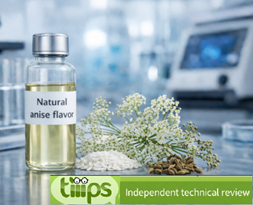
Natural anise flavour is a plant-derived flavouring ingredient obtained from Pimpinella anisum (family Apiaceae), used to deliver a characteristic “sweet, spicy, liquorice-like” olfactory–gustatory profile. In food applications, the term “natural flavour” generally refers to a flavouring preparation obtained from natural raw materials (e.g., by distillation/extraction), which may be supplied as an essential oil, distillate, extract, or as a solution in a carrier (ethanol, glycols, triacetin, etc.), depending on the producer’s specification.
Application fields: food (flavouring), cosmetics (fragrance and sensory role in suitable formulas), medical/pharmaceutical (limited use as a flavouring in some oral forms), industrial use (ingredient systems for beverages, bakery, confectionery, and premixes).
Production process
Production varies by commercial form:
Steam distillation of the fruits (seeds) to obtain an essential oil rich in characteristic volatile components.
Extraction with food-grade solvents followed by removal/standardization (to obtain extracts with a defined aromatic profile).
Formulation of the flavour into a carrier (e.g., ethanol or hydro-glycolic systems) to improve dosing, miscibility, and stability in the target matrix.
Standardization: aromatic profile, purity, contaminant limits, compatibility, and stability (oxygen/light/temperature).
Key constituents
Characteristic volatile components (trans-anethole as a representative); other terpenes and aromatic trace compounds (profile depends on process and batch); carrier components (ethanol, glycols, or others if present); variable residual water in solutions; natural impurities and minor constituents within specification.
Practical note: the actual chemical profile is strongly dependent on botanical origin, agronomic conditions, distillation/extraction, and producer standardization.
Identification data and specifications
| Characteristic | Value | Note |
|---|---|---|
| Ingredient name | Natural anise flavour | Form: essential oil, extract, or solution |
| Botanical name | Pimpinella anisum | Family: Apiaceae |
| Plant part | Fruits (seeds) | Typical raw material |
| Nature | Mixture of natural flavouring compounds | Often rich in volatiles |
| Commercial form | Liquid (most common) | Sometimes supported on carriers/powders |
| Key parameters | Aromatic profile, assay, impurity limits, solvents/carriers, stability | Drivers of reproducibility |
| Allergen | Generally no (not a typical major allergen) | Individual sensitivities possible |
| Caloric value | Variable | Often negligible at use levels; carrier-dependent |
Physicochemical properties (indicative)
| Characteristic | Indicative value | Note |
|---|---|---|
| Physical state | Liquid | Oil or solution |
| Color | Colorless → pale yellow | Batch and oxidation dependent |
| Odor | Anise, sweet-spicy | Driven by volatiles |
| Water solubility | Low (oil); variable (solution) | Improved with ethanol/glycols |
| Oil-phase solubility | Good | Easier in fat-rich matrices |
| Stability | Moderate–good | Sensitive to light/oxygen/temperature |
| Typical criticalities | Haze in beverages, aromatic drift, oxidation | Matrix and packaging dependent |
Main uses
Food
Used to flavour liqueurs and beverages (including anise-flavoured products), baked goods, biscuits, confectionery, creams, ice cream, and syrups. In aqueous matrices it may cause opalescence/haze (“louche effect”) if the oil fraction is not adequately solubilized or emulsified; incorporation is generally easier in fat-rich matrices.
Serving note
Use levels are typically low (high-impact flavour). Nutritional impact is generally negligible compared with the food matrix.
Safety (allergens, food)
Not a typical major allergen, but natural flavours rich in volatiles may be irritating/sensitizing in predisposed individuals, especially at higher concentrations. Quality is driven by purity, contaminant limits, and control of solvents/carriers.
Storage and shelf-life
Store tightly closed, away from light and heat. Minimizing oxygen exposure (headspace, quick resealing) helps preserve the aromatic profile.
Labelling
In foods it can be declared as “natural anise flavour” according to applicable rules. If it contains solvents/carriers subject to declaration or specific limits, they must be managed in line with specifications and regulations.
Cosmetics
Possible use for fragrance and sensory effects (especially in wash-off products or targeted fragrance profiles), with compatibility and tolerance assessment.
INCI functions.
Medical and pharmaceutical
Use as a flavouring in certain oral formulations (e.g., syrups or palatable preparations) only with suitable grades and dedicated specifications.
Industrial use
Used in premixes and beverage/bakery bases, where profile standardization and storage stability are decisive for finished-product consistency.
Functional role and use rationale
Its primary function is to deliver a strong, recognizable flavour signature at low dosage. Sensory performance depends on volatility, solubilization, and interactions with the matrix (sugars, fats, alcohol, emulsifiers). In beverages and syrups, solubility management is often the most critical technical point to avoid unwanted haze.
Formulation compatibility
In aqueous systems, compatibility depends on the carrier and on the presence of co-solvents or emulsifiers; addition temperature and order of addition can influence clarity. In alcoholic systems, solubility is generally better. In fat-rich products (creams, chocolate), incorporation is simpler but aromatic stability (oxidation) and possible migration into packaging must be controlled.
Pros and cons
Pros
Highly distinctive, high-impact flavour profile (low use levels).
Good versatility in confectionery, bakery, and beverages (especially alcoholic).
Multiple commercial forms (oil/solution) allow optimization of miscibility and dosing.
Cons
Potential haze/opalescence in aqueous beverages if not properly solubilized.
Light/oxygen sensitivity with risk of aromatic drift over time.
Variable tolerance in sensitive individuals, especially at higher concentrations.
Safety, regulatory, and environment
Allergen
Generally no (not among typical major allergens), but individual sensitivities are possible.
Contraindications
Caution in cases of hypersensitivity to intense flavours/essential oils. In the finished product, concentration and matrix drive tolerance.
Regulatory/quality note
Supplier compliance on specifications (profile, solvents/carriers, contaminants) and GMP/HACCP management in the food chain are central. The wording “natural flavour” must be consistent with definitions and the producer’s technical documentation.
Conclusion
Natural anise flavour (Pimpinella anisum) is a high-impact plant-derived flavouring, available in multiple forms (oil/extract/solution) that determine miscibility and stability. The main drivers for reproducible performance are aromatic profile standardization, solubility management (especially in aqueous systems), oxidation protection, and correct grade selection for the target matrix and process.
Mini-glossary
Trans-anethole: key volatile component of anise, responsible for much of its characteristic note.
Louche effect: opalescence/haze caused by micro-droplet separation of oil in aqueous systems when solubility is insufficient.
Carrier: solvent or support (e.g., ethanol, glycols) used to improve flavour dosing and miscibility.
GMP/HACCP: good manufacturing practices and a food safety management system for food safety and contamination prevention.

