



Raspberry powder (Rubus idaeus)
Definition
Raspberry powder is produced from raspberry fruit (Rubus idaeus, family Rosaceae) that is dehydrated and then milled into a powder. Common technologies include hot-air drying (with potential impacts on color/aroma) or freeze-drying (generally better at preserving sensitive compounds and sensory profile). The product may be “100% fruit” or formulated with carriers (e.g., maltodextrin) to improve flowability and reduce hygroscopicity, depending on the commercial specification.
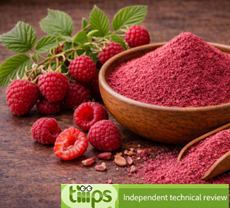
Application fields: food (flavor/color, ingredient systems), cosmetics (possible use as a botanical powder in scrubs/masks with a suitable grade), medical/pharmaceutical (indirect use; as a food ingredient in supplements), industrial use (premixes, dry blends, flavoring systems).
Production process
A typical process includes: fruit selection and washing, optional partial seed removal/sieving (specification-dependent), then dehydration via controlled drying or freeze-drying. Milling follows, then sieving to define particle size, optional blending with a carrier (if required), microbiological control, and packaging in moisture- and oxygen-barrier materials (critical for color and aroma retention).
Key constituents
Dietary fiber; natural sugars; organic acids (citric and malic acids as representatives); phenolic compounds (anthocyanins as representatives); vitamin C (variable and process-sensitive); trace minerals (potassium among the main ones); pectins; seed fractions and trace oils (depending on filtration); low residual water. If a carrier is present: maltodextrins or other supports as per the label.
Practical note: the powder is often hygroscopic and tends to compact; color stability (anthocyanins) is sensitive to pH, oxygen, light, and temperature.
Identification data and specifications
| Characteristic | Value | Note |
|---|---|---|
| Ingredient name | Raspberry powder | 100% fruit or with carrier |
| Botanical name | Rubus idaeus | Family: Rosaceae |
| Plant part | Fruit | Plant-derived raw material |
| Nature | Dehydrated fruit powder | Rich in fiber and phenolic compounds |
| Key parameters | Moisture, water activity, particle size, color, microbiology | Drive stability and flowability |
| Allergen | Generally no | Individual sensitivities possible |
| Caloric value | Variable: typically ~250–380 kcal/100 g | Depends on pure fruit vs carrier |
Physicochemical properties (indicative)
| Characteristic | Indicative value | Note |
|---|---|---|
| Physical state | Powder | Fine to coarser |
| Color | Pink → purplish red | Driven by anthocyanins and process |
| Odor | Fruity | Can fade with oxidation |
| Water solubility | Dispersible, not fully soluble | Fiber and particulates contribute |
| Hygroscopicity | Medium–high | Lumping/caking risk |
| Stability | Moderate | Sensitive to light, O₂, and moisture |
| Typical criticalities | Caking, color/aroma loss, browning | Driven by moisture and oxidation |
Main uses
Food
Used to flavor and color yogurt, ice cream, creams, bakery, chocolate, powdered beverages, and bars. It adds fruity notes and some fiber; in aqueous products it may cause haze or sedimentation if particle size is large or if seed fractions are present.
Serving note
Typically 2–10 g per serving as a flavor/color ingredient, depending on the finished product and target intensity.
Safety (allergens, food)
Not a typical allergen; however, microbiological control is important because the powder may be used in ready-to-eat products. Individual sensitivities to red berries are possible.
Storage and shelf-life
Store in tightly closed containers away from moisture, light, and heat. After opening, minimize air exposure. Carrier-containing powders tend to be more free-flowing and less prone to lumping than 100% fruit powders.
Labelling
Declare “raspberry powder” and, if present, carriers (maltodextrin, etc.). Claims such as “100% fruit” or “freeze-dried” must match supplier specifications and documentation.
Cosmetics
Possible use as a botanical powder in scrubs and masks, contributing color and sensory feel. Cosmetic use requires dedicated specifications (microbiology, metals, contaminants).
INCI functions.
Medical and pharmaceutical
Indirect use; may be included in supplements as a food ingredient, with quality requirements aligned to the intended use.
Industrial use
Used in premixes and dry blends, where color consistency, particle size, and storage stability are central drivers.
Functional role and use rationale
Its primary function is to deliver natural flavor and color (anthocyanins) in a dry, doseable form. Fiber and pectins influence texture and rheology in aqueous matrices. Freeze-drying, when used, generally preserves sensitive compounds and sensory intensity better than more aggressive drying.
Formulation compatibility
In aqueous products, dispersion depends on particle size and fiber/seed content: preblending with sugar or other dry solids can help reduce lumping. In acidic matrices, color may be more stable, while at higher pH anthocyanins can shift hue and degrade. In fat-rich systems (chocolate, anhydrous creams), behavior depends on residual moisture: excessive moisture can cause pasting or clumping.
Pros and cons
Pros
Practical dry format with good aromatic and color intensity (especially freeze-dried).
Easy dosing and use in premixes and dry blends.
Possible contribution of fiber and phenolic compounds.
Cons
Hygroscopicity and lumping tendency, especially for 100% fruit powders.
Color sensitivity to oxygen, light, pH, and temperature.
Batch-to-batch variability linked to origin, ripeness, and process (color/aroma).
Safety, regulatory, and environment
Allergen
Generally no (not a typical major allergen). Individual sensitivities are possible.
Contraindications
For individuals sensitive to red berries, tolerance should be assessed. In sugar-controlled regimens, consider natural sugar content and any added carrier.
Regulatory/quality note
Specifications on microbiology, contaminants, and traceability are central; in the food chain, GMP/HACCP drives safety. Claims such as “freeze-dried” or “100% fruit” must align with documentation and specifications.
Storage and shelf-life
Shelf-life is mainly driven by moisture uptake and oxidation. Barrier packaging (moisture and oxygen), cool/dark storage, and minimizing headspace air after opening help preserve color and aroma.
Conclusion
Raspberry powder (Rubus idaeus) is a functional ingredient for natural flavor and color in a dry format, with performance strongly influenced by the process (freeze-dried vs air-dried), residual moisture, and oxygen management. The key drivers are chromatic stability (anthocyanins), control of hygroscopicity and microbiology, and selection of grade (100% fruit vs with carrier) based on application and target shelf-life.
Mini-glossary
Freeze-drying: water removal by sublimation at low temperatures; better preserves aroma and sensitive compounds.
Anthocyanins: phenolic pigments responsible for red–purple color; sensitive to pH, light, and oxygen.
Water activity (aᵥ): measure of water available for reactions and microbial growth; low aᵥ improves stability.
GMP/HACCP: good manufacturing practices and a food safety management system for food safety and contamination prevention.

