



Raw beet sugar: properties, uses, pros, cons, safety
(Beta vulgaris)
Definition
Raw beet sugar is a sweetening ingredient obtained from sugar beet (Beta vulgaris, family Amaranthaceae) through sucrose extraction and crystallization, with a lower refining level than white sugar. “Raw” generally indicates the residual presence of non-sugar components (trace molasses, mineral salts, and coloring compounds) that influence color, aroma, and technological behavior. In practice, it may appear as darker crystals with slightly warmer sensory notes than highly refined sugar.
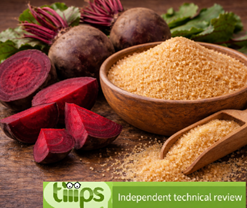
Application fields: food (sweetener and bulking/structuring agent), cosmetics (scrubs and exfoliating products, if the grade is suitable), medical/pharmaceutical (limited use as a sweetening excipient in some formulations), industrial use (ingredient supply for bakery, beverages, and fermentations).
Production process
A typical industrial process includes: washing and slicing beets, diffusion in hot water to extract sugary juice, juice purification (lime–carbonation or equivalent processes to remove impurities), evaporation to concentrate the syrup, then sucrose crystallization and separation of crystals from the mother liquor (molasses). For “raw” sugar, the subsequent refining stage (decolorization, further purification) is reduced or partial, preserving a higher fraction of residual components.
Key constituents
Sucrose; residual water (trace, drying-dependent); trace molasses components (pigments, aroma compounds); mineral salts (potassium, calcium, magnesium in traces); minor nitrogenous and organic compounds in traces (variable by supply chain and grade); possible micro-traces of process-related substances within specification (producer-dependent).
Identification data and specifications
| Characteristic | Value | Note |
|---|---|---|
| Ingredient name | Raw beet sugar | Reduced-refining sugar |
| Botanical name | Beta vulgaris | Family: Amaranthaceae |
| Plant part | Root (sugar beet) | Sucrose source |
| Nature | Crystalline carbohydrate | Predominantly sucrose |
| Key parameters | Polarization (sugar content), moisture, color, ash | Drive quality and reproducibility |
| Allergen | Generally no | Cross-contact may apply by supply chain |
| Caloric value | Typically ~400 kcal/100 g | Almost entirely carbohydrates |
Physicochemical properties (indicative)
| Characteristic | Indicative value | Note |
|---|---|---|
| Physical state | Crystals/granules | Particle size varies |
| Color | Beige → light brown | Driven by molasses residues and ash |
| Odor | Sweet, mild “warm” note | Variable by lot and grade |
| Water solubility | Very high | Slower with large crystals |
| Hygroscopicity | Low to moderate | Can increase with molasses residues |
| Stability | High when dry | Moisture-sensitive (caking) |
| Typical criticalities | Lumping, color/aroma variability, caramelization during heating | Driven by moisture and residual profile |
Main uses
Food
Used as a sweetener in baked goods, biscuits, creams, beverages, and preserves. Beyond sweetness, it contributes structure (bulk), water activity reduction, and sensory stability. In bakery, it supports browning reactions and may intensify slightly more “toasted” notes than highly refined sugar, depending on processing and trace molasses content.
Serving note
For nutrition labelling and dietary management, a practical serving may be 5–10 g as a sweetener, but impact depends on the finished product and consumption frequency.
Safety (allergens, food)
Not a typical allergen. Main quality/safety aspects concern purity, contaminants within applicable limits, and correct storage to prevent moisture uptake and agglomeration.
Storage and shelf-life
Store in a cool, dry place in closed, moisture-barrier containers. Moisture absorption can cause lumps and changes in flowability; ambient odors may be absorbed more easily if packaging is not adequate.
Labelling
Typically declared as “sugar” or “beet sugar,” with an optional “raw” specification depending on commercial positioning and applicable rules. Claims such as “unrefined” must be used carefully and aligned with permitted definitions and product specifications.
Cosmetics
Used as an abrasive/solid phase in scrubs and exfoliating products, where particle size determines aggressiveness and sensory feel. Cosmetic use requires dedicated specifications (microbiology, metals, contaminants) and a purity profile consistent with the finished product.
INCI functions.
Medical and pharmaceutical
Limited use as a sweetener or carrier in certain preparations when compatible with pharmaceutical-quality requirements (dedicated grades are more common).
Industrial use
Used as a fermentable sugar source (leavening, fermentations) and as a standardizing ingredient at scale; controlling moisture, color, and batch-to-batch consistency is central.
Functional role and use rationale
Sucrose provides sweetness and formulation “bulk”; in raw sugar, trace molasses components can modulate color and aroma and, in some cases, slightly increase hygroscopicity and caking tendency. During heating, sugar contributes to caramelization and browning reactions, influencing color and aromatic notes in finished products.
Formulation compatibility
Compatible with most food matrices, but particle size affects dissolution and texture (coarse crystals in toppings, finer in doughs). In humid products or high relative humidity environments, it may agglomerate: water management and packaging are decisive. In acidic or high-temperature systems, browning may be more evident; reproducibility requires control of lot color and ash profile.
Pros and cons
Pros
Slightly more characterful sensory profile than white sugar, with more color and aromatic notes.
Good technological functionality as sweetener and bulking agent.
“Less refined” positioning can be useful for certain product lines.
Cons
Higher batch-to-batch variability (color, aroma, ash) than highly refined grades.
Potentially higher lumping tendency under humidity exposure.
May undesirably darken the final color in some applications (bakery, light-colored creams).
Safety, regulatory, and environment
Allergen
Generally no. Cross-contact management remains relevant depending on the supply chain and facility.
Contraindications
In glycemic- or calorie-controlled regimens, simple sugar intake is the primary factor; portion size and consumption frequency are practical drivers.
Regulatory/quality note
Compliance depends on specifications (polarization, moisture, ash, color, contaminants) and on GMP/HACCP implementation in the supply chain. Commercial terms like “raw” or “unrefined” should be consistent with applicable definitions and standards.
Conclusion
Raw beet sugar (Beta vulgaris) is a sucrose-based sweetener with reduced refining, characterized by a more pronounced color and aromatic profile than white sugar and potentially greater technological variability. The main drivers for reproducible performance are control of moisture, color/ash, particle size, and proper storage to limit caking and sensory drift.
Mini-glossary
Sucrose: disaccharide (glucose + fructose) responsible for the main sweetness of sugar.
°Brix: measure of soluble solids in sugar solutions; useful for syrups and beverages.
Caking: lumping/compaction due to moisture uptake and surface recrystallization.
GMP/HACCP: good manufacturing practices and a food safety management system for food safety and contamination prevention.

