



Puffed durum wheat (Triticum durum)
Definition
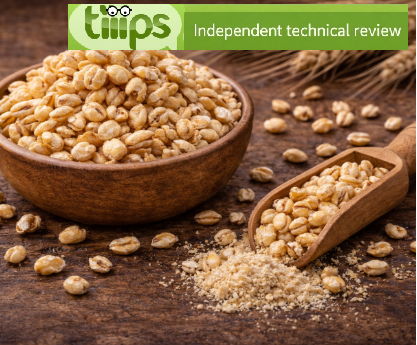
Puffed durum wheat is a cereal product made from Triticum durum (family Poaceae) subjected to a high-energy thermal process that causes rapid expansion (“puffing”) of the kernel or of semolina-based intermediates. The result is a porous, lightweight structure with reduced bulk density and increased crispness. Compared with the untreated grain, puffing significantly modifies starch structure (gelatinization and partial dextrinization), affecting texture, digestibility, and behavior in food matrices.
Main application fields: food (breakfast cereals, snacks, bars, crunchy inclusions for yogurt/desserts), cosmetics (rare and generally not relevant; starch derivatives are more common), medical/pharmaceutical (indirect use as a dietary base in controlled regimens where applicable), industrial use (semi-finished ingredient for mixes, extruded products, or “light”/aerated items).
Production process
Puffing can be achieved with different technologies, generally based on: conditioning the cereal (controlled moisture), rapid heating (hot air, steam, or short-cook extrusion), pressurization, and instantaneous depressurization, which drives expansion via flash evaporation of trapped water. Some supply chains use whole kernels, others start from agglomerated semolina granules. Critical parameters include initial moisture, thermal profile, pressure, residence time, and final cooling/drying to reach a water activity compatible with shelf-life and crispness.
Identification data and specifications
| Characteristic | Value | Note |
|---|---|---|
| Ingredient name | Puffed durum wheat | Expanded cereal product |
| Botanical name | Triticum durum | Family: Poaceae |
| Plant part | Caryopsis / agglomerated semolina | Depends on technology |
| Nature | Expanded cereal | Starch matrix with porous structure |
| Key parameters | Bulk density; crispness; moisture/water activity; piece integrity | Main sensory quality drivers |
| Caloric value | About 340–380 kcal/100 g | Depends on moisture and any additions |
Physicochemical properties (indicative)
| Characteristic | Indicative value | Note |
|---|---|---|
| Physical state | Solid, porous pieces | Fragile, easily crumbled |
| Color | Straw-yellow → golden | Depends on thermal treatment |
| Odor | Light toasted cereal | “Burnt” notes indicate overprocessing |
| Water solubility | Not soluble | Absorbs water and loses crispness |
| Texture | Crispy, lightweight | Sensitive to ambient humidity |
| Stability | Good if dry and well packaged | Crispness loss risk with moisture |
| Key constituents (representative) | Thermally modified starch; gluten proteins; fiber (if whole) | Profile depends on refinement level |
Main uses
Food
Used in breakfast cereals, snacks, and bars as a crunchy low-density component. Works well as an inclusion in yogurt and desserts, but requires moisture protection to avoid texture loss. In bars, compatibility depends on the binder (syrups, honey, fats) and the ability to maintain crispness over time.
Serving note
Serving sizes vary with the finished product; as a component of cereals or bars, even 20–40 g can contribute meaningfully to carbohydrate and calorie intake.
Safety (allergens, food)
Contains gluten (durum wheat) and is contraindicated for people with celiac disease. Additional aspects include cross-contact management and supply-chain contaminant control (mycotoxins), within quality plans.
Storage and shelf-life
Store in moisture-barrier packaging in a cool, dry environment. Once opened, moisture uptake quickly reduces crispness; shelf-life depends mainly on packaging integrity and water activity.
Industrial use
Semi-finished ingredient for aerated products and mixes, where bulk density, crispness, and moisture stability are critical.
Functional role and use rationale
The value of puffed durum wheat is primarily structural and sensorial: it provides crispness and a “light” perception due to the porous structure. From a technological standpoint, starch is already partially gelatinized, so the product tends to absorb moisture and soften. Formulation and packaging must therefore minimize water transfer (dry matrices, low-water-activity binders, vapor barriers).
Formulation compatibility
Compatible with dry mixes and with sugary or fat-based binders, but it performs poorly in high-moisture matrices. In yogurt and desserts, crispness is preserved only with separated inclusions or with coatings/barriers. In bars, highly hygroscopic syrups can accelerate softening. Controlling finished-product water activity is often the main driver of sensorial stability.
Pros and cons
Pros
Provides crispness and apparent volume at relatively low weight.
Versatile as an inclusion in cereals, snacks, and bars.
Processing can develop pleasant toasted notes.
Cons
Loses crispness rapidly in the presence of moisture; requires appropriate packaging and formulation.
Contains gluten.
If the process is too intense, burnt notes may appear and fragility increases, generating excess fines.
Safety, regulatory, and environment
Allergen
Yes: gluten (durum wheat).
Contraindications
Not suitable for gluten-free diets. In glycemic-control regimens, the expanded structure and thermally modified starch may promote faster carbohydrate availability than less processed forms, so portion size and meal context should be managed.
Regulatory/quality note
Labelling and claims must be consistent with the finished product. GMP/HACCP controls remain central for cross-contact, safety, and batch-to-batch consistency.
Storage and shelf-life
The primary critical factor is moisture: packaging should have good vapor barrier properties, and post-opening handling should limit humidity exposure (resealing, airtight containers). In storage, avoid high temperatures and high relative humidity, which accelerate crispness loss and sensorial degradation.
Conclusion
Puffed durum wheat (Triticum durum) is a cereal semi-finished ingredient designed to deliver crispness and “lightness” through the porous structure created by puffing. Performance depends mainly on moisture management (water activity, binders, and packaging), which is the primary driver for maintaining texture. From a safety perspective, gluten is the main constraint; from an application perspective, format selection and moisture barriers determine stability and reproducibility of the sensorial result.
Mini-glossary
Puffing: rapid expansion of cereal via heating/pressurization and sudden depressurization, creating a porous structure.
Water activity (aw): measure of “available” water that governs crispness and stability; the higher it is, the more the product softens.
Gelatinization: transformation of starch with water and heat; in puffed products it occurs rapidly and partially.
GMP/HACCP: good manufacturing practices and a food safety management system for food safety and contamination prevention.

