



Hazelnut paste: properties, uses, pros, cons, safety
(Corylus avellana)
Definition
Hazelnut paste is a semi-finished ingredient obtained by fine grinding hazelnuts (Corylus avellana, family Betulaceae) until a creamy paste is formed, with variable fluidity. It is a matrix naturally rich in lipids (hazelnut oil), with a solid phase made of finely ground hazelnut particles (proteins, fiber, minerals). Rheology and stability depend on particle size distribution, processing temperature, optional roasting, and management of oil separation during shelf-life.
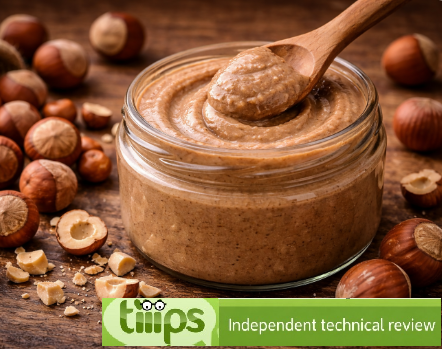
Main applications are in food (spreads, gelato, pastry, fillings, pralines), only indirectly in medical/pharmaceutical (as excipients/flavoring in specific products, subject to requirements), and in industrial use as a lipid–protein base for formulations and semi-finished products. In cosmetics, direct use of food-grade paste is uncommon; hazelnut derivatives (hazelnut oil) are more typical in emollient products.
Production process
The typical process includes selection and cleaning of hazelnuts, optional roasting (aroma development, moisture reduction, rheology changes), cooling, removal of skins (if required), and multi-stage grinding to the desired fineness. A final refining step is often used to stabilize texture and improve “smooth” perception. For industrial applications, standardization may be performed for oil content, moisture, and particle size, along with controls for oxidation (peroxide value), microbiology, and contaminants (e.g., aflatoxins, depending on the control plan).
Identification data and specifications
| Characteristic | Value | Note |
|---|---|---|
| Ingredient name | Hazelnut paste | 100% hazelnuts or hazelnut base (if added ingredients) |
| Botanical name | Corylus avellana | Family: Betulaceae |
| Plant part | Seed (hazelnut) | Lipid–protein raw material |
| Nature | Paste/semi-finished product | Mixture of lipids + fine solids |
| Commercial form | Creamy paste | Fluidity depends on temperature and grade |
| Key parameters | Particle size; oil content; moisture; peroxide value | Drive texture and stability |
| Caloric value | Typically ~600–650 kcal/100 g | Depends on lipid content and any additions |
Physicochemical properties (indicative)
| Characteristic | Indicative value | Note |
|---|---|---|
| Physical state | Semi-fluid paste | More fluid when warmer or higher in oil |
| Color | Beige → brown | Darker when roasted |
| Odor | Typical hazelnut; stronger when roasted | Rancid notes indicate oxidation |
| Water solubility | Not soluble | Dispersible; oil phase separation may occur |
| Oxidative stability | Moderate | Depends on storage, oxygen, light, temperature |
| Oil separation | Possible | Depends on particle size and processing |
| Key constituents (representative) | Lipids: oleic acid, linoleic acid; proteins; fiber; tocopherols; phytosterols | Profile depends on cultivar and roasting |
Main uses
Food
Used as an aromatic and structural base in spreads, fillings, ganache, pralines, gelato, and semifreddo. It provides flavor, fat richness, and body, contributing to creamy textures. In baked goods it can be used in doughs or fillings; in gelato it supports mouthfeel and structural stability depending on balance with sugars and total solids.
Serving note
In finished preparations servings vary widely; as a pure ingredient, 10–30 g is already nutritionally meaningful due to the high lipid content.
Safety (allergens, food)
Hazelnut is a major allergen. Cross-contact management and correct label declaration are essential. Additional safety aspects include moisture and microbiological control, plus contaminant plans (notably aflatoxins, per applicable requirements).
Storage and shelf-life
Store tightly closed in a cool, dry environment, protected from light and oxygen. Avoid thermal stress that accelerates oxidation and oil separation. Shelf-life depends on roasting level, natural antioxidant content, and packaging.
Labelling
Label must clearly declare hazelnuts as an allergen. For blends/bases, any added ingredients (sugars, oils, emulsifiers) must also be declared.
Cosmetics
Use of the food-grade paste is uncommon; hazelnut oil is more typical as an emollient in body and facial products, where lipid profile and oxidative stability matter.
Medical and pharmaceutical
Rare and mostly indirect use (flavoring or carrier forms), subject to quality and intended-use requirements.
Industrial use
Semi-finished ingredient for confectionery lines and ingredient supply; in industrial contexts, standardization of particle size, aroma consistency, and oxidation parameters is critical for batch-to-batch reproducibility.
Functional role and use rationale
Hazelnut paste plays both a sensorial role (aroma, roasted notes, roundness) and a technological role (a lipid phase that plasticizes and increases creaminess). It is also structuring: its interaction with sugars, cocoa, and milk powders affects viscosity, spreadability, and stability over time. The balance between oil phase and solids (particle size) drives oil separation and “smooth” vs “grainy” perception.
Formulation compatibility
Compatible with lipid systems and many confectionery bases, but in the presence of free water it can lead to instability (phase separation, texture drift). In spreads, compatibility depends on emulsifiers, particulate load, and fat balance (hazelnut, cocoa, any added fats). In gelato, lipids and solids must be balanced to avoid excess free fat and structure defects. In cocoa-containing products, lipid migration may affect bloom and firmness if not managed.
Pros and cons
Pros
Premium sensorial profile, with high acceptability and strong differentiation potential.
Supports creaminess and structure across many confectionery applications.
Contains predominantly unsaturated lipids and minor components (tocopherols, phytosterols) of nutritional interest, while remaining energy-dense.
Cons
Major allergen: requires strict management and limits for sensitive consumers.
Risk of oxidation (rancidity) and oil separation if storage and process are not controlled.
High energy density: meaningful nutritional impact when used in significant amounts.
Safety, regulatory, and environment
Allergen
Yes: hazelnuts (tree nuts). Cross-contact risk management and correct labelling are essential.
Contraindications
Contraindicated for individuals allergic to hazelnut. In calorie- or lipid-controlled diets, portion size should be moderated.
Regulatory/quality note
Compliance depends on allergen requirements, contaminant limits (e.g., aflatoxins), microbiology, and traceability. GMP/HACCP procedures are central to prevent contamination and ensure consistent quality.
Practical/formulation troubleshooting
Oil separation in spreads: optimize particle size distribution, increase fine solids fraction, evaluate compatible emulsifiers/fat structuring agents, improve cooling and storage conditions.
Rancidity over shelf-life: reduce oxygen/light exposure, use barrier packaging, optimize roasting, and control oxidation indices.
Excessively thick texture: adjust process temperature, balance oil content, and modify particle size and shear.
Perceived graininess: increase refining, control particles, and check for unintended crystallization of sugars or fats in the finished formula.
Conclusion
Hazelnut paste (Corylus avellana) is a high-value sensorial and technological semi-finished ingredient, essential in pastry and gelato for delivering aroma, fat richness, and structure. Performance and stability depend mainly on controlling particle size, oxidation, and oil separation, as well as correct design of the final matrix (fat and solids balance). From a safety standpoint, the presence of the hazelnut allergen and contaminant control remain the key drivers for compliant and reproducible production.
Mini-glossary
Particle size distribution: size distribution of solid particles in the paste; affects texture, creaminess, and stability.
Oil separation: migration of the lipid phase to the surface during storage; depends on structure and particles.
Oxidation: lipid degradation leading to rancid off-notes; accelerated by oxygen, light, and heat.
GMP/HACCP: good manufacturing practices and a food safety management system for food safety and contamination prevention.

