



Ursoloyl tripeptide-1: properties, uses, pros, cons, safety
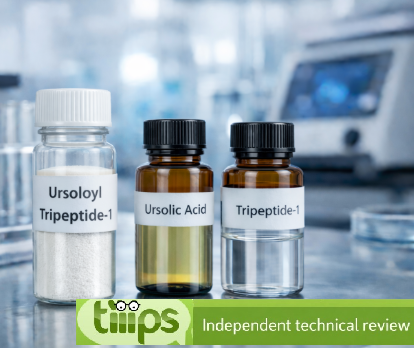
Ursoloyl tripeptide-1 is a lipophilic–peptidic conjugate obtained by reaction between ursolic acid (a plant-derived pentacyclic triterpene, structurally isomeric with oleanolic acid) and Tripeptide-1 (a three–amino acid peptide under INCI nomenclature). Attaching a lipophilic triterpene fragment to the peptide is designed to increase affinity for the skin barrier and keratinized surfaces, improve deposition and persistence in the superficial film, and support a functional positioning oriented to protection and conditioning.
Definition
Ursoloyl tripeptide-1 is an acylated derivative: a tripeptide linked to an “ursoloyl” group derived from ursolic acid. From a formulation standpoint, the lipophilic portion promotes interaction with interfaces and lipid-rich domains (stratum corneum, skin surface film; partly also the hair fiber), while the peptide portion contributes to the typical functional profile of cosmetic peptides (sensory/conditioning and support to barrier function). The commercial INCI definition remains “Ursoloyl tripeptide-1”; physical form, salt form, carrier, assay, and impurity profile depend on the supplier (raw material supplied as a powder or, more often, as a solution/concentrate).
Production process and key constituents
How it is produced (summary)
Synthesis or sourcing of Tripeptide-1 (peptidic phase).
Activation of ursolic acid (or a derivative) to make it suitable for coupling.
Conjugation reaction (formation of the coupling bond, typically via coupling chemistry).
Purification and removal of reagents/by-products.
Standardization (conjugate assay, impurity limits) and optional formulation into a carrier (e.g., glycol-based systems or hydro-glycolic blends) to facilitate cosmetic use.
Typical raw materials / reagents (industrial practice)
Ursolic acid (or activated derivatives).
Tripeptide-1 (free form or as a salt).
Coupling agents (carbodiimide class or equivalents; alternative processes possible).
Organic bases for pH control/neutralization.
Process solvents (removed or controlled to specification).
Relevant components in the finished product (categories)
Main conjugate: Ursoloyl tripeptide-1.
Secondary/specification-controlled impurities: residual ursolic acid, residual Tripeptide-1, neutralization salts/inorganics (process-dependent), trace solvents (if applicable).
Technical note: in this family of raw materials, quality is mainly driven by conjugate assay, limits on free acid/free peptide, impurity profile, and stability in the carrier (pH, storage, electrolyte sensitivity).
Main uses
Cosmetics
Typical use in leave-on products (serums, creams, light emulsions, eye contour) positioned for skin protecting and “skin defense” support from a sensory/functional standpoint. Less common but possible use in haircare if the supplier offers a grade with a carrier compatible with surfactants and electrolytes, especially for scalp-care or lightweight leave-on products.
INCI functions
Antioxidant agent. Ingredient that counteracts oxidative stress and prevents cell damage. Free radicals, pathological inflammatory processes, reactive nitrogen species and reactive oxygen species are responsible for the ageing process and many diseases caused by oxidation.
Skin protectant. It creates a protective barrier on the skin to defend it from harmful substances, irritants, allergens, pathogens that can cause various inflammatory conditions. These products can also improve the natural skin barrier and in most cases more than one is needed to achieve an effective result.
Industrial use
“Functionalized peptide” raw material for anti-age and barrier/skin defense lines, often included in complexes with humectants, film formers, and barrier-support systems (perceived performance is strongly influenced by the carrier and overall formula architecture).
Identification data and specifications
| Characteristic | Value | Note |
|---|---|---|
| INCI name | Ursoloyl tripeptide-1 | Cosmetic denomination |
| Description | reaction between ursolic acid and Tripeptide-1 | Lipophilic–peptidic conjugate |
| Type | acylated derivative (lipid–peptide) | Increases affinity for lipophilic interfaces |
| INCI functions | antioxidant; skin protecting | Functional framing |
| Solvent/carrier | variable (grade-dependent) | Often supplied as a solution/concentrate |
| Variability note | medium–high | Depends on salt form, purity, and supplier carrier |
Physicochemical properties (indicative)
| Characteristic | Indicative value | Note |
|---|---|---|
| Physical state | powder or solution/concentrate | Depends on commercial grade |
| Color | white/off-white → pale yellow | Varies with purity/carrier |
| Odor | mild to neutral | Often driven by the carrier |
| Water solubility | variable | Often improved by the carrier (e.g., glycols) |
| Oil-phase solubility | limited–moderate | More lipophilic than the native peptide |
| Stability | good with controlled pH and temperature | Sensitive to extremes (hydrolysis/oxidation) |
| Criticalities | electrolytes/polymers/preservatives | Depends on formula and carrier |
Functional role and mechanism of action
The ursoloyl portion may promote anchoring and deposition in the superficial film and near lipid domains, increasing the residence time of the tripeptide compared with a non-functionalized peptide. In practical terms, the formulation rationale is: improved persistence of the conditioning/protecting contribution on the skin surface, with positioning consistent with the antioxidant function (defense from oxidative stress at the surface level) and skin protecting (support to barrier/film). The final effect depends strongly on dose, vehicle, and formulation synergies (film formers, humectants, barrier systems).
Formulation compatibility
Generally compatible with O/W emulsions and aqueous gels/solutions in the presence of suitable cosolvents. Development checkpoints:
Stability across the finished product pH range (avoid extremes).
Compatibility with preservatives and polymers sensitive to charge/electrolytes.
Risk of haze/precipitation if the carrier is not properly integrated into the matrix.
In haircare: behavior in the presence of surfactants and salts (especially in high ionic strength systems).
Pros and cons
Pros
Lipophilic conjugation that can improve deposition and persistence versus an unmodified peptide.
Clear technical positioning on protection and surface-level antioxidant contribution.
Good integration into modern leave-on systems (if carrier and pH are well chosen).
Cons
Performance and compatibility strongly dependent on the supplier’s grade and carrier.
Potential sensitivity to extreme pH and highly electrolyte-rich formulas (haze/instability).
Need for clear specifications on purity and free acid/free peptide content to control batch-to-batch reproducibility.
Safety, regulatory, and environment
Allergen
Not a typical fragrance allergen. As with many functionalized peptides, tolerability should be evaluated on the finished product considering concentration and vehicle; impurities (free acid, residues) and overall formula design can influence the skin response.
Contraindications (brief)
Use caution on very reactive skin and in high-dose leave-on products; ensure that any instability phenomena (precipitation/haze) do not worsen comfort and irritation potential.
Regulatory/claim note
“Antioxidant/protective” positioning should be supported by a dossier (in vitro/in vivo studies) consistent with concentration, commercial form, and product matrix. In the EU, inclusion in informational inventories does not equate to “approval”: the safety assessment of the finished cosmetic product remains central.
Formulation troubleshooting
Precipitation or haze in aqueous serums: increase a compatible cosolvent, revise order of addition, reduce electrolytes, optimize final pH.
Loss of perceived performance over time: stress test (temperature/light), more barrier packaging, verify conjugate stability within the preservative system.
Instability in haircare with surfactants/salts: test in the real matrix (salt level, surfactant profile), evaluate a grade with a more suitable carrier or move the active into leave-on/scalp-care formats.
Conclusion
Ursoloyl tripeptide-1 is a ursolic acid–Tripeptide-1 conjugate designed to combine a lipophilic “anchoring” component with a peptidic component, with INCI functions oriented toward skin protecting and antioxidant activity. In formulation development, outcome depends decisively on purity, carrier, and compatibility parameters (pH, electrolytes, preservatives); therefore, grade selection, specification control, and batch verification remain the main drivers for stable and reproducible performance.

