



Styrax benzoin resin extract (Styrax benzoin): properties, uses, pros, cons, safety
Styrax Benzoin Resin Extract is an extract of the balsamic resin of benzoin, obtained from Styrax benzoin (family Styracaceae). In cosmetics it is used mainly as a perfuming and masking ingredient, with a typically balsamic, sweet-vanillic, resinous odor profile. In some bases it can also contribute a mild film-forming effect, adding “body” and improving the persistence of the base note.
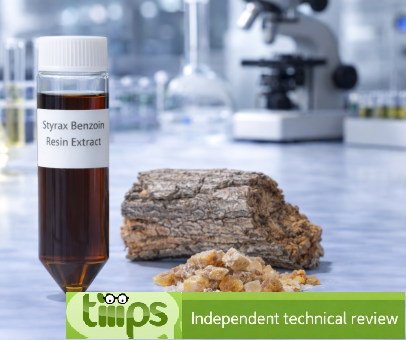
Definition
It is a plant-derived extract/resinoid obtained from the exuded resin (collected after incising the trunk) and then processed into a material suitable for perfumery and cosmetics. Composition is a complex mixture whose fingerprint depends on botanical source, geographic origin, and supplier standardization.
Production process and key constituents
In practice, the material is obtained by collecting the crude resin (trunk incision), sorting/cleaning, then solvent extraction to obtain a resinoid/extract usable in perfumery and cosmetics; filtration, possible concentration, and standardization (color, viscosity, odor profile) typically follow. Some commercial grades are supplied pre-diluted (carrier) to improve handling and dosing; a carrier frequently reported for certain benzoin resinoids is Benzyl Benzoate.
Key constituents reported in technical documentation and literature (variable by origin and grade, e.g., “Siam” vs “Sumatra”) can be grouped as follows, listing only representative examples:
Aromatic acids (2–3 representative compounds)
Benzoic Acid
Cinnamic Acid
Aromatic esters (2–3 representative compounds)
Benzyl Benzoate
Benzyl Cinnamate
Cinnamyl Cinnamate
Aromatic aldehydes/phenolics contributing to the vanillic facet (2–3 representative compounds)
Vanillin
Isovanillin
Benzaldehyde
Aromatic alcohols (2–3 representative compounds)
Benzyl Alcohol
Triterpenoid fraction described in some profiles (2–3 representative compounds)
Siaresinolic Acid
Sumaresinolic Acid
3-Oxo-siaresinolic Acid
In practice, cosmetic-grade quality is managed through supplier specifications and QC controls (chromatographic profile, odor, color, viscosity, and limits for carrier/residual solvents where applicable), because composition may vary with origin and extraction/standardization conditions.
Main uses
Cosmetics
Used as a perfuming component in leave-on and rinse-off products (creams, balms, cleansers, body/hair products) and as a base note in oriental/amber/gourmand accords. It is also useful to mask base odors from certain raw materials and to create a smoother, rounder olfactory profile.
INCI functions
Film-forming agent. It produces, upon application, a very thin continuous film with an optimal balance of cohesion, adhesion and stickiness on skin, hair or nails to counteract or limit damage from external phenomena such as chemicals, UV rays and pollution.
Fragrance. It plays a very important role in the formulation of cosmetic products as it provides the possibility of enhancing, masking or adding fragrance to the final product, increasing its marketability. It is able to create a perceptible pleasant odour, masking a bad smell. The consumer always expects to find a pleasant or distinctive scent in a cosmetic product.
Perfuming. Unlike fragrance, which can also contain slightly less pleasant or characteristic odours, the term perfume indicates only very pleasant fragrances. Used for perfumes and aromatic raw materials.
Industrial use
Raw material for perfumery and fragrances (including soaps and detergents), where it can contribute to olfactory persistence and “body” in the fragrance base.
Identification data and specifications
| Characteristic | Value | Note |
|---|---|---|
| INCI name | Styrax Benzoin Resin Extract | Cosmetic denomination |
| Botanical source | Styrax benzoin (family Styracaceae) | Balsamic resin |
| Preparation type | resin extract (often solvent extract / resinoid) | Grade-dependent |
| CAS number | 84929-79-3 | Substance identifier |
| EC number (EINECS) | 284-557-7 | EU identifier |
| Molecular formula | not applicable (mixture) | Complex mixture |
| Molecular weight | not applicable (mixture) | Distribution, not a single value |
| Variability note | high | Depends on origin and standardization |
Chemical-physical properties (indicative)
| Characteristic | Indicative value | Note |
|---|---|---|
| Physical state | viscous resin / semi-solid; sometimes in solution | Depends on commercial grade |
| Color | yellow-amber to brown | Batch/oxidation dependent |
| Odor | balsamic, sweet, vanillic, resinous | Base note |
| Water solubility | very low | Typical of resinoids |
| Solubility in solvents/oils | variable, often good | Depends on carrier and system polarity |
| Volatility | low | Resin fraction predominates |
| Stability | generally good, but light/air sensitive over time | Packaging and storage matter |
Functional role and mechanism of action
The action is primarily sensorial and physical: as a perfuming ingredient it defines the balsamic signature and supports persistence (base note). As a masking ingredient it reduces the perception of undesirable odors. The film-forming contribution is linked to deposition of the resin fraction, which can increase perceived “body” of the surface film depending on matrix and dosage.
Formulation compatibility
It is generally easier to incorporate into anhydrous systems or oil-rich phases and into fragrance bases. In emulsions and cleansers it may require appropriate solubilization to prevent haze or separation. Compatibility should be verified against pH, surfactants, electrolytes, and processing conditions (temperature and order of addition), because resin fractions can influence appearance and viscosity.
Pros and cons
Pros
Distinctive balsamic-vanillic note, useful to build warm and smooth bases.
High usefulness as an odor masking component.
Can increase perceived “body” and fragrance persistence in many formulas.
Cons
Grade/batch variability: requires supplier standardization and olfactory QC.
Potential solubility challenges in highly aqueous or strongly surfactant-based systems.
Like many odorant raw materials, it may contribute to irritation/sensitization in predisposed individuals if used at high levels or in non-optimized formulas.
Safety, regulatory, and environmental aspects
Safety evaluation must always be performed on the finished product (use level, area of use, frequency, and format). Because this is a complex resin extract, the correct approach is to rely on supplier documentation (SDS/TDS, any relevant allergen information, and usage guidance when it is part of a fragrance).
Allergen and sensitization.
It is not a “single allergen,” but a mixture: sensitization potential depends on real composition and oxidation over time. Good storage practices (light/air/temperature control) and grade selection are important.
Formulation troubleshooting
Haze or separation (especially in cleansers).
Action: adjust solubilizer and fragrance system; consider a grade supplied in a carrier; optimize order of addition.
Odor drift over time.
Action: improve packaging barrier, reduce headspace, control light/temperature, and verify batch stability.
Excessive “heaviness” or residue feel.
Action: reduce dosage; rebalance with fresher/lighter notes; consider dilution or a “cleaner” grade.
Conclusion
Styrax Benzoin Resin Extract is a resin-derived perfuming and masking ingredient that delivers sweet balsamic notes and can enhance olfactory persistence. Performance depends on commercial grade, standardization, and correct formulation integration, with attention to solubility and long-term stability.

