



Turkey tail: properties, uses, pros, cons, safety
(Trametes versicolor)
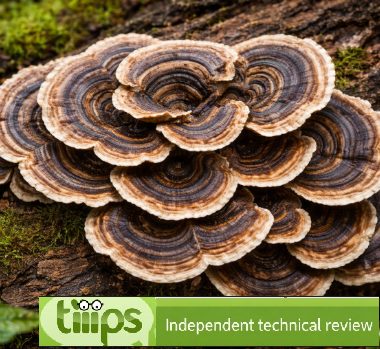
Turkey tail (Trametes versicolor) is a wood-decaying basidiomycete in the family Polyporaceae, very common on hardwoods and recognizable by thin, shelf-like fruiting bodies arranged in overlapping rosettes with multicolored concentric zoning. In commercial contexts it is often positioned as a “functional” mushroom, especially as extracts. It is useful to note that historical synonyms are frequently encountered in the literature and on the market (notably Coriolus versicolor and Polyporus versicolor): for quality control and data comparability, correct identification of the raw material and traceability of the matrix used (fruiting body, powder, extract, mycelium on substrate) are therefore central.
Mycological classification
| Characteristic | Value |
|---|---|
| Kingdom | fungi |
| Phylum | basidiomycota |
| Class | agaricomycetes |
| Order | polyporales |
| Family | polyporaceae |
| Genus | trametes |
| Species | trametes versicolor |
Identification data and specifications
| Characteristic | Value |
|---|---|
| Hymenophore type | pores (polypore) |
| Ecology | saprotrophic; white rot (lignin degradation) |
| Typical substrate | dead or declining hardwood; stumps and logs |
| Part used in the supply chain | dried and powdered fruiting body; extracts; sometimes cultivated mycelium |
| Main marker families | polysaccharides (β-glucans), glycoproteins/polysaccharopeptides (PSP), polysaccharide–protein (PSK) |
| Standardization implications | matrix and extraction method drive the profile (aqueous extracts are more oriented to hydrophilic fractions; other processes may enrich polysaccharide–protein complexes) |
Mushroom characteristics
Ecology: it is a highly efficient wood decomposer; it belongs to “white rot” fungi, capable of oxidizing and degrading lignin in addition to cellulose, with a relevant ecological role in forest carbon cycling.
Fruiting body: thin, leathery, often in overlapping shelves; the upper surface shows concentric bands with variable colors (brown, grey, ochre, sometimes with greenish films from algae on older specimens); the lower surface is poroid and generally pale.
Spores: the spore print is typically light; in morphological control this is useful information, but in the supply chain confirmation may require more robust approaches (especially when the material is powdered or extracted).
Part used: in practical use and on the market, dried fruiting body, powders, and extracts are most common. These matrices are not equivalent: a PSP/PSK-standardized extract is not the same as whole powder, and mycelium on substrate can show profiles that differ from the fruiting body.
Chemical composition and structure
Composition depends on strain, substrate, developmental stage, and process. From a functional and quality-control perspective, the most relevant classes include cell-wall polysaccharides and polysaccharide–protein complexes.
Polysaccharides: β-glucans with a β-(1→3) backbone and β-(1→6) branching are frequently reported, with heterogeneity linked to fraction and extraction method. Analytically, β-glucan measurement requires consistent, comparable methods, because different procedures can produce different results.
Polysaccharopeptides and polysaccharide–protein: two preparation families are central in applied literature, PSP (polysaccharopeptide) and PSK (polysaccharide-K, also known as “krestin”). These are complexes in which a polysaccharide fraction is associated with protein/peptide components; composition and molecular weight may vary depending on the industrial process.
Proteins and peptides: beyond PSP/PSK, fungal proteins and peptides occur across fractions; in commercial practice, however, the most “actionable” markers remain PSP/PSK and the polysaccharide profile.
Oxidative enzymes: as a lignicolous polypore, it expresses enzymes (e.g., laccases and peroxidases) involved in wood degradation. In food contexts these are not typically treated as reference “actives,” but they matter for understanding ecology and metabolic variability.
Other molecules: modern reviews also discuss phenolics and minor secondary metabolites, generally more useful for fingerprinting and characterization than for routine standardization, unless specifically chosen by the producer.
Uses and benefits
Traditional use: in Asia it is also known as “yun zhi” and has historically been used in decoctions or traditional preparations, more as a component of formulations than as a direct food (the fruiting body is leathery and not well suited to table-mushroom consumption).
Modern use (supplements): the market includes powders and extracts presented for general wellness and immune support. The strength of evidence depends critically on matrix, dose, duration, population, and especially standardization (PSP/PSK or β-glucans with declared analytical methods).
Regulated clinical context: PSK has historically been used in some countries as an adjunct in oncology protocols; this point, while relevant, is not automatically transferable to any non-standardized supplement that is not regulated as a medicine.
Applications
Dietary supplements: capsules/powders of fruiting body, predominantly aqueous extracts (more oriented to hydrophilic fractions), and preparations declared as standardized in terms of PSP/PSK (when actually controlled). In multi-mushroom products, the true percentage of T. versicolor and the presence of verifiable markers become decisive.
Beverages and preparations: teas/decoctions and powdered blends; actual extraction depends on particle size, time, and temperature, and is not equivalent to a concentrated industrial extract.
Research and quality control: species identification (morphology and, if needed, genetic markers), verification of the declared matrix, titrations (β-glucans, PSP/PSK when declared), and contaminant control (microbiology, metals, residues), with particular attention to concentrated products.
Cultivation
Substrates: it grows on hardwood; in cultivation it can be produced on logs or on sawdust-based blocks from hardwoods, sometimes with supplements to improve colonization and yield.
Indicative parameters: fruiting is managed through humidity, aeration, and temperature; variability among strains and facilities affects yield and the quality of harvested material.
Product variability: strain, substrate, and process can create marked differences between lots, especially when moving from fruiting body to extracts. For this reason, comparability requires technical specifications and declared analytical methods.
Environmental and safety considerations
Allergens and tolerability: as an oral preparation it is often described as well tolerated; clinical studies and observations on extracts mainly report mild, transient adverse events (gastrointestinal discomfort, non-specific symptoms). In practical use, it is prudent to introduce doses gradually and discontinue if reactions occur.
Interactions and prudent use: for concentrated extracts, caution is reasonable in individuals on immunomodulatory therapies or with autoimmune conditions, and in complex therapeutic regimens in general, because product variability and matrix non-equivalence make individual response hard to predict.
Pregnancy and breastfeeding: in the absence of robust safety data for standardized extracts in these populations, it is prudent to avoid supplemental use and limit to any appropriate traditional dietary uses.
Quality and authenticity: the most relevant practical risks are process heterogeneity, lack of standardization (PSP/PSK declared but not verifiable), contaminants, and poor transparency on the matrix (fruiting body vs mycelium on substrate). Supply chains with clear specifications and lot analyses are preferable.
Synonyms
turkey tail (en)
Coriolus versicolor (frequent historical synonym)
Polyporus versicolor (frequent historical synonym)

