Reishi: properties, uses, pros, cons, safety
(Ganoderma lucidum)
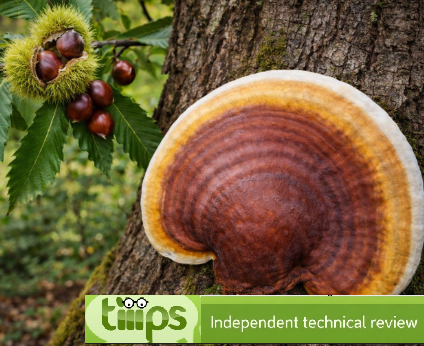
Reishi (Ganoderma lucidum) is a wood-associated basidiomycete mushroom in the Ganodermataceae family, known for its shelf-like fruiting body with a “varnished” (glossy) cap surface. In commercial contexts it is often promoted as a “functional mushroom.” A key technical point is that the name “reishi/lingzhi” is sometimes used non-rigorously for different species within the Ganoderma complex (with real differences in chemistry and markers), so correct identification of the raw material is essential for quality control and for comparing data across studies.
Botanical framework
Mushroom characteristics
Ecology: saprotrophic and sometimes a weak parasite on hardwoods; colonises dead or declining wood.
Fruiting body: a tough, woody polypore, often shelf-like or with a short stipe; the upper surface is glossy due to a resinous layer; the hymenophore is poroid.
Spores: brown basidiospores with a double wall, characteristic of the genus.
Material used: in supply chains and common use, fruiting body, fruiting-body powder, extracts (aqueous or hydroalcoholic), and sometimes cultivated mycelium are used; these matrices are not chemically equivalent.
Chemical composition and structure
Composition varies with the true species (the “reishi” complex), the material used (fruiting body, mycelium, spores), substrate, and extraction method. The most relevant classes include polysaccharides, triterpenoids, sterols, and proteins/peptides.
Polysaccharides and glycoconjugates (hydrophilic fraction): β-glucans with β-(1→3) backbone and β-(1→6) branching (a common pattern in fungal polysaccharides); heteropolysaccharides with monosaccharide units often reported as glucose, mannose, galactose, xylose, fucose (varying by fraction and method); polysaccharide–protein complexes (proteoglycans) reported in some extracted fractions and discussed as “biologically active” components.
Triterpenoids (lipophilic fraction; typical Ganoderma markers): lanostane-type triterpenic acids often used as markers, such as ganoderic acids (frequently cited examples include ganoderic acid A, ganoderic acid B, ganoderic acid C, with many variants); additional triterpenes/derivatives reported in reviews include lucidenic acids (the “lucidenic” series) and triterpenic alcohols/aldehydes (with extensive related nomenclature); technical note: different matrices (fruiting body vs mycelium) can show marked differences in triterpenoid profiles and “ganoderic-acid richness.”
Proteins and peptides: immunomodulatory proteins are reported in the reishi literature, including LZ-8 (ling zhi-8) as a frequently cited model protein in experimental studies; oxidative enzymes typical of wood-decaying polypores (e.g., laccases/peroxidases) are part of the fungus biology (more relevant ecologically than as “actives” in finished products).
Sterols and other lipids: ergosterol as the main fungal sterol; in some technological contexts its photo-induced conversion to vitamin D2 in dried mushroom matrices is discussed; common fatty acids in lipid fractions include linoleic acid, oleic acid, palmitic acid (profiles vary by matrix and cultivation).
Nucleosides and small polar molecules: nucleosides often reported in analytical profiles include adenosine, guanosine, uridine, frequently discussed as “minor” constituents but useful for analytical fingerprinting.
Uses and benefits
Traditional Asian use: historically used as a bitter decoction/infusion and as a “tonic” preparation in traditional contexts.
Modern use (supplements): commercial products are often proposed for supporting the immune system, stress adaptation, and general well-being; clinical evidence quality is variable and depends critically on true species, matrix, dose, and standardisation.
Preclinical research: extensive experimental literature on polysaccharides and triterpenoids; results are not automatically transferable to all market products.
Applications
Dietary supplements: capsules/powders, aqueous extracts (more oriented to polysaccharides) and hydroalcoholic extracts (more oriented to triterpenoids); multi-mushroom blends are also common.
Functional beverages: infusions/decoctions; effective extraction depends on particle size, temperature, and time.
Research and quality control: fingerprinting of β-glucans, triterpenoid profiles (ganoderic/lucidenic acids), sterol profiles (ergosterol), and contaminant testing (microbiology, metals, residues), with species verification via morphology and, when needed, DNA barcoding.
Cultivation
Substrates: grown on hardwood logs or lignocellulosic substrates (hardwood sawdust/bran blends, agricultural by-products) in bags or on logs.
Indicative parameters: mycelial growth is generally favoured by “warm” temperatures, while fruiting is managed via humidity, aeration, and light control.
Product variability: strain, substrate, and cultivation conditions influence yield and polysaccharide/triterpenoid profiles.
Environmental and safety considerations
Allergens and tolerability: generally well tolerated in traditional food-like use; with concentrated extracts, gastrointestinal discomfort (nausea, diarrhoea), headache, or rash may occur in sensitive individuals.
Liver: clinical cases of liver injury have been reported in association with reishi/lingzhi products (often in supplement contexts and sometimes with co-factors); product variability and concurrent exposures complicate causality, but caution is warranted, especially in individuals with liver disease or complex therapies.
Coagulation: caution is advisable with anticoagulant/antiplatelet therapy and prior to surgery due to potential bleeding-risk considerations reported in literature and supplement safety summaries.
Blood pressure and glycaemia: caution in individuals taking antihypertensive or glucose-lowering therapy due to potential functional interactions (especially with concentrated products).
Pregnancy and breastfeeding: in the absence of robust safety data, avoiding extracts/supplements is prudent.
Quality and authenticity: the most critical issue is heterogeneity—misidentified species (the “reishi” complex), unclear matrix (fruiting body vs mycelium), lack of standardisation, contaminants; prefer supply chains with transparent analyses and specifications.
Synonyms
References__________________________________________________________________________
Chan SW, Tomlinson B, Chan P, Lam CWK. The beneficial effects of Ganoderma lucidum on cardiovascular and metabolic disease risk. Pharm Biol. 2021 Dec;59(1):1161-1171. doi: 10.1080/13880209.2021.1969413.
Abstract. Context: Various herbal medicines are thought to be useful in the management of cardiometabolic disease and its risk factors. Ganoderma lucidum (Curtis) P. Karst. (Ganodermataceae), also known as Lingzhi, has received considerable attention for various indications, including some related to the prevention and treatment of cardiovascular and metabolic disease by ameliorating major cardiovascular risk factors. Objective: This review focuses on the major studies of the whole plant, plant extract, and specific active compounds isolated from G. lucidum in relation to the main risk factors for cardiometabolic disease. Methods: References from major databases including PubMed, Web of Science, and Google Scholar were compiled. The search terms used were Ganoderma lucidum, Lingzhi, Reishi, cardiovascular, hypoglycaemic, diabetes, dyslipidaemia, antihypertensive, and anti-inflammatory. Results: A number of in vitro studies and in vivo animal models have found that G. lucidum possesses antioxidative, antihypertensive, hypoglycaemic, lipid-lowering, and anti-inflammatory properties, but the health benefits in clinical trials are inconsistent. Among these potential health benefits, the most compelling evidence thus far is its hypoglycaemic effects in patients with type 2 diabetes or hyperglycaemia. Conclusions: The inconsistent evidence about the potential health benefits of G. lucidum is possibly because of the use of different Ganoderma formulations and different study populations. Further large controlled clinical studies are therefore needed to clarify the potential benefits of G. lucidum preparations standardised by known active components in the prevention and treatment of cardiometabolic disease.
Lian W, Yang X, Duan Q, Li J, Zhao Y, Yu C, He T, Sun T, Zhao Y, Wang W. The Biological Activity of Ganoderma lucidum on Neurodegenerative Diseases: The Interplay between Different Active Compounds and the Pathological Hallmarks. Molecules. 2024 May 26;29(11):2516. doi: 10.3390/molecules29112516.
Abstract. Neurodegenerative diseases represent a cluster of conditions characterized by the progressive degeneration of the structure and function of the nervous system. Despite significant advancements in understanding these diseases, therapeutic options remain limited. The medicinal mushroom Ganoderma lucidum has been recognized for its comprehensive array of bioactive compounds with anti-inflammatory and antioxidative effects, which possess potential neuroprotective properties. This literature review collates and examines the existing research on the bioactivity of active compounds and extracts from Ganoderma lucidum in modulating the pathological hallmarks of neurodegenerative diseases. The structural information and preparation processes of specific components, such as individual ganoderic acids and unique fractions of polysaccharides, are presented in detail to facilitate structure-activity relationship research and scale up the investigation of in vivo pharmacology. The mechanisms of these components against neurodegenerative diseases are discussed on multiple levels and elaborately categorized in different patterns. It is clearly presented from the patterns that most polysaccharides of Ganoderma lucidum possess neurotrophic effects, while ganoderic acids preferentially target specific pathogenic proteins as well as regulating autophagy. Further clinical trials are necessary to assess the translational potential of these components in the development of novel multi-target drugs for neurodegenerative diseases.
Lin S, Meng J, Li F, Yu H, Lin D, Lin S, Li M, Zhou H, Yang B. Ganoderma lucidum polysaccharide peptide alleviates hyperuricemia by regulating adenosine deaminase and urate transporters. Food Funct. 2022 Dec 13;13(24):12619-12631. doi: 10.1039/d2fo02431d.
Abstract. Hyperuricemia (HUA) affects human health and is involved in the pathogenesis of common chronic diseases. Previous studies showed that Ganoderma lucidum extract lowered HUA in animals. However, the active ingredient and pharmacological mechanism of Ganoderma lucidum extract in the improvement of HUA are unknown. The purpose of this study was to determine the anti-HUA efficacy and related mechanism of Ganoderma lucidum polysaccharide peptide (GLPP) using a potassium oxonate (PO)-induced mouse model and an adenosine-induced cell model. The experimental results showed that blood uric acid (UA) was decreased up to 40.6% by GLPP in HUA mice in a dose-dependent manner. Additionally, GLPP significantly reduced UA production by inhibiting the hepatic and blood adenosine deaminase (ADA) activity and increased UA excretion by decreasing the expression of glucose transporter 9 (GLUT9) and increasing the expression of organic anion transporter 1 (OAT1) in kidney. The adenosine-induced cell model showed that the inhibitory effect of GLPP on ADA activity may be the main reason for the alleviation of HUA by GLPP. Furthermore, PO-induced renal histopathological damage was also alleviated by GLPP in a dose-dependent manner. The experimental results in this study indicated that GLPP exerted anti-HUA effects via regulating the UA production and excretion, suggesting that GLPP could be developed into a therapeutic agent for HUA.
Wu YL, Han F, Luan SS, Ai R, Zhang P, Li H, Chen LX. Triterpenoids from Ganoderma lucidum and Their Potential Anti-inflammatory Effects. J Agric Food Chem. 2019 May 8;67(18):5147-5158. doi: 10.1021/acs.jafc.9b01195.
Abstract. Ganoderma lucidum, as food, tea, dietary supplement, and medicine, is widely used in China and Eastern Asian countries. In order to discover its anti-inflammatory constituents and provide some references for the usage of G. lucidum and G. sinense, two official species in China, the fruiting bodies of G. lucidum were studied, leading to the isolation of six new triterpenoids (1-6) and 27 known analogues (7-33). Compound 4 exhibited the most potent inhibition on nitric oxide (NO) production induced by lipopolysaccharide (LPS) in RAW264.7 macrophage cells. The production of IL-6 and IL-1β, as well as the expression of iNOS, COX-2, and NF-κB were dose-dependently reduced by 4. The phosphorylations of IκBα and IKKβ in LPS-induced macrophage cells were blocked by 4. Therefore, 4 could be used as a potential anti-inflammatory candidate and the total triterpenoids might be developed as value-added functional food for the prevention of inflammation. In combination of previous studies, it should be cautious for the interchangeable usage of G. lucidum and G. sinense.




