Chaga: properties, uses, pros, cons, safety
(Inonotus obliquus)
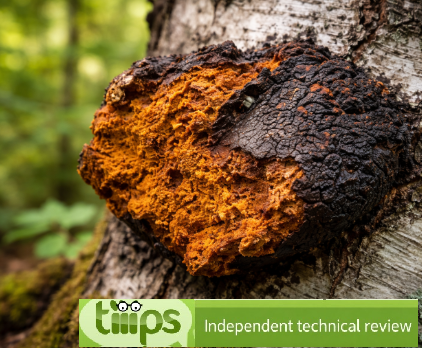
Chaga (Inonotus obliquus) is a basidiomycete fungus in the Hymenochaetaceae family, typical of cold regions across the Northern Hemisphere and frequently associated with birch. Commercially it is often sold as a “functional mushroom,” but an important technical point is that the commonly harvested black mass is not a typical “classic” fruiting body: it is a sterile mass (often described as a sclerotium or a mycelial aggregate) with a charred appearance and a high content of dark pigments.
Botanical framework
Fungus characteristics
Ecology: parasite/saprotroph on hardwoods, with a strong association with birch; it causes progressive wood decay over time.
Harvested structure (“chaga”): irregular external sterile mass, hard and blackish, with a more brown interior; the “burnt” look is linked to high levels of dark pigments.
Fertile fruiting body: may develop especially when the host tree is severely compromised or after parts of the trunk die; it can be less conspicuous because it may form under the bark.
Variability: morphology and metabolite content vary with host species, geography, age of the sterile mass, and harvest/drying conditions.
Chemical composition and structure
Composition depends strongly on the matrix (sterile mass vs cultivated mycelium), the host (birch vs other hardwoods), processing (water vs hydroalcoholic vs lipophilic extraction), and standardisation. Main classes and representative molecules include:
Polysaccharides and high-molecular-weight complexes (1)
β-glucans (often discussed with β-(1→3) backbones and β-(1→6) branching in medicinal-mushroom literature).
Heteropolysaccharides and polysaccharide–protein complexes reported in extracted fractions, with profiles that change markedly depending on extraction method.
Pigments and phenolic polymers
Triterpenoids and sterols (lipophilic fraction, especially from wild birch chaga)
Inotodiol (often reported as an abundant triterpenoid).
Trametenolic acid.
Lanosterol.
3β-hydroxylanosta-8,24-dien-21-al (reported in recent quantitative profiles).
Technical note: in some analytical comparisons, mycelium grown in liquid culture or on fermented grains shows a greatly reduced or absent triterpenoid profile compared with wild birch chaga.
Birch-derived triterpenes (fungus–host interaction)
Oxalates (safety relevance)
Uses and benefits
Traditional use: decoction/infusion-style drinks in some parts of Eastern and Northern Europe, historically used as a “tonic” or general support preparation.
Modern use: powders and extracts sold for “antioxidant” and “immunomodulatory” effects; interpretation of efficacy depends heavily on matrix, dose, extraction profile, and product quality.
Methodological note: preclinical results on triterpenoids and polysaccharides do not automatically translate to commercial products, especially when the raw material is cultivated mycelium rather than birch sterile mass.
Applications
Dietary supplements: capsules, powders, aqueous extracts (more oriented to polysaccharide fractions) and hydroalcoholic/lipophilic extracts (more oriented to triterpenoids and sterols).
Functional beverages: “chaga tea” or infusion/decoction blends; actual compound concentration depends on particle size and extraction time/temperature.
Research and quality control: quantification of β-glucans, triterpenoid profiling (inotodiol, trametenolic acid, lanosterol), contaminant testing, and verification of matrix (sterile mass vs mycelium).
Cultivation
Production on controlled substrates: mycelium can be produced by fermentation (liquid or solid-state), but metabolite profiles can differ markedly from wild birch chaga.
Wild harvesting: the sterile mass is obtained from host trees; harvest requires sustainable management (long growth times and a localised resource).
Technological implication: choosing between cultivated mycelium and sterile mass directly affects markers, standardisation, and expected use profile.
Environmental and safety considerations
Environmental impact: harvesting from birch in cold environments can put pressure on a local resource and habitat; traceability and collection practices that avoid depletion are relevant.
Kidney and oxalates: clinical documentation exists for oxalate nephropathy associated with high and prolonged chaga intake; extra caution is warranted in individuals with kidney disease, a history of kidney stones, or high-oxalate diets.
Interactions and coagulation: as a precaution, caution is often recommended in people using anticoagulants/antiplatelets or before surgery, partly because commercial products are heterogeneous.
Glycaemia: caution is advisable in individuals on glucose-lowering therapy, since some functional products are used with the aim of modulating metabolic parameters.
Product quality: high variability risk (origin, true matrix, contaminants, metals, environmental mycotoxins, residues); prefer products with analyses and clear specifications (part used, extraction method, markers).
Synonyms
chaga
“birch fungus” (common usage)
sterile conk / sterile mass (technical-popular terminology)
Inonotus obliquus (Pers.) Pilát (botanical author citation)
References__________________________________________________________________________
(1) Lu Y, Jia Y, Xue Z, Li N, Liu J, Chen H. Recent Developments in Inonotus obliquus (Chaga mushroom) Polysaccharides: Isolation, Structural Characteristics, Biological Activities and Application. Polymers (Basel). 2021 Apr 29;13(9):1441. doi: 10.3390/polym13091441.
Abstract. Inonotus obliquus (Chaga mushroom) is a kind of medicine and health food widely used by folk in China, Russia, Korea, and some occidental countries. Among the extracts from Inonotus obliquus, Inonotus obliquus polysaccharide (IOPS) is supposed to be one of the major bioactive components in Inonotus obliquus, which possesses antitumor, antioxidant, anti-virus, hypoglycemic, and hypolipidemic activities. In this review, the current advancements on extraction, purification, structural characteristics, and biological activities of IOPS were summarized. This review can provide significant insight into the IOPS bioactivities as their in vitro and in vivo data were summarized, and some possible mechanisms were listed. Furthermore, applications of IOPS were reviewed and discussed; IOPS might be a potential candidate for the treatment of cancers and type 2 diabetes. Besides, new perspectives for the future work of IOPS were also proposed.
(2) Kikuchi, Y., Seta, K., Ogawa, Y., Takayama, T., Nagata, M., Taguchi, T., & Yahata, K. (2014). Chaga mushroom-induced oxalate nephropathy. Clinical nephrology, 81(6), 440-444.
Abstract . Chaga mushrooms have been used in folk and botanical medicine as a remedy for cancer, gastritis, ulcers, and tuberculosis of the bones. A 72-year-old Japanese female had been diagnosed with liver cancer 1 year prior to presenting at our department. She underwent hepatectomy of the left lobe 3 months later. Chaga mushroom powder (4 - 5 teaspoons per day) had been ingested for the past 6 months for liver cancer. Renal function decreased and hemodialysis was initiated. Renal biopsy specimens showed diffuse tubular atrophy and interstitial fibrosis. Oxalate crystals were detected in the tubular lumina and urinary sediment and oxalate nephropathy was diagnosed. Chaga mushrooms contain extremely high oxalate concentrations. This is the first report of a case of oxalate nephropathy associated with ingestion of Chaga mushrooms.
Łysakowska P, Sobota A, Wirkijowska A. Medicinal Mushrooms: Their Bioactive Components, Nutritional Value and Application in Functional Food Production-A Review. Molecules. 2023 Jul 14;28(14):5393. doi: 10.3390/molecules28145393.
Abstract. Medicinal mushrooms, e.g., Lion's Mane (Hericium erinaceus (Bull.) Pers.), Reishi (Ganoderma lucidum (Curtis) P. Karst.), Chaga (Inonotus obliquus (Ach. ex Pers.) Pilát), Cordyceps (Ophiocordyceps sinensis (Berk.) G.H. Sung, J.M. Sung, Hywel-Jones and Spatafora), Shiitake (Lentinula edodes (Berk.) Pegler), and Turkey Tail (Trametes versicolor (L.) Lloyd), are considered new-generation foods and are of growing interest to consumers. They are characterised by a high content of biologically active compounds, including (1,3)(1,6)-β-d-glucans, which are classified as dietary fibre, triterpenes, phenolic compounds, and sterols. Thanks to their low-fat content, they are a low-calorie product and are classified as a functional food. They have a beneficial effect on the organism through the improvement of its overall health and nutritional level. The biologically active constituents contained in medicinal mushrooms exhibit anticancer, antioxidant, antidiabetic, and immunomodulatory effects. In addition, these mushrooms accelerate metabolism, help fight obesity, and slow down the ageing processes thanks to their high antioxidant activity. The vast therapeutic properties of mushrooms are still not fully understood. Detailed mechanisms of the effects of medicinal mushrooms on the human organism still require long-term clinical studies to confirm their nutraceutical effects, their safety of use, and their dosage. Medicinal mushrooms have great potential to be used in the design of innovative functional foods. There is a need for further research on the possibility of incorporating mushrooms into food products to assess the interactions of their bioactive substances with ingredients in the food matrix. This review focuses on the properties of selected medicinal mushrooms and their effects on the human organism and presents current knowledge on the possibilities of their use in the production of functional foods.
Wang Y, Gu J, Wu J, Xu Y, Liu Y, Li F, Liu Q, Lu K, Liang T, Hao J, Li L, Cao X, Jiang J. Natural Products and Health Care Functions of Inonotus obliquus. Curr Issues Mol Biol. 2025 Apr 10;47(4):269. doi: 10.3390/cimb47040269.
Abstract. With the increasing attention of modern medicine to natural medicinal agents, Inonotus obliquus (chaga), a macrofungus with remarkable medicinal value, has gradually garnered widespread academic interest. This paper reviews the primary bioactive components of I. obliquus in recent years, including polysaccharides, phenolic compounds, and triterpenoids, which exhibit diverse pharmacological effects such as antioxidant, anti-inflammatory, immunomodulatory, and antitumor activities. It further discusses how these bioactive components enhance human health and disease resistance through distinct biological mechanisms, such as the activation of antioxidant systems, regulation of immune responses, and modulation of apoptosis pathways. Additionally, the article explores the biosynthetic pathways of I. obliquus metabolites and their pharmacological relevance. Finally, we summarize the potential of I. obliquus as a natural medicinal resource and envisage its future applications in clinical drug development. This review aims to provide novel perspectives for the cultivation, utilization, and industrial-scale exploitation of I. obliquus.
Sumreen Javed S, Mitchell K, Sidsworth D, Sellers SL, Reutens-Hernandez J, Massicotte HB, Egger KN, Lee CH, Payne GW. Inonotus obliquus attenuates histamine-induced microvascular inflammation. PLoS One. 2019 Aug 22;14(8):e0220776. doi: 10.1371/journal.pone.0220776.
Abstract. Cell-to-cell communication is a key element of microvascular blood flow control, including rapidly carrying signals through the vascular endothelium in response to local stimuli. This cell-to-cell communication is negatively impacted during inflammation through the disruption of junctional integrity. Such disruption is associated with promoting the onset of cardiovascular diseases as a result of altered microvascular blood flow regulation. Therefore, understanding the mechanisms how inflammation drives microvascular dysfunction and compounds that mitigate such inflammation and dysfunction are of great interest for development. As such we aimed to investigate extracts of mushrooms as potential novel compounds. Using intravital microscopy, the medicinal mushroom, Inonotus obliquus was observed, to attenuate histamine-induced inflammation conducted vasodilation in second-order arterioles in the gluteus maximus muscle of C57BL/6 mice. Mast cell activation by C48/80 similarly disrupted endothelial junctions and conducted vasodilation but only histamine was blocked by the histamine antagonist, pyrilamine not C48/80 suggesting the importance of mast cell activation. Data presented here supports that histamine induced inflammation is a major disruptor of junctional integrity, and highlights the important anti-inflammatory properties of Inonotus obliquus focusing future assessment of mast cells as putative target for Inonotus obliquus.




