Inonotus obliquus: proprietà, usi, pro, contro, sicurezza
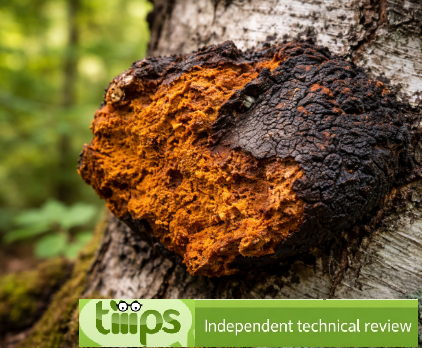
Inonotus obliquus (Chaga) è un fungo basidiomicete della famiglia Hymenochaetaceae, tipico delle aree fredde dell’emisfero nord e frequentemente associato alla betulla. In ambito commerciale viene spesso venduto come “fungo funzionale”, ma è importante chiarire che la massa nera comunemente raccolta non è il carpoforo “classico”: è una massa sterile (spesso descritta come sclerozio o aggregato miceliare) dall’aspetto carbonizzato, ricca di pigmenti scuri.
Inquadramento botanico
Caratteristiche del fungo
Ecologia: parassita/saprotrofo su latifoglie, con forte associazione a betulla; causa degradazioni del legno (marciume) nel tempo.
Struttura raccolta (“chaga”): massa sterile irregolare esterna, dura e nerastra, con interno più bruno; l’aspetto “bruciato” è correlato all’elevata presenza di pigmenti scuri.
Carpoforo fertile: può svilupparsi soprattutto quando l’albero ospite è gravemente compromesso o dopo la morte di porzioni del tronco; spesso è meno evidente perché può formarsi sotto la corteccia.
Variabilità: morfologia e contenuto di metaboliti variano con specie ospite, area geografica, età della massa sterile e condizioni di raccolta/essiccazione.
Composizione chimica e struttura
La composizione dipende molto da matrice (massa sterile vs micelio coltivato), ospite (betulla e altre latifoglie), processo (estrazione acquosa vs idroalcolica vs lipofila) e standardizzazione. Di seguito le principali classi con esempi di molecole.
Polisaccaridi (1) e complessi ad alto peso molecolare
β-glucani (tipicamente con architetture β-(1→3) e ramificazioni β-(1→6) nella letteratura sui funghi medicinali).
Eteropolisaccaridi e complessi polisaccaride-proteina riportati in frazioni estratte (con profili che cambiano sensibilmente in base al metodo di estrazione).
Pigmenti e polimeri fenolici
Triterpenoidi e steroli (frazione lipofila, soprattutto da chaga selvatico su betulla)
Inotodiolo (spesso riportato come triterpenoide abbondante).
Acido trametenolico.
Lanosterolo.
3β-hydroxylanosta-8,24-dien-21-al (riportato in profili quantitativi recenti).
Nota tecnica: in alcune comparazioni analitiche, micelio coltivato in liquido o su cereali fermentati mostra un profilo triterpenoidico molto ridotto o assente rispetto al chaga selvatico.
Derivati triterpenici “da betulla” (interazione fungo–ospite)
Ossalati (rilevanza di sicurezza)
Usi e benefici
Uso tradizionale: bevande tipo decotto/infuso in alcune aree dell’Europa orientale e del nord, storicamente come preparazione “tonica” o di supporto generale.
Uso moderno: polveri ed estratti venduti per attività “antiossidante” e “immunomodulante”; l’interpretazione dell’efficacia dipende fortemente da matrice, dose, profilo estrattivo e qualità del prodotto.
Nota metodologica: i risultati preclinici su triterpenoidi e polisaccaridi non sono automaticamente trasferibili ai prodotti commerciali, soprattutto quando la materia prima è micelio coltivato e non massa sterile da betulla.
Applicazioni
Integratori alimentari: capsule, polveri, estratti acquosi (più ricchi in frazioni polisaccaridiche) ed estratti idroalcolici/lipofili (più orientati a triterpenoidi e steroli).
Bevande funzionali: “chaga tea” o miscele per infusione/decotto; la concentrazione effettiva di composti dipende da granulometria e tempo/temperatura di estrazione.
Ricerca e controllo qualità: quantificazione di β-glucani, profilo triterpenoidico (inotodiolo, acido trametenolico, lanosterolo), controllo di contaminanti e verifica della matrice (massa sterile vs micelio).
Coltivazione
Produzione su substrati controllati: il micelio può essere coltivato in fermentazione (liquida o su solidi), ma il profilo di metaboliti può differire in modo marcato rispetto al chaga selvatico su betulla.
Raccolta in natura: la “massa sterile” si ottiene da alberi ospiti; la raccolta richiede gestione sostenibile (tempi lunghi di crescita e risorsa localizzata).
Implicazione tecnologica: la scelta tra micelio coltivato e massa sterile influenza direttamente marcatori, standardizzazione e aspettative d’uso.
Considerazioni ambientali e di sicurezza
Impatto ambientale: la raccolta su betulle in ambienti freddi può creare pressione su risorsa e habitat; sono rilevanti tracciabilità e pratiche di raccolta che evitino depauperamento locale.
Rene e ossalati: esiste documentazione clinica di nefropatia da ossalato associata a consumo elevato e prolungato di chaga; cautela maggiore in soggetti con storia di calcoli renali, malattia renale o diete ad alto ossalato. Vedi studio
Interazioni e coagulazione: per prudenza, è spesso raccomandata cautela in caso di terapia anticoagulante/antiaggregante o prima di interventi chirurgici, anche perché i prodotti commerciali sono eterogenei.
Glicemia: cautela in soggetti in terapia ipoglicemizzante, poiché alcuni prodotti “funzionali” vengono utilizzati con l’idea di modulare parametri metabolici.
Qualità del prodotto: rischio di variabilità elevata (origine, matrice reale, contaminanti, metalli, micotossine ambientali, residui); preferire prodotti con analisi e specifiche chiare (parte usata, metodo estrattivo, marcatori).
Sinonimi
chaga
“fungo della betulla” (uso comune)
sterile conk / massa sterile (terminologia tecnico-divulgativa)
Inonotus obliquus (Pers.) Pilát (citazione d’autore botanica)
Bibliografia__________________________________________________________________________
(1) Lu Y, Jia Y, Xue Z, Li N, Liu J, Chen H. Recent Developments in Inonotus obliquus (Chaga mushroom) Polysaccharides: Isolation, Structural Characteristics, Biological Activities and Application. Polymers (Basel). 2021 Apr 29;13(9):1441. doi: 10.3390/polym13091441.
Abstract. Inonotus obliquus (Chaga mushroom) is a kind of medicine and health food widely used by folk in China, Russia, Korea, and some occidental countries. Among the extracts from Inonotus obliquus, Inonotus obliquus polysaccharide (IOPS) is supposed to be one of the major bioactive components in Inonotus obliquus, which possesses antitumor, antioxidant, anti-virus, hypoglycemic, and hypolipidemic activities. In this review, the current advancements on extraction, purification, structural characteristics, and biological activities of IOPS were summarized. This review can provide significant insight into the IOPS bioactivities as their in vitro and in vivo data were summarized, and some possible mechanisms were listed. Furthermore, applications of IOPS were reviewed and discussed; IOPS might be a potential candidate for the treatment of cancers and type 2 diabetes. Besides, new perspectives for the future work of IOPS were also proposed.
(2) Kikuchi, Y., Seta, K., Ogawa, Y., Takayama, T., Nagata, M., Taguchi, T., & Yahata, K. (2014). Chaga mushroom-induced oxalate nephropathy. Clinical nephrology, 81(6), 440-444.
Abstract . Chaga mushrooms have been used in folk and botanical medicine as a remedy for cancer, gastritis, ulcers, and tuberculosis of the bones. A 72-year-old Japanese female had been diagnosed with liver cancer 1 year prior to presenting at our department. She underwent hepatectomy of the left lobe 3 months later. Chaga mushroom powder (4 - 5 teaspoons per day) had been ingested for the past 6 months for liver cancer. Renal function decreased and hemodialysis was initiated. Renal biopsy specimens showed diffuse tubular atrophy and interstitial fibrosis. Oxalate crystals were detected in the tubular lumina and urinary sediment and oxalate nephropathy was diagnosed. Chaga mushrooms contain extremely high oxalate concentrations. This is the first report of a case of oxalate nephropathy associated with ingestion of Chaga mushrooms.
Łysakowska P, Sobota A, Wirkijowska A. Medicinal Mushrooms: Their Bioactive Components, Nutritional Value and Application in Functional Food Production-A Review. Molecules. 2023 Jul 14;28(14):5393. doi: 10.3390/molecules28145393.
Abstract. Medicinal mushrooms, e.g., Lion's Mane (Hericium erinaceus (Bull.) Pers.), Reishi (Ganoderma lucidum (Curtis) P. Karst.), Chaga (Inonotus obliquus (Ach. ex Pers.) Pilát), Cordyceps (Ophiocordyceps sinensis (Berk.) G.H. Sung, J.M. Sung, Hywel-Jones and Spatafora), Shiitake (Lentinula edodes (Berk.) Pegler), and Turkey Tail (Trametes versicolor (L.) Lloyd), are considered new-generation foods and are of growing interest to consumers. They are characterised by a high content of biologically active compounds, including (1,3)(1,6)-β-d-glucans, which are classified as dietary fibre, triterpenes, phenolic compounds, and sterols. Thanks to their low-fat content, they are a low-calorie product and are classified as a functional food. They have a beneficial effect on the organism through the improvement of its overall health and nutritional level. The biologically active constituents contained in medicinal mushrooms exhibit anticancer, antioxidant, antidiabetic, and immunomodulatory effects. In addition, these mushrooms accelerate metabolism, help fight obesity, and slow down the ageing processes thanks to their high antioxidant activity. The vast therapeutic properties of mushrooms are still not fully understood. Detailed mechanisms of the effects of medicinal mushrooms on the human organism still require long-term clinical studies to confirm their nutraceutical effects, their safety of use, and their dosage. Medicinal mushrooms have great potential to be used in the design of innovative functional foods. There is a need for further research on the possibility of incorporating mushrooms into food products to assess the interactions of their bioactive substances with ingredients in the food matrix. This review focuses on the properties of selected medicinal mushrooms and their effects on the human organism and presents current knowledge on the possibilities of their use in the production of functional foods.
Wang Y, Gu J, Wu J, Xu Y, Liu Y, Li F, Liu Q, Lu K, Liang T, Hao J, Li L, Cao X, Jiang J. Natural Products and Health Care Functions of Inonotus obliquus. Curr Issues Mol Biol. 2025 Apr 10;47(4):269. doi: 10.3390/cimb47040269.
Abstract. With the increasing attention of modern medicine to natural medicinal agents, Inonotus obliquus (chaga), a macrofungus with remarkable medicinal value, has gradually garnered widespread academic interest. This paper reviews the primary bioactive components of I. obliquus in recent years, including polysaccharides, phenolic compounds, and triterpenoids, which exhibit diverse pharmacological effects such as antioxidant, anti-inflammatory, immunomodulatory, and antitumor activities. It further discusses how these bioactive components enhance human health and disease resistance through distinct biological mechanisms, such as the activation of antioxidant systems, regulation of immune responses, and modulation of apoptosis pathways. Additionally, the article explores the biosynthetic pathways of I. obliquus metabolites and their pharmacological relevance. Finally, we summarize the potential of I. obliquus as a natural medicinal resource and envisage its future applications in clinical drug development. This review aims to provide novel perspectives for the cultivation, utilization, and industrial-scale exploitation of I. obliquus.
Sumreen Javed S, Mitchell K, Sidsworth D, Sellers SL, Reutens-Hernandez J, Massicotte HB, Egger KN, Lee CH, Payne GW. Inonotus obliquus attenuates histamine-induced microvascular inflammation. PLoS One. 2019 Aug 22;14(8):e0220776. doi: 10.1371/journal.pone.0220776.
Abstract. Cell-to-cell communication is a key element of microvascular blood flow control, including rapidly carrying signals through the vascular endothelium in response to local stimuli. This cell-to-cell communication is negatively impacted during inflammation through the disruption of junctional integrity. Such disruption is associated with promoting the onset of cardiovascular diseases as a result of altered microvascular blood flow regulation. Therefore, understanding the mechanisms how inflammation drives microvascular dysfunction and compounds that mitigate such inflammation and dysfunction are of great interest for development. As such we aimed to investigate extracts of mushrooms as potential novel compounds. Using intravital microscopy, the medicinal mushroom, Inonotus obliquus was observed, to attenuate histamine-induced inflammation conducted vasodilation in second-order arterioles in the gluteus maximus muscle of C57BL/6 mice. Mast cell activation by C48/80 similarly disrupted endothelial junctions and conducted vasodilation but only histamine was blocked by the histamine antagonist, pyrilamine not C48/80 suggesting the importance of mast cell activation. Data presented here supports that histamine induced inflammation is a major disruptor of junctional integrity, and highlights the important anti-inflammatory properties of Inonotus obliquus focusing future assessment of mast cells as putative target for Inonotus obliquus.




