Hericium erinaceus: properties, uses, pros, cons, safety
Hericium erinaceus, also known as “Lion’s mane”, is an edible basidiomycete mushroom in the Hericiaceae family, distributed in temperate regions and typically associated with hardwood (older or declining trunks). It is valued both as a food and as a “functional” mushroom. A key technical distinction is between the fruiting body and the mycelium: these two matrices can differ substantially in phytochemical profile and processing behaviour.
Botanical framework
Mushroom characteristics
Ecology: wood-associated and saprotrophic (it may also behave as a weak parasite on stressed trees), linked primarily to hardwoods.
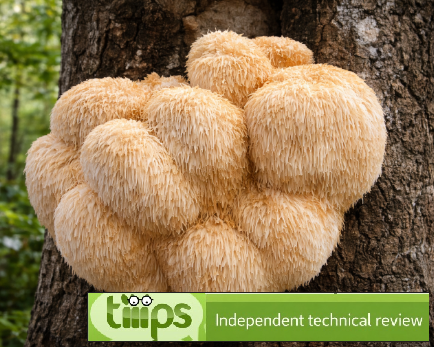
Fruiting body: a compact white-to-cream mass with characteristic hanging “spines” (hymenial teeth), highly recognisable morphologically.
Natural substrate: hardwood; in cultivation, lignocellulosic substrates are used (hardwood sawdust/wood, straw, enriched blends).
Variability: morphology and yield depend on strain, substrate, and environmental parameters; the metabolite profile can also vary with cultivation method.
Chemical composition and structure
The chemical profile depends on the material used (fruiting body vs mycelium), substrate, growth stage, and extraction approach (water, hydroalcoholic, enriched fractions). Main classes and representative molecules frequently reported in the literature include:
Cell-wall polysaccharides and extracted polysaccharide fractions
β-glucans (commonly β-(1→3) with β-(1→6) branching in many mushrooms) and heteropolysaccharides with recurring monosaccharide units such as glucose, galactose, mannose, and fucose.
Fractions described as polysaccharides/protein–polysaccharide complexes may contribute to technological properties and to biological activities observed in experimental models.
Cyathane-type diterpenoids (mainly mycelium)
The erinacins series is often cited as characteristic of mycelium: erinacin A, erinacin C, erinacin D, erinacin E, erinacin F, erinacin G, erinacin H, with additional analogues reported in the literature (historically described as erinacins A–K in isolation work).
Erinacin S has also been described as a compound with neurotrophic activity in experimental models.
Aromatic/phenolic compounds characteristic of the fruiting body
The hericenones series: many reviews and isolation studies report hericenone A, hericenone B, and further analogues (hericenones A–I, with reports also including J in some summaries).
These compounds are often described as phenolic/resorcinol-type derivatives and are discussed for potential involvement in neurotrophic pathways (primarily in preclinical models).
Other reported secondary metabolites
Hericene A and related molecules (including reports such as N-de(phenylethyl)isohericerin, NDPIH) in metabolomics and experimental neurotrophic-activity studies.
Ergothioneine (L-ergothioneine), a naturally occurring compound of interest for antioxidant/cytoprotective roles, reported in mushrooms and discussed also for H. erinaceus.
Sterols: ergosterol as a typical fungal sterol, sometimes used as an indicator of the lipophilic fraction; in some technological contexts, its photo-induced conversion to vitamin D2 is discussed.
“Classical” phenolics and organic acids (matrix- and method-dependent)
Reported phenolic acids include protocatechuic acid, caffeic acid, p-coumaric acid, ferulic acid; associated compounds may include catechin and certain organic acids such as succinic acid.
Uses and benefits
Food use: consumed as an edible mushroom; in cooking it is appreciated for texture and aromatic profile (sensory outcomes depend strongly on freshness and cooking method).
Supplements and “functional” use: fruiting-body or mycelium powders/extracts are often proposed for support of cognitive function, nervous-system well-being, and the gut–brain axis; available clinical evidence is heterogeneous and strongly dependent on matrix, standardisation (e.g., erinacin-enriched fractions), and study design.
Preclinical research: extensive experimental literature on polysaccharides and terpenoids (erinacins/hericenones), with interest in neurotrophic mechanisms (e.g., pathways associated with nerve growth factors) and modulation of inflammatory/oxidative parameters.
Applications
Food and gastronomy: fresh, dried, powdered; used in warm preparations, soups, and savoury dishes, with marked differences between “whole mushroom” products and concentrated ingredients.
Dietary supplements: capsules/powders/water or hydroalcoholic extracts; mycelium-based products marketed as “enriched” (e.g., markers associated with erinacin A) are common.
Research and quality control: analysis of β-glucans, terpenoid metabolite profiles (erinacins) and aromatic compounds (hericenones), plus supply-chain parameters (microbiology, metals, contaminants) depending on intended use.
Some clinical research reports that Hericium erinaceus may be effective as an antidepressant (1) and as a potential functional food in the treatment of osteoarthritis (2).
Cultivation
Substrates: predominantly lignocellulosic matrices (hardwood/wood sawdust, blends with straw and supplements).
Indicative parameters: mycelial growth is often reported as optimal around 25 °C, while fruiting is favoured by lower temperatures (about 15–18 °C) with high humidity; ventilation and CO₂ levels influence the shape and development of the “spines.”
Variability: strain and substrate can change yield and the profile of secondary metabolites.
Environmental and safety considerations
Allergens and tolerability: generally well tolerated as a food; individual allergic reactions and gastrointestinal discomfort (abdominal discomfort, nausea/diarrhoea) can occur in a minority of users, especially with concentrated extracts.
Liver: in available pharmacovigilance summaries, H. erinaceus is considered an unlikely cause of clinically significant hepatotoxicity at typical use levels; caution remains appropriate due to product heterogeneity and multi-ingredient supplement blends.
EU regulatory aspects (novel food): European consultation documents distinguish the history of use of the fruiting body from dried mycelium products, for which novel-food classification has been indicated when a significant pre-1997 consumption history is not established; more recent national consultations also exist for specific fruiting-body powders/extracts.
Good practice: prefer products with traceability, clear indication of the matrix (fruiting body vs mycelium), standardisation, and contaminant controls.
Synonyms
References__________________________________________________________________________
(1) Limanaqi F, Biagioni F, Busceti CL, Polzella M, Fabrizi C, Fornai F. Potential Antidepressant Effects of Scutellaria baicalensis, Hericium erinaceus and Rhodiola rosea. Antioxidants (Basel). 2020 Mar 12;9(3):234. doi: 10.3390/antiox9030234.
Abstract. Recent studies focused on the pharmacology and feasibility of herbal compounds as a potential strategy to target a variety of human diseases ranging from metabolic to brain disorders. Accordingly, bioactive ingredients which are found within a variety of herbal compounds are reported to produce both neuroprotective and psychotropic activities which may help to combat mental disorders such as depression, anxiety, sleep disturbances and cognitive alterations. In the present manuscript, we focus on three herbs which appear effective in mitigating anxiety or depression with favourable risk-benefit profiles, namely Scutellaria baicalensis (S. baicalensis), Hericium erinaceus (H. erinaceus) and Rhodiola rosea (R. rosea). These three traditional folk medicinal herbs target the main biochemical events that are implicated in mental disorders, mimicking, to some extent, the mechanisms of action of conventional antidepressants and mood stabilizers with a wide margin of tolerability. In detail, they rescue alterations in neurotransmitter and neuro-endocrine systems, stimulate neurogenesis and the synthesis of neurotrophic factors, and they counteract oxidative stress, mitochondrial dysfunction and inflammation. Albeit the encouraging results that emerge from both experimental and clinical evidence, further studies are needed to confirm and better understand the mental-health promoting, and specifically, the antidepressant effects of these herbs.
(2) Yang SY, Fang CJ, Chen YW, Chen WP, Lee LY, Chen CC, Lin YY, Liu SC, Tsai CH, Huang WC, Wu YC, Tang CH. Hericium erinaceus Mycelium Ameliorates In Vivo Progression of Osteoarthritis. Nutrients. 2022 Jun 23;14(13):2605. doi: 10.3390/nu14132605.
Abstract. Osteoarthritis (OA) is an age-related disorder that affects the joints and causes functional disability. Hericium erinaceus is a large edible mushroom with several known medicinal functions. However, the therapeutic effects of H. erinaceus in OA are unknown. In this study, data from Sprague-Dawley rats with knee OA induced by anterior cruciate ligament transection (ACLT) indicated that H. erinaceus mycelium improves ACLT-induced weight-bearing asymmetry and minimizes pain. ACLT-induced increases in articular cartilage degradation and bone erosion were significantly reduced by treatment with H. erinaceus mycelium. In addition, H. erinaceus mycelium reduced the synthesis of proinflammatory cytokines interleukin-1β and tumor necrosis factor-α in OA cartilage and synovium. H. erinaceus mycelium shows promise as a functional food in the treatment of OA.
Vigna L, Morelli F, Agnelli GM, Napolitano F, Ratto D, Occhinegro A, Di Iorio C, Savino E, Girometta C, Brandalise F, Rossi P. Hericium erinaceus Improves Mood and Sleep Disorders in Patients Affected by Overweight or Obesity: Could Circulating Pro-BDNF and BDNF Be Potential Biomarkers? Evid Based Complement Alternat Med. 2019 Apr 18;2019:7861297. doi: 10.1155/2019/7861297.
Abstract. Epidemiological data indicate that subjects affected by obesity have an increased risk of developing mood disorders. The relationship between obesity and mood disorders is bidirectional. We assessed whether a Hericium erinaceus treatment improved depression, anxiety, sleep, and binge eating disorders after 8 weeks of supplementation in subjects affected by overweight or obesity under a low calorie diet regimen. Looking for a possible clinical biomarker, we assessed the serum balance between brain-derived neurotrophic factor (BDNF) and its precursor pro-BDNF before and after H. erinaceus supplementation. Seventy-seven volunteers affected by overweight or obesity were recruited at the offices of the Department of Preventive Medicine, Luigi Devoto Clinic of Work, Obesity Centre, at the IRCCS Foundation Policlinico Hospital of Milan (Italy). Patients were recruited only if they had a mood and/or sleep disorder and/or were binge eating as evaluated through self-assessment questionnaires. We used two different enzyme-linked immunosorbent assays kits to discriminate circulating levels of pro-BDNF and BDNF. Eight weeks of oral H. erinaceus supplementation decreased depression, anxiety, and sleep disorders. H. erinaceus supplementation improved mood disorders of a depressive-anxious nature and the quality of the nocturnal rest. H. erinaceus increased circulating pro-BDNF levels without any significant change in BDNF circulating levels.
Szućko-Kociuba I, Trzeciak-Ryczek A, Kupnicka P, Chlubek D. Neurotrophic and Neuroprotective Effects of Hericium erinaceus. Int J Mol Sci. 2023 Nov 3;24(21):15960. doi: 10.3390/ijms242115960.
Abstract. Hericium erinaceus is a valuable mushroom known for its strong bioactive properties. It shows promising potential as an excellent neuroprotective agent, capable of stimulating nerve growth factor release, regulating inflammatory processes, reducing oxidative stress, and safeguarding nerve cells from apoptosis. The active compounds in the mushroom, such as erinacines and hericenones, have been the subject of research, providing evidence of their neuroprotective effects. Further research and standardization processes for dietary supplements focused on H. erinaceus are essential to ensuring effectiveness and safety in protecting the nervous system. Advancements in isolation and characterization techniques, along with improved access to pure analytical standards, will play a critical role in achieving standardized, high-quality dietary supplements based on H. erinaceus. The aim of this study is to analyze the protective and nourishing effects of H. erinaceus on the nervous system and present the most up-to-date research findings related to this topic.
Cornford N, Charnley M. Hericium erinaceus: A possible future therapeutic treatment for the prevention and delayed progression of Alzheimer's disease? - A narrative review. Nutr Res Rev. 2025 Dec;38(2):613-627. doi: 10.1017/S0954422425000058.
Abstract. At present, the treatment of Alzheimer's disease involves only symptomatic medications which have continually demonstrated little efficacy, primarily due to the presence of biological barriers. Despite efforts, researchers have yet to discover a therapeutic treatment that delays neurodegenerative progression or restores associated Alzheimer neuropathological processes. For centuries, Hericium erinaceus (HE) has been used predominantly in Asian countries for its culinary and medicinal purposes; however, this mushroom has not yet been utilised in western pharmacology. This review systematically investigates evidence pertaining to the use of HE as a potential future therapeutic treatment for the prevention and delayed progression of Alzheimer's disease, by highlighting any fundamental neurotrophic and neuroprotective properties. In total, three human clinical trials and thirteen animal-model studies were included in review. The use of HE demonstrated positive significant differences in results obtained from behavioural, histological and biochemical assessments from both human clinical trials and animal model studies accentuating its utility for the improvement of cognitive function. In addition, erinacine-A-enriched HE appears to demonstrate the highest bioactive potency of all HE extracted compounds, providing the greatest effects while also showing transportability ease across biological barriers. In conclusion, evidence suggests that intake of HE may be an appropriate and relevant future therapeutic treatment for the prevention and delayed progression of Alzheimer's disease; however, continued research is necessary to provide further significant evidence of this relationship, through an increased quantity of human clinical trials.




