



Lavandula angustifolia herb oil: properties, uses, pros, cons, safety
(Lavandula angustifolia; Lamiaceae)
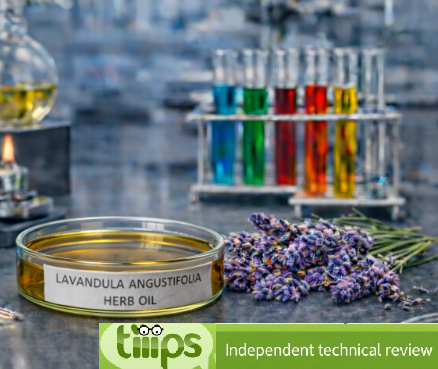
Lavandula angustifolia herb oil is an essential oil typically obtained by distillation (commonly steam distillation) from the flowering tops/herbaceous aerial parts of true lavender. In cosmetics, it is used primarily as a perfuming ingredient to deliver the characteristic “lavender” olfactory note, supporting the sensory positioning of many rinse-off and leave-on formulations and, when aligned with the product concept, the product’s botanical profile.
Definition
Lavandula angustifolia herb oil is not a single substance but a UVCB mixture with variable composition, consisting of a volatile fraction of terpenes and terpenoids. Its chemical profile depends significantly on botanical/geographic origin, harvesting time, yield and distillation parameters, as well as any supplier standardization or blending practices.
From a formulation standpoint, real-world performance is driven by: olfactory intensity and cleanliness, stability over time (oxidation control), compatibility with the base, and batch-to-batch consistency (specifications, analytical and organoleptic controls).
Main uses
Cosmetics.
It is used in cleansers, shower gels, shampoos, liquid/solid soaps, body creams, deodorants, and fragranced products. The impact is primarily sensory; in low-fragrance formulas or very “clean” olfactory targets, the essential oil may become a development constraint due to potential odor drift over shelf life.
INCI Functions
Fragrance. It plays a very important role in the formulation of cosmetic products as it allows perfume to be enhanced, masked or added to the final product, improving its commercial viability. The consumer always expects to find a pleasant scent in a cosmetic product.
Medicine.
It is not a therapeutic active within the scope of a cosmetic technical report. Lavender, in traditional medicine, is used as a medical plant in the treatment of inflammation, depression and stress, due to its sedative and anxiolytic action, thrombotic and antimicrobial properties.
Cultivation
True lavender (Lavandula angustifolia) is cultivated in temperate regions. For an essential oil derived from “herb”, agronomic and harvesting variability can affect composition and aromatic intensity. In industrial practice, this variability is managed through specifications, incoming controls, and, when needed, standardization or blending strategies to maintain sensory and analytical consistency.
For more information: LAVENDER
Key constituents
The composition is variable; operationally, the most relevant constituents are those that define the olfactory profile, stability, and regulatory/labeling implications. In practical terms, the oil typically contains:
Linalool and linalyl acetate, often predominant and central to the “lavender” character.
Other monoterpenes/terpenoids in variable proportions (for example 1,8-cineole, terpinen-4-ol, α-terpineol, camphor in some qualities/origins).
Trace components that may fall under fragrance allergens subject to label declaration when exceeding the applicable thresholds for the product category.
For formulators, the decisive controls remain: odor signature, batch-to-batch consistency, supplier-declared allergen profile, and resistance to oxygen/light (oxidation risk that can shift odor and increase sensitization potential).
Identification data and specifications
| Characteristic | Value |
|---|---|
| INCI name | Lavandula angustifolia herb oil |
| INCI functions | fragrance |
| CAS number | 90063-37-9 (frequently associated with “herb oil”); some technical sheets also report 8000-28-0 for “lavender oil” |
| EC/EINECS number | 289-995-2 (commonly reported) |
| Origin | Essential oil from Lavandula angustifolia (Lamiaceae) |
| Substance type | UVCB mixture (essential oil) |
| Molecular formula | Not applicable (mixture) |
| Molecular weight | Not applicable as a single value (mixture) |
| Standards and technical references (indicative) | Potential reference to sector/ISO quality standards, per supplier specification |
| Typical specification items (indicative) | GC profile (markers), refractive index/density/optical rotation, limits on impurities/contaminants, batch traceability |
Indicative physico-chemical properties
| Characteristic | Indicative value | Note |
|---|---|---|
| Chemical nature | Lipophilic mixture of terpenes/terpenoids | Composition varies with origin and process |
| Solubility | Lipophilic; limited in water | A solubilizer is often required in aqueous systems |
| pH stability | Matrix-dependent | Extreme pH can accelerate odor drift in formula |
| Light/oxygen stability | Sensitive | Barrier packaging and compatible antioxidants can be useful |
| Thermal stability | Sensitive to prolonged stress | Prefer controlled-temperature addition when feasible |
| Critical parameters | Odor, GC profile, declarable allergens, oxidation status | Drive repeatability and compliance |
Functional role and practical mechanism of action
The primary function is fragrance: volatile molecules are released, determining the scent of the product and/or skin. Performance depends on dose, volatility, interactions with surfactants/polymers/emulsifiers, and especially stability in the final packaging over shelf life. In products with delicate olfactory targets, even small batch variation or oxidation can be perceptible and may require fragrance adjustments or a change of grade/supplier.
Formulation compatibility
Common points of attention include compatibility with solubilizers and surfactant systems (risk of haze), interactions with polymers and thickeners (appearance or viscosity shifts), and compatibility with preservative systems and complex fragrances (note overlap). Packaging is also critical: oxygen permeability and light transmission can accelerate odor drift and increase oxidized fractions with potentially higher sensitization relevance.
Use guidelines
Use levels are strongly dependent on the sensory target and product category (rinse-off vs leave-on). In practice, it is advisable to define measurable organoleptic targets (intensity, note cleanliness, acceptability) and validate through accelerated stability and final-packaging tests, including checks on odor profile and, when relevant, on components/allergens subject to declaration at applicable thresholds.
Quality, grades, and specifications
Supplier-to-supplier variability can be significant. Robust control typically benefits from: organoleptic specifications, GC marker profile with acceptable ranges, declared allergen profile requirements, impurity/contaminant limits, and batch-acceptance criteria aligned with finished-product positioning. In the supply chain, applying GMP (good manufacturing practice; benefit: improves traceability and reduces contamination/variability) supports repeatability and control.
Safety, regulatory, and environment
Safety must be assessed on the finished product based on concentration, exposure area, and target population. For essential oils, a key operational regulatory topic is the presence of fragrance allergens that may require label declaration when exceeding the thresholds applicable to leave-on or rinse-off products. Oxidation control is also central because oxidation can shift odor and may increase sensitization relevance in susceptible individuals.
Allergen status.
It may contain fragrance allergens (for example linalool and others) that can be subject to declaration above threshold; treat as a potential allergen-containing ingredient depending on composition and finished-product level.
Contraindications
Use with caution for very sensitive or reactive skin, in products intended for children or delicate areas, and in formulas with higher fragrance loads; avoid use on compromised skin when the risk assessment indicates a tolerability concern.
From an environmental and process perspective, practical priorities include impurity control, appropriate waste handling, and adequate supplier quality systems. In the absence of supplier-specific sustainability data, it is prudent to treat the oil as sensitive (oxygen/light) and implement controls and packaging consistent with that risk profile.
Formulation troubleshooting
Odor drift over time.
Action: reduce light/oxygen exposure (barrier packaging), evaluate compatible antioxidants, select a grade with more stable specifications, and set organoleptic tolerances.
Haze or instability in aqueous/surfactant systems.
Action: optimize solubilization (solubilizer type, order of addition), re-balance use level, check compatibility with thickeners and electrolytes, and confirm with accelerated stability.
Loss of perceived intensity in formula.
Action: review the overall fragrance system, check absorption into polymers or packaging, and evaluate fixation strategies consistent with the product concept.
Conclusion
Lavandula angustifolia herb oil is an essential oil used in cosmetics primarily as a fragrance ingredient. Reliable use requires quality control (analytical and organoleptic profile), management of batch variability, attention to formulation compatibility, and oxidation prevention across shelf life. Finished-product safety assessment and labeling compliance for declarable fragrance allergens remain critical for market placement.
Mini-glossary
UVCB. Substances of unknown or variable composition, complex reaction products, or biological materials; a typical case is essential oils.
Marker (GC). “Tracer” components used to define and control quality by gas chromatography.
Oxidation. Chemical alteration induced by oxygen and/or light that can change odor and increase the presence of potentially more sensitizing derivatives.
GMP. Good manufacturing practice; benefit: improves traceability and reduces contamination/variability.

