



Lavandula angustifolia callus extract: properties, uses, pros, cons, safety
(Lavandula angustifolia; Lamiaceae)
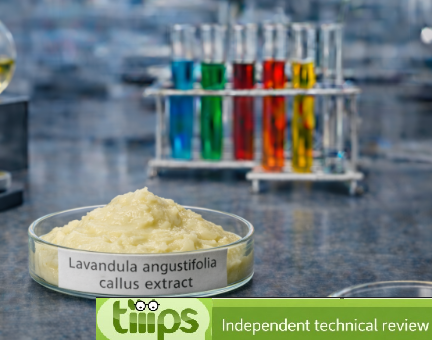
Lavandula angustifolia callus extract is an extract obtained from callus (cultured tissue) of Lavandula angustifolia. In cosmetics it is used as a functional ingredient to help keep skin in good condition and, in some applications, to support skin protection and the formula’s hygiene (in terms of a declared antimicrobial ingredient function).
Definition
“Callus” is an undifferentiated plant tissue produced through tissue culture. A callus-derived extract has a composition influenced by culture conditions, growth medium, and the extraction process specification. Practically, compared with “whole-plant” extracts, the callus/tissue culture approach often aims for higher repeatability and control of the starting material, while still remaining a variable-composition ingredient (not attributable to a single molecule).
From a technical standpoint, in-formula performance depends mainly on: the commercial grade (assay/standardization if declared), vehicle (aqueous, glycolic, hydroalcoholic, etc.), organoleptic profile, and quality specifications (impurities, residues, microbiology).
Main uses
Cosmetics.
Used in skincare and, in some cases, haircare products where it is positioned for skin conditioning, skin protecting, and hair conditioning. The antimicrobial function is intended as an ingredient function (supporting control of microbial growth), but it does not replace a properly validated preservative strategy for the finished product.
INCI functions
Antimicrobial agent. This ingredient is able to suppress or inhibit the growth and replication of a broad spectrum of microorganisms such as bacteria, fungi and viruses by making the stratum corneum temporarily bactericidal and fungicidal.
Hair conditioning agent. A large number of ingredients with specific purposes can co-exist in a hair shampoo: cleansers, conditioners, thickeners, mattifying agents, sequestering agents, fragrances, preservatives, special additives. However, the indispensable ingredients are the cleansers and conditioners as they are necessary and sufficient for hair cleansing and manageability. The others act as commercial and non-essential auxiliaries such as: appearance, fragrance, colouring, etc. Hair conditioning agents have the task of increasing shine, manageability and volume, and reducing static electricity, especially after treatments such as colouring, ironing, waving, drying and brushing. They are, in practice, dispersing agents that may contain cationic surfactants, thickeners, emollients, polymers. The typology of hair conditioners includes: intensive conditioners, instant conditioners, thickening conditioners, drying conditioners.
Skin conditioning agent. It is the mainstay of topical skin treatment by restoring, increasing or improving skin tolerance to external factors, including melanocyte tolerance. The most important function of the conditioning agent is to prevent skin dehydration, but the subject is rather complex and involves emollients and humectants.
Skin protectant. It creates a protective barrier on the skin to defend it from harmful substances, irritants, allergens, pathogens that can cause various inflammatory conditions. These products can also improve the natural skin barrier and in most cases more than one is needed to achieve an effective result.
Medicine.
Not a therapeutic active. In traditional medical medicine it is used as a medical plant in the treatment of inflammation, depression and stress, due to its sedative and anxiolytic action, thrombotic and antimicrobial properties.
Cultivation
Not applicable in the traditional agricultural sense: the starting material is produced via tissue culture (callus). Variability is linked to bioprocess parameters (plant/cell line, medium, growth conditions) rather than to seasonality and terroir.
For more information: LAVENDER
Key constituents
Composition is variable and process-dependent. In general terms, a callus extract may contain polar and semi-polar fractions of the phytocomplex (with possible markers defined by the supplier), in addition to vehicle-related components. Operationally, the most critical points for formulators are: standardization (if present), vehicle/solvent residues, color/odor, and microbiological controls of the commercial grade.
Nutritional use note and bioactive compounds
Not relevant within the cosmetic scope. Technical focus is on function in formula and grade quality (standardization, compatibility, and stability).
Identification data and specifications
| Characteristic | Value |
|---|---|
| INCI name | Lavandula angustifolia callus extract |
| INCI functions | antimicrobial, hair conditioning, skin conditioning, skin protecting |
| CAS number | not unique / often not listed for this specific INCI entry; verify supplier SDS and documentation |
| EC/EINECS number | not unique / often not listed; verify supplier SDS and documentation |
| Molecular formula | not applicable (variable-composition mixture/extract) |
| Molecular weight | not applicable as a single value (mixture/extract) |
| Typical commercial form | extract in solution or blend (vehicle grade-dependent) |
| Practical quality note | specifications on assay/markers (if any), residues/impurities, color/odor, and microbiological requirements per supplier |
Physico-chemical properties (indicative)
| Characteristic | Value | Note |
|---|---|---|
| Chemical nature | complex extract with variable composition | dependent on culture and process |
| Solubility | vehicle-dependent | verify the grade technical sheet |
| pH stability | generally better in moderate ranges | extremes may accelerate color/odor changes |
| Light/oxygen stability | variable | accelerated tests and barrier packaging are useful |
| Thermal stability | sensitive to prolonged stress | prefer addition at controlled temperatures |
| Critical parameters | color, odor, vehicle residues, microbiology | determine repeatability and acceptability |
Functional role and practical mechanism of action
In cosmetics, Lavandula angustifolia callus extract is used mainly for skin conditioning and skin protecting; in haircare it may contribute to hair conditioning. The practical rationale is linked to the extract’s overall contribution to perceived product quality and to skin/scalp management within the formulation context, with results depending on concentration, vehicle, and matrix (leave-on vs rinse-off).
Formulation compatibility
Most relevant technical points include:
compatibility with the preservative system (the ingredient does not replace finished-product preservation)
management of color and odor in pale or lightly fragranced formulas
shelf-life stability with respect to pH, light, and oxygen
batch-to-batch consistency when the extract is “characterizing” for claims and sensorial perception
Use guidelines (indicative)
Use levels are grade-dependent. It is advisable to define targets in relation to assay/markers (if available), validate with accelerated stability, and verify compatibility in final packaging. In leave-on products, it is particularly useful to assess tolerability on sensitive skin and organoleptic impact at the target dose.
Quality, grades, and specifications
Quality depends on process standardization (tissue culture and extraction) and the supplier specification. Robust control includes: assay/markers (if declared), vehicle residues, impurities, microbiological requirements, and tolerances for color/odor. Batch-to-batch repeatability is a key driver for finished-product consistency.
Safety, regulatory, and environment
Safety must be assessed on the finished product considering concentration, use area, and target population. For complex extracts, practical concerns include compositional variability (mitigated by standardization) and individual tolerability, plus the vehicle’s contribution (solvents and preservatives), which often drives skin compatibility. A GMP framework (good manufacturing practice; benefit: reduces variability and contamination) across the supply chain supports traceability and quality control of the commercial grade.
Formulation troubleshooting
Color/odor instability over time.
Action: check pH and light/oxygen stress, retune packaging and dose, and select a grade with more stable organoleptic specifications.
Preservative compatibility or haze/precipitation.
Action: evaluate a different vehicle/grade, optimize the preservative strategy, and confirm via accelerated stability in the final matrix.
Conclusion
Lavandula angustifolia callus extract is a callus (tissue culture)-derived extract used in cosmetics for skin conditioning, skin protecting, and in some cases hair conditioning, with an antimicrobial function intended as an ingredient function. For reliable use, key points are: grade selection (vehicle and standardization), stability management (pH, light, oxygen), batch-to-batch quality control, and finished-product safety assessment, supported by a GMP-oriented supply chain.
Mini-glossary
Callus: undifferentiated plant tissue produced in culture, used as a basis for tissue-culture-derived ingredients.
Tissue culture: technique for culturing plant cells/tissues under controlled conditions.
Skin protecting: a cosmetic function associated with helping protect skin from external influences.
GMP: good manufacturing practice; benefit: improves quality control and reduces contamination/variability.

