



Polylysine: INCI functions, identifiers (CAS/EC), cosmetic uses, and formulation notes
Polylysine – polymer/chain of L-lysine (technical note: in technical/food contexts you may also encounter ε-poly-L-lysine, often as the hydrochloride salt)
Synonyms: polylysine, poly-L-lysine, lysine homopolymer, ε-polylysine (technical use), ε-poly-L-lysine hydrochloride (salt form)
INCI / Functions: hair conditioning (hair-conditioning function as reported in EU cosmetic databases)
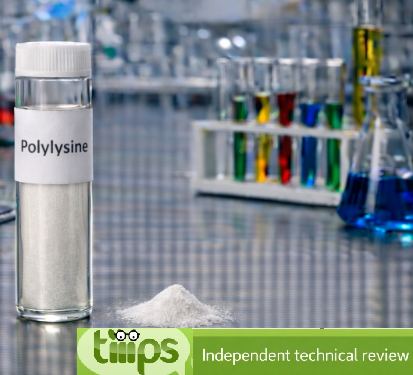
Definition
Polylysine is a cationic polypeptide made of repeating L-lysine units; in practical terms, it is an amino-acid “chain” that, in aqueous solution, carries a pronounced positive charge due to its side-chain amine groups. This property explains most of its formulation behavior: it tends to interact electrostatically with negatively charged surfaces and materials (hair keratin, certain dispersed particles, and several anionic polymers) and can contribute to improved combability and sensoriality, while also influencing system stability and haze/turbidity.
It is useful to distinguish two overlapping “families”/use areas that can coexist in practice:
Polylysine (INCI): cosmetic use mainly as a conditioning agent (especially in hair care).
ε-poly-L-lysine (often supplied also as the hydrochloride): technical use as an antimicrobial agent in various contexts (well known outside the EU in food applications); in cosmetics it may also appear as a functional component in some protective systems or as support to microbiological robustness strategies, but the official INCI function may not be “preservative” depending on the ingredient’s classification/registration and the market.
Main uses
Food. In several non-EU markets, ε-polylysine is used as an antimicrobial at very low levels (ppm range) to support microbiological stability of specific food matrices. From a technological standpoint, its value lies in activity across a broad microbial spectrum and the possibility of working across relatively wide pH ranges. In the European Union, food labeling logic is linked to the E-number system under Regulation (EC) 1333/2008: this is a critical point because the global market sometimes shows “E-xxx” claims that do not align with the EU framework and can therefore be misleading if used in EU labeling.
Cosmetics. In cosmetic formulation, polylysine is primarily associated with hair care products (rinse-off and, in some cases, leave-on) as a conditioning agent: it can help reduce post-wash roughness, improve combability, reduce static, and support a more “compact” fiber feel. Its cationic nature makes it conceptually aligned with conditioning technologies: it is attracted to keratin and can support the deposition/anchoring of other actives and polymers. In industrial practice, polylysine may also be used where a functional contribution to microbiological robustness is sought (often in synergy with polyols or other components), but real efficacy must be interpreted at the full-system level and verified via challenge testing on the finished product.
Medicine. In biomedical and research contexts, polylysine polymers (especially poly-L-lysine) are known as cationic materials useful for interactions with surfaces and biomaterials; they are widely referenced in laboratory/research settings (e.g., supports, coatings, biointerface applications). In an “ingredient for cosmetics” profile, this area is more technical background than a direct use indication.
Pharmaceutical. It may appear as a polymeric auxiliary in technical or development settings, but any real pharmaceutical use is dossier-dependent (specifications, purity, grade, impurities, compliance). For true pharma use, critical aspects include quality, control of endotoxins/bioburden (where relevant), and lot-to-lot consistency.
Industrial use. Beyond cosmetics and (in some markets) food, polylysine is a cationic polymer of interest in technical applications requiring electrostatic interactions or an antimicrobial contribution in specific systems. Here too, the determining factor is compatibility with the matrix (pH, salinity, surfactants, polymers) and the regulatory profile of the sector/country.
Calories (energy value)
| Parameter | Value |
|---|---|
| Energy value | Not meaningful at typical use levels (technical/cosmetic ingredient; when used as an antimicrobial, levels are generally in the ppm range) |
Identification data and specifications
| Identifier | Value |
|---|---|
| INCI name | Polylysine |
| Chemical nature | Polypeptide/polymer of L-lysine (cationic polymer) |
| Formula (repeat unit, indicative) | (C6H14N2O2)_x |
| Molar mass | Variable (depends on degree of polymerization; often stated as “variable” in technical sheets) |
| CAS number (polylysine / poly-L-lysine) | 25104-18-1 |
| CAS number (ε-poly-L-lysine hydrochloride, when applicable) | 28211-04-3 |
| EC/EINECS number | Not unique across commercial grades; some SDS report 219-078-4 |
| Typical commercial appearance | White to pale yellow powder, hygroscopic; water-soluble/dispersible (grade-dependent) |
Chemical-physical properties (indicative)
| Property | Value | Note |
|---|---|---|
| Charge in solution | positive | key feature for keratin adsorption and anionic interactions |
| Water solubility | good to high (grade-dependent) | improves handling in aqueous phase |
| Sensitivity to electrolytes/pH | moderate | salinity and pH influence electrostatic association and haze |
| Thermal stability (general) | good under compatible conditions | always verify in the real matrix and intended storage conditions |
Functional role and practical mechanism
| Function | What it does in formula | Technical note |
|---|---|---|
| Hair conditioning | improves combability and sensoriality, reduces roughness | adsorption favored by positive charge |
| Support to system performance | may contribute to colloidal stability or, conversely, cause complexation | depends on anionic polymers/surfactants and ionic strength |
| Antimicrobial action (specific context) | interacts with microbial membranes and destabilizes them | more typical of ε-polylysine in technical contexts; always validate via challenge testing on the finished product |
Formulation compatibility
Because polylysine is cationic, it should be treated as a “charge-active” ingredient: it is generally easier to incorporate into systems where the anionic component is controlled or balanced. Compatibility is often good with many nonionic bases and a range of emulsifying/surfactant architectures, but it can become critical in the presence of: (i) anionic polymers (e.g., non-neutralized carbomer or certain anionic acrylates), (ii) high levels of anionic surfactants, and (iii) high ionic strength (salt), which can shift solubility/association equilibria. The typical risks are haze, erratic viscosity, or precipitation due to anionic–cationic complexation.
In hair care, where deposition onto the fiber is often desired, the practical goal is to reach a balance: enough interaction to provide conditioning, but not so much as to cause build-up, heaviness, or physical instability. The real working window depends strongly on pH, surfactant ratio, presence of silicones/film formers, and the addition sequence (pre-dissolution in water, cold vs hot addition, hydration time).
Use guidelines (indicative)
| Application | Typical range | Technical note |
|---|---|---|
| Shampoos / conditioners / masks | 0.05–0.5% | depends on desired conditioning and the rest of the polymer package |
| Leave-on hair treatments | 0.01–0.2% | verify tackiness, build-up, and film-former compatibility |
| Systems aiming at microbiological support | variable | does not automatically replace a preservative: validate with challenge testing |
Quality, grades, and specifications
| QC parameter | What to check |
|---|---|
| Identity | INCI/CAS alignment and grade traceability (polylysine vs ε-polylysine and corresponding salt forms) |
| Average molecular weight | affects viscosity, deposition, and performance |
| Purity and impurities | residues (grade-dependent), ash/ions, insolubles |
| Moisture | often critical for hygroscopic powders |
| Microbiology | especially for grades used in aqueous bases or sensitive applications |
| Appearance/color/odor | lot-to-lot stability and absence of off-notes |
Safety, regulatory, and environment
From a cosmetic safety standpoint, polylysine is generally considered manageable at typical use levels when incorporated into finished products that have been properly assessed. The most frequent criticalities are technical rather than toxicological: charge incompatibilities, haze, and physical instability can drive performance variability and, indirectly, reformulation decisions. As always, assessment must be carried out on the finished product (real exposure, target population, application area, potential eye contact).
From a regulatory perspective, in EU cosmetics the practical framing is via INCI naming and the associated functions in sector databases. In EU food, labeling is tied to the list of authorized additives under Regulation (EC) 1333/2008 with the E-number system: it is essential not to confuse numbers or naming used in other markets with those valid in Europe (for example, in the EU framework “E 239” corresponds to a different substance). In manufacturing and QC, adoption of GMP (Good manufacturing practice; benefit: improves consistency and reduces variability/contamination risk) and, where relevant, a HACCP approach (Hazard analysis and critical control points; benefit: strengthens preventive control at critical process points) helps maintain consistency and reduce contamination or variability risks.
Formulation troubleshooting
| Problem | Possible cause | Recommended intervention |
|---|---|---|
| Haze/precipitation | complexation with anionics (polymers or surfactants), high salinity | reduce anionics, rebalance charges, adjust pH/ionic strength, modify addition order |
| Unstable viscosity | polymer–polymer or polymer–salt interactions | optimize electrolytes, use compatible co-polymers, retune neutralization |
| Hair feels “weighed down” | excessive deposition or synergy with other conditioners | reduce dose, change molecular weight/grade, rebalance film formers and silicones |
| Loss of transparency in shampoo | electrostatic association + micelles | adjust surfactant/polymer ratio, add compatible solubilization strategy |
Conclusion
Polylysine (Polylysine) is an L-lysine polymer with a positive charge that, in cosmetics, is positioned primarily as a hair conditioning ingredient supporting sensoriality and manageability. The most relevant technical point is charge compatibility: the same property that drives deposition can also cause complexation and instability if the system contains anionics under unfavorable conditions. Effective use therefore requires a balanced formulation approach (pH, ionic strength, surfactant/polymer architecture) and practical validation on the finished product.
Mini-glossary
INCI: standard nomenclature for cosmetic ingredient labeling.
Cationic polymer: polymer that in water carries a positive charge and interacts with negatively charged species.
Anionic–cationic complex: electrostatic association between oppositely charged species, which can cause haze or precipitation.
E-number: EU code identifying food additives authorized in the European Union.
GMP: Good manufacturing practice; supports quality and process control, reducing variability and contamination risk.
HACCP: Hazard analysis and critical control points; preventive risk analysis and control of critical points (relevant as a control approach in regulated contexts).

