



Castanea sativa leaf extract (Castanea sativa)
Synonyms: sweet chestnut leaf extract, chestnut leaf extract
Botanical family: Fagaceae
INCI / functions: skin conditioning, soothing
Definition
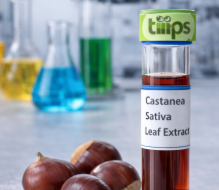
Castanea sativa leaf extract is an extract (typically solvent-based) obtained from the leaves of Castanea sativa (Fagaceae), used mainly to support skin comfort and overall skin condition. From a compositional standpoint, the ingredient primarily contains polyphenols (especially hydrolysable tannins, including gallo- and ellagitannins) and flavonoids (commonly quercetin derivatives), with additional phenolic acids; the exact profile depends on botanical origin, harvest conditions, and extract standardization.
Food: limited use depending on regulatory framework and grade; leaves are more often referenced for traditional/technical purposes rather than mainstream food ingredient use.
Cosmetics: soothing and skin conditioning in face/body products and, where relevant, scalp care; supports comfort-oriented formulas.
Medicine: traditional uses of leaves in herbal preparations with an astringent profile (not equivalent to clinical claims).
Pharmaceutical: potential use as a component of non-sterile preparations/support products, subject to grade specifications and product dossier.
Industrial use: plant raw material rich in tannins for technical extraction and formulation uses (sector- and grade-dependent).
Calories (energy value)
| Metric | Value |
|---|---|
| Energy value (100 g) | Not practically significant at typical use levels (functional use, not nutritional) |
| Technical note | In cosmetics, “calories” are not a performance driver; assay, purity, and standardization are more relevant |
Identification data and specifications
| Parameter | Value |
|---|---|
| INCI | Castanea Sativa Leaf Extract |
| Plant part used | leaves |
| Preparation type (general) | extract |
| CAS number | 84695-99-8 (commonly used assignment for several Castanea sativa extracts) |
| EC number | 283-619-0 |
| Property | Indicative value |
|---|---|
| Physical form | liquid/solution or powder (depends on grade: glycerite, hydro-glycolic, dry extract) |
| Color | yellow-brown to brown (linked to polyphenol content) |
| Solubility/dispersibility | depends on the carrier (water, glycerin, glycols) and on dry-form handling |
| Batch variability | influenced by harvest and standardization; control of total polyphenols or specific markers is recommended |
Key constituents
| Constituent class | Examples of constituents | Functional note |
|---|---|---|
| Tannins (hydrolysable) | gallo- and ellagitannins | contributes to an astringent profile and the antioxidant character of the polyphenolic matrix |
| Flavonoids | quercetin derivatives (and other leaf flavonoids) | supports a soothing profile and helps address oxidative stress (dose- and form-dependent) |
| Phenolic acids | e.g., gallic acid and derivatives | contributes to the overall antioxidant profile |
| Minerals/other | variable (raw-material dependent) | generally not the primary performance driver in cosmetics |
Functional role in formulation
| Topic | Detail |
|---|---|
| Primary cosmetic function | soothing and skin conditioning |
| Expected effect | supports comfort (skin feels “more at ease”), depending on dose, carrier, and overall formula |
| Technical levers | choice of grade (hydro-glycolic/glycerite/dry), standardization markers, compatibility with pH and metals |
Formulation compatibility
| System / variable | Compatibility | Control notes |
|---|---|---|
| Aqueous phase (O/W) | generally good | verify haze based on carrier and assay |
| pH | to be verified | polyphenols may destabilize outside the supplier’s recommended pH window |
| Salts/metals | caution | tannins can complex metals (risk of darkening/color instability) |
| Preservatives | to be verified | possible interactions with preservation systems; run challenge testing per protocol |
| Surfactants | generally compatible | evaluate impact on color/odor and clarity |
Use guidelines (indicative)
| Application | Typical range | Technical note |
|---|---|---|
| Leave-on skincare (serums/creams/lotions) | 0.1–2.0% | depends on actual extract strength (solution vs dry) |
| Rinse-off (cleansing) | 0.1–1.0% | assess color stability and surfactant compatibility |
| Scalp care | 0.1–1.5% | align with intended positioning/claims and finished-product tolerance |
Quality, grades and specifications
| Topic | Detail |
|---|---|
| Grades | cosmetic (different carriers), sometimes technical/herbal grades |
| Recommended controls | polyphenol markers, microbiological limits, trace metals, residual solvents (if applicable) |
| Documentation | CoA, technical sheet, and specification are critical for repeatability and defensible claims |
Safety, regulation and environment
| Topic | Operational guidance |
|---|---|
| Safety profile | generally suitable for cosmetic use at typical levels; manage possible irritation in sensitive subjects via finished-product assessment |
| Allergens | not typically classified as an allergen; still verify impurities and carrier composition (glycols, etc.) |
| EU cosmetics | usable under general rules and GMP; responsibility lies with the finished-product safety assessment and substantiation |
| Environment | manage effluents and process residues per good practice; pay attention to solvents/carriers used by the supplier |
Formulation troubleshooting
| Issue | Possible cause | Corrective actions |
|---|---|---|
| Progressive darkening / color shift | metal complexation (Fe/Cu), polyphenol oxidation | reduce metal contact, use compatible chelators, optimize packaging and formula antioxidants |
| Haze / precipitates | carrier–system incompatibility, high assay, non-optimal pH | switch grade (glycerite vs dry), adjust pH, filter/standardize batches |
| Microbiological instability | high initial load or non-optimized preservation | define microbiological specs, optimize preservation and process, confirm with challenge testing |
Conclusion
Castanea sativa leaf extract is a plant-derived ingredient rich in polyphenols (tannins and flavonoids), used mainly in cosmetics as a soothing and skin-conditioning component. Formulation performance depends critically on grade form (solution vs dry), standardization, the pH window, and management of metals/oxidation, as well as on supplier documentation quality (CoA and specifications).
For more information and studies: Chestnut

