Ban Xia – Pinellia ternata – family Araceae
Description
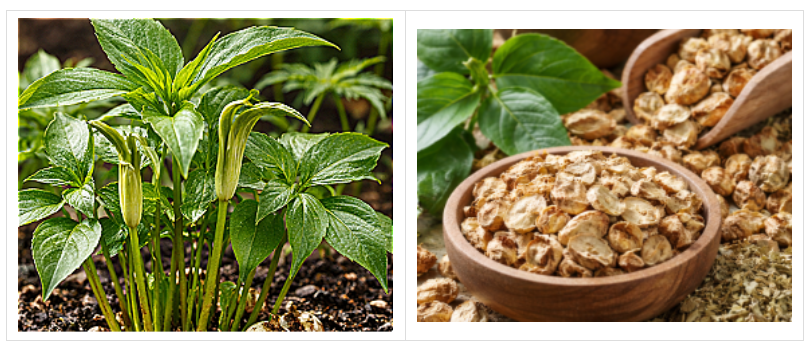
Pinellia ternata is a perennial herbaceous species belonging to the botanical family Araceae and is widely used in East Asian traditional medicine. The plant is relatively small in size, usually reaching 15–40 cm in height, and develops from a globose underground tuber, which represents the part of greatest traditional and functional relevance.
The stem is short and upright, while the leaves are characteristically ternate (hence the specific name ternata), composed of three ovate to lanceolate segments with entire or slightly undulate margins and an acuminate apex. Leaf surfaces are smooth and medium to dark green in colour.
The inflorescence is typical of the Araceae family and consists of a spadix surrounded by a spathe, usually green to greenish-purple and inconspicuous. The species follows a seasonal growth cycle, with active development during spring and summer and dormancy during colder or drier periods.
Distribution, ecology and cultivation aspects
Pinellia ternata is native to China, Korea and Japan, where it grows naturally in plains and hilly areas, field margins, moist grasslands and partially shaded habitats.
Ecologically, it prefers:
Temperate climates with adequate seasonal moisture;
Well-drained soils, typically loose or loamy and rich in organic matter;
Semi-shaded to moderately sunny exposures;
Good tolerance to winter cold, due to the presence of the underground tuber.
Propagation occurs through tuber division or via small bulbils that form along the leaf petiole, a distinctive trait of the species. In cultivation, growth is relatively rapid, but tuber harvesting for traditional use generally takes place after several growing cycles to ensure adequate size and quality.
Chemical composition of the tuber and functional characteristics
The tuber of Pinellia ternata contains a complex mixture of primary and secondary metabolites, including:
Alkaloids and nitrogen-containing compounds;
Lectins and specific proteins;
Polysaccharides;
Calcium oxalate crystals in the form of needle-like raphides, typical of Araceae;
Volatile compounds and other minor constituents.
The presence of calcium oxalate raphides makes the fresh tuber naturally irritant and toxic, and therefore unsuitable for direct use. Traditional detoxification and processing methods—often involving treatment with ginger, alum or other adjuvants followed by drying—are essential to reduce irritancy and render the material suitable for herbal applications.
Traditional uses and modern applications
In Traditional Chinese Medicine, Pinellia ternata is known as Ban Xia and is one of the most commonly used herbal materials, always after appropriate processing. Traditionally, it is employed in compound formulations to:
Support the regulation of body fluids;
Assist in the management of phlegm and mucus accumulation;
Contribute to the functional balance of the digestive system;
Promote general wellbeing in specific traditional patterns.
Processed and dried tubers are used in decoctions, powders and extracts, almost always in combination with other medicinal plants. In modern contexts, Pinellia ternata is the subject of phytochemical and pharmacological research aimed at better understanding its mechanisms of action, safety profile and potential applications within regulated frameworks.
Tuber quality and commercial requirements
Quality evaluation of Pinellia ternata tubers intended for traditional or functional use is based on:
Size and shape of the tuber, indicating maturity;
Colour and texture after drying;
Absence of mould, pests or degradation;
Correct processing and detoxification, a critical safety requirement;
Chemical profile consistent with reference standards;
Microbiological compliance with regulations for herbal raw materials.
Careful control of harvesting, processing, drying and storage is essential to ensure safety, stability and consistent quality of the final product.
Cultural value and safety considerations
Pinellia ternata holds a prominent place in the traditional pharmacopoeia of East Asia, while also serving as a clear example of a medicinal plant that requires specialised processing knowledge for safe use.
Improper handling or use of the fresh tuber may pose significant health risks; therefore, its use is restricted to properly processed material and to contexts that comply with regulatory and safety requirements. The species highlights the importance of traditional processing techniques as a means of both valorisation and toxicity mitigation in herbal medicine.
Classification
| Level | Classification |
|---|
| Origin | Plant-based |
| Species | Pinellia ternata |
| Botanical family | Araceae |
| Traditional name | Ban Xia |
| Category | Perennial herbaceous plant |
Plant and raw material characteristics
| Aspect | Description |
|---|
| Plant type | Perennial herb |
| Underground organ | Tuberous rhizome |
| Leaves | Trifoliate |
| Inflorescence | Spathe and spadix |
| Used part | Tuber |
| Form of use | Dried and processed |
| Traditional use | Phytotherapeutic |
| Allergens | None known |
Indicative nutritional values
Not applicable for food use.
Pinellia ternata is not a food and is not used for caloric or nutritional intake. Its application is limited to processed tuber preparations within traditional medicinal systems.
Note on use and bioactive compounds present
The tuber of Pinellia ternata contains alkaloids, lectins, and calcium oxalate crystals, which are responsible for the strong irritant properties of the fresh plant material. Traditional processing methods aim to modify and reduce the activity of these compounds, making the material suitable for controlled traditional use.
Ban Xia has a long-standing role in traditional Chinese medicine, but it must be handled and used exclusively within regulated and specialized frameworks.
References________________________________________________________________________
Lin S, Nie B, Yao G, Yang H, Ye R, Yuan Z. Pinellia ternata (Thunb.) Makino Preparation promotes sleep by increasing REM sleep. Nat Prod Res. 2019 Nov;33(22):3326-3329. doi: 10.1080/14786419.2018.1474466.
Abstract. Pinellia ternata (Thunb.) Makino Preparation (PTP) is widely used to treat insomnia in traditional Chinese medicine; however, its specific role is not clear. In this study, PTP was prepared at three concentrations. For locomotor activity tests, mice were treated with PTP and evaluated for 14 days. For polygraph recordings, mice were treated for 14 days and recorded after treatment. The main chemical constituents in PTP were identified by Ultra performance liquid chromatography/quadrupole time spectrometry (UPLC/Q-TOF-MS). The results showed that 0.9 g/mL PTP significantly reduced locomotor activity. The effect was related to the time of treatment. PTP reduced wakefulness and increased sleep in mice. Furthermore, PTP promoted sleep by increasing the number of REM sleep episodes with a duration of 64-128s and increasing the number of transitions from NREM sleep to REM sleep and from REM sleep to wakefulness. A total of 17 compounds were identified.
Du W, Su J, Ye D, Wang Y, Huang Q, Gong X. Pinellia ternata Attenuates Mucus Secretion and Airway Inflammation after Inhaled Corticosteroid Withdrawal in COPD Rats. Am J Chin Med. 2016;44(5):1027-41. doi: 10.1142/S0192415X16500579.
Abstract. Inhaled corticosteroids (ICS) are widely used to manage chronic obstructive pulmonary disease (COPD). However, withdrawal of ICS generally causes various adverse effects, warranting careful management of the ICS withdrawal. Pinellia ternata, a traditional Chinese herbal medicine, has been used to treat respiratory diseases in China for centuries. Here, we investigated its role in antagonizing ICS withdrawal-induced side effects, and explored the underlying mechanisms. The rat COPD model was established using a combination of passive cigarette smoking and intratracheal instillation of lipopolysaccharide (LPS). COPD rats were treated with saline or budesonide inhalation, or with budesonide inhalation followed by saline inhalation or Pinellia ternata gavage. The number of goblet cells and the level of mucin 5AC (MUC5AC) were enhanced by budesonide withdrawal. Pinellia ternata treatment significantly blocked these effects. Further, Pinellia ternata treatment reversed budesonide withdrawal-induced increase of interleukin 1[Formula: see text] (IL-1[Formula: see text] and tumor necrosis factor [Formula: see text] (TNF-[Formula: see text]) levels in bronchoalveolar lavage fluid (BALF). Extracellular signal-regulated kinase (ERK), but neither p38 nor c-Jun N-terminal kinase (JNK), was activated by budesonide withdrawal, and the activation was blocked by Pinellia ternata treatment. The MUC5AC expression was positively correlated with goblet cell number, IL-1[Formula: see text] and TNF-[Formula: see text] levels, and ERK activity. Pinellia ternata treatment protected the airway from ICS withdrawal-induced mucus hypersecretion and airway inflammation by inhibiting ERK activation. Pinellia ternata treatment may represent a novel therapeutic strategy to prevent ICS withdrawal-induced side effects in COPD patients.
Lu HK, Huang Y, Liang XY, Dai YY, Liu XT. Pinellia ternata attenuates carotid artery intimal hyperplasia and increases endothelial progenitor cell activity via the PI3K/Akt signalling pathway in wire-injured rats. Pharm Biol. 2020 Dec;58(1):1184-1191. doi: 10.1080/13880209.2020.1845748.
Abstract. Context: Clinically, Pinellia ternata (Thunb.) Breit. (Araceae) (PT) has been widely used in the treatment of atherosclerosis and hyperlipidaemia, but the underlying mechanisms are still not clearly understood. Objective: This research was conducted to confirm the mechanism by which PT affects carotid artery intimal hyperplasia. Materials and methods: An intestinal hyperplasia Sprague-Dawley rat model was established by carotid artery injury. The rats were randomly divided into five groups (n = 8): sham, model, PT (with daily intragastric administration of 10 g/mL/kg PT tubers water extract), PT+LY294002 (with intraperitoneal injection of 50 mg/kg LY294002 + 10 g/mL/kg PT) and endothelial progenitor cells (EPCs) (with injection of 5 × 10⁵/cells), and treated for 4 or 8 weeks. Results: HE staining showed that PT attenuated intimal hyperplasia. RT-PCR, Western blotting and immunohistochemistry showed that PT increased the expression of vascular endothelial growth factor (VEGF) and eNOS in the atherosclerotic carotid artery. PT increased the Dil-acLDL+/FITC-UEA-1+ population (from 0.41 ± 0.085% to 0.60 ± 0.092%) in the blood, decreased TCHO, TG, LDL-C, IL-6 and TNF-α levels, and increased HDL-C and IL-10 levels in the blood. However, these changes were reversed by the PI3K/Akt pathway inhibitor LY294002. Discussion and conclusions: PT can be developed as an atherosclerosis and carotid intimal hyperplasia treatment drug. Therefore, further study will focus on the effects of PT on intimal hyperplasia in wire-injured atherosclerosis patients and explore in depth some other relevant molecular mechanisms.
Zhao XL, Guo ZL, Qi KL, Zhou QS, Liu YM, Xiong LX, Zhang J, Zhang J, Zhang WJ. The Polysaccharides from Pinellia ternata and Their Derivatives: Preparation, Structure Characteristics, and Activities in Vitro. Chem Biodivers. 2024 Aug;21(8):e202400596. doi: 10.1002/cbdv.202400596.
Peng W, Li N, Jiang E, Zhang C, Huang Y, Tan L, Chen R, Wu C, Huang Q. A review of traditional and current processing methods used to decrease the toxicity of the rhizome of Pinellia ternata in traditional Chinese medicine. J Ethnopharmacol. 2022 Dec 5;299:115696. doi: 10.1016/j.jep.2022.115696. Epub 2022 Sep 7. PMID: 36087845.




