



High oleic sunflower seed oil (Helianthus annuus – family Asteraceae)
Description
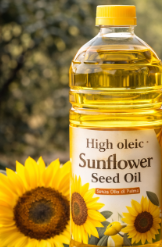
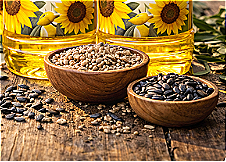
High-oleic sunflower seed oil is a vegetable oil obtained from the seeds of sunflower (Helianthus annuus), a plant belonging to the botanical family Asteraceae, selected for a very high oleic acid content. Unlike conventional sunflower oil, this oil is produced from specific high-oleic cultivars developed through traditional plant breeding (non-GMO), which results in a markedly different fatty acid profile.
The oil is clear, light yellow in colour, with a neutral odour and flavour, characteristics that make it suitable for a wide range of food and industrial applications. Its high oxidative stability is one of its most distinctive features.
 |  |
Classification
| Level | Classification |
|---|---|
| Origin | Plant-based |
| Species | Helianthus annuus |
| Botanical family | Asteraceae |
| Category | Vegetable oil |
| Raw material | High oleic sunflower seeds |
Botanical origin and raw material
Sunflower (Helianthus annuus) is an annual herbaceous species originally from the Americas and now widely cultivated in temperate regions worldwide. High-oleic sunflower varieties are characterised by lipid metabolism favouring oleic acid over linoleic acid accumulation in the seed.
Cultivation generally requires:
high solar exposure,
temperate to warm climates,
well-drained soils,
agronomic practices aimed at preserving seed quality and lipid composition.
Raw material and product characteristics
| Aspect | Description |
|---|---|
| Raw material | Selected sunflower seeds |
| Extraction method | Mechanical pressing |
| Refining | Possible |
| Color | Light yellow |
| Flavor | Neutral |
| Oxidative stability | High |
| Allergens | None |
Indicative average nutritional values per 100 g
| Component | Average value |
|---|---|
| Energy | 884 kcal |
| Fat | 100 g |
| of which saturated | 7.0 g |
| of which monounsaturated | 82.0 g |
| of which polyunsaturated | 9.0 g |
| Carbohydrates | 0 g |
| Protein | 0 g |
| Vitamin E | 45 mg |
| Vitamin K | 5 µg |
Average indicative values referring to high oleic sunflower seed oil. Natural variability may occur depending on cultivar and degree of refining.
Lipid composition and nutritional characteristics
The defining feature of high-oleic sunflower oil is its fatty acid profile, typically characterised by:
oleic acid (MUFA): approximately 75–90%,
saturated fatty acids: relatively low proportion,
linoleic acid (PUFA): markedly lower than in conventional sunflower oil.
This composition provides:
excellent oxidative stability,
greater resistance to high temperatures,
a nutritional profile that, in some respects, is comparable to that of refined olive oil.
From an energy standpoint, the oil supplies about 884 kcal per 100 g, as is typical for vegetable oils. It contains no proteins, carbohydrates or fibre and provides vitamin E (tocopherols) in variable amounts, contributing to its antioxidant capacity.
Technological properties
Thanks to its high oleic acid content, high-oleic sunflower oil shows:
a high smoke point,
reduced formation of oxidation products during heating,
good storage stability,
favourable behaviour in continuous industrial processing.
These properties make it particularly suitable for deep-frying, high-temperature cooking and applications requiring long oil life.
Food uses
In the food sector, high-oleic sunflower oil is used for:
domestic and professional frying,
baked goods and snack production,
formulation of margarines and structured vegetable fats,
neutral-tasting dressings,
industrial food applications where stability and sensory neutrality are required.
It is often chosen as an alternative to other vegetable oils when a reduced intake of oxidation-prone polyunsaturated fats is desired.
Note on nutritional use of the bioactive compounds present
High oleic sunflower seed oil provides large amounts of oleic acid, which contributes to the maintenance of normal blood cholesterol levels when replacing saturated fats. The presence of vitamin E supports cellular protection against oxidative stress. Thanks to its thermal stability, this oil is suitable for both raw use and cooking, allowing efficient management of dietary fat intake.
Non-food applications
High-oleic sunflower oil is also used in:
cosmetics, as an emollient and carrier in creams, lotions and skin oils;
technical and industrial applications, including biodegradable lubricants, inks, resins and bio-based products;
formulations requiring renewable, plant-derived and stable raw materials.
Quality assessment and commercial requirements
Key quality parameters include:
fatty acid profile, with a declared minimum oleic acid content;
free fatty acid level, indicating correct processing and storage;
peroxide value, reflecting oxidative status;
colour, odour and clarity, free from sensory defects;
absence of chemical contaminants and compliance with regulatory limits.
Optimal storage requires protection from light, heat and oxygen to preserve nutritional and technological properties over time.
Studies
In this study a review of the advancements in the development of sunflower oil varieties containing high stearic (∼18%) and high oleic (∼70%) acids which makes them healthy and sustainable alternatives to palm oil.(1) The results of the present study provide further evidence that sunflower-oil-enriched diets does not protect LDL against oxidation as virgin olive oil does in patients with peripheral vascular disease (2). The oxidative degradation of oily samples can be limited by using supercritical fluid extract of garlic as it is a safe and an effective natural antioxidant formulation (3).

