Carne suina (Sus scrofa domesticus)
Taglio fresco (muscolo + tessuti connettivi e variabile quota di grasso) ottenuto da suini da macello. Ampia variabilità compositiva e sensoriale in funzione di taglio (lonza, capocollo, spalla, pancetta, coscia, costine, filetto), età/peso, alimentazione e gestione post-mortem (pH, frollatura, raffreddamento). Impiegata come carne fresca, macinata e come base per salumi cotti e stagionati.
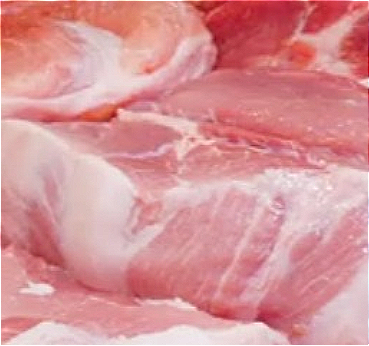
Valore calorico (per 100 g di parte edibile, cruda)
Tagli magri (filetto, lonza sgrassata): ~120–160 kcal; proteine ~20–23 g; grassi ~3–6 g.
Tagli medi (coscia, spalla sgrassata): ~160–220 kcal; grassi ~7–14 g.
Tagli grassi (pancetta, coppa con cotenna): ~250–350+ kcal; grassi >20 g.
Cotture a secco riducono l’acqua e concentrano i nutrienti; cotture umide e rifilature grasso riducono l’energia per porzione.
Composizione e micronutrienti (valori tipici, crudo)
Proteine complete con tutti gli amminoacidi essenziali (~20–23%).
Vitamine del gruppo B: tiamina (B1) elevata (≈0,5–0,8 mg/100 g nei tagli magri), B3 (niacina), B6, B12.
Minerali: ferro eme (inferiore al bovino ma biodisponibile), zinco, selenio, fosforo.
Colesterolo: ~60–80 mg/100 g (può salire con maggior quota grassa).
Profilo lipidico (riferito alla frazione grassa del suino)
Grassi totali: altamente variabili per taglio.
Saturi (SFA): ~35–42% (prevalenti palmitico C16:0 e stearico C18:0).
Monoinsaturi (MUFA): ~42–50% (oleico C18:1 dominante).
Polinsaturi (PUFA): ~8–15% totali
n-6 (linoleico C18:2, arachidonico C20:4): ~7–13%
n-3 (ALA C18:3, EPA/DHA tracce): ~0,3–1%
Trans/CLA: trascurabili (non ruminante).
Rapporto n-6/n-3: tipicamente elevato (≈10:1–20:1), modulabile con l’alimentazione del suino.
Nota: i tagli magri forniscono la stessa qualità di acidi grassi ma minor quantità assoluta di lipidi per 100 g.
Qualità tecnologica e parametri
pH finale (pH₍ᵤ₎): ~5,5–5,9 (influenza colore, WHC e tenerezza).
Colore (L*a*b*): lonza L* medio-alto; a* moderato (mioglobina).
Perdita di gocciolamento/WHC: critica per resa e succosità.
Difetti tecnologici: PSE (pale, soft, exudative – pallida, molle, essudante; L* alto, pH basso precoce); DFD (dark, firm, dry – scura, soda, asciutta; pH elevato).
Marmorizzazione (IMF): intramuscolare % correlata a succosità e sapore.
Processo e filiera
Macellazione → scotennatura/eviscerazione → raffreddamento rapido → frollatura breve (24–72 h) → sezionamento e taglio → confezionamento refrigerato (film, sottovuoto, MAP) → distribuzione a catena del freddo. Per salumi: salagione, cottura/affumicatura o fermentazione/essiccazione; eventuale uso di nitriti/nitrati secondo normativa.
Proprietà sensoriali e culinarie
Tagli rapidi: filetto, braciole di lonza → griglia/padella, cottura breve.
Tagli a lenta cottura: spalla, guancia, pancetta, costine → brasati, pulled pork, low & slow.
Cotture: arrostire, grigliare, brasare, sottovuoto/sous-vide; salamoia e marinature migliorano ritenzione idrica e tenerezza.
Reazioni di Maillard: fondamentali per crosta e aromi; asciugatura superficiale prima della rosolatura.
Sicurezza alimentare e cotture interne
Patogeni di rilievo: Salmonella, Yersinia enterocolitica, Campylobacter, Listeria (in RTE), Trichinella (oggi controllata in UE tramite filiera/analisi; rischio residuo in selvaggina/suino non ispezionato).
Temperature interne (linee guida pratiche):
Interi: almeno 63 °C al cuore con riposo (3 minuti).
Macinati/salsicce fresche: 70–72 °C al cuore.
Carni suine pronte: mantenere ≥60 °C in caldo.
Conservazione domestica: 0–4 °C; consumare entro 2–4 giorni (crudo confezionato); congelamento a −18 °C per 4–8 mesi (tagli) / 2–3 mesi (macinati). Evitare la zona di pericolo 5–60 °C e la cross-contamination.
Nutrizione e salute
Fonte di proteine ad alto valore biologico, B1 (e altre B), zinco e selenio. Allo stesso tempo, è stato dimostrato che un elevato consumo di carne rossa, in particolare di carne lavorata, può essere associato a un aumento del rischio di diverse importanti malattie croniche (1).
Il consumo moderato di carne, fino a ~ 100 g / die, non è stato associato a un aumento della mortalità per cardiopatia ischemica, ictus o malattie cardiovascolari totali (2).
I tagli magri riducono l’apporto di SFA e calorie; cucinare eliminando grasso visibile e preferendo metodi a umidità o sgrasso in cottura.
Sodio e nitriti/nitrati possono essere elevati nei prodotti trasformati (salumi): valutare il consumo e le porzioni.
Allergeni: la carne suina non è un allergene maggiore; i trasformati possono contenere latte/soia/glutine come coadiuvanti → leggere l’etichetta.
Qualità e specifiche (temi tipici)
pH, L*a*b*, WHC/drip loss, IMF (%) e forza di taglio.
Microbiologia: TVC, Enterobacteriaceae, Salmonella assente/25 g; nei RTE Listeria sotto i limiti.
Residui/contaminanti: metalli, antibiotici entro MRL; istamina bassa in carni fresche (salumi stagionati variabile).
Confezionamento: MAP (O₂/CO₂/N₂) o sottovuoto; integrità saldature; temperatura di trasporto.
Sostenibilità e filiera
Impatto ambientale legato a mangimi, emissioni e gestione reflui. Migliorano l’impronta: uso di coprodotti, ottimizzazione FCR (indice di conversione), benessere animale, energie rinnovabili in stabilimento, gestione effluenti verso target BOD/COD, packaging riciclabile e riduzione scarti (nose-to-tail).
Troubleshooting (uso/qualità)
Carne asciutta: sovracottura/bassa WHC → salamoia (1–2%), cottura a T interne precise, riposo post-cottura.
Colore troppo pallido (PSE): pH basso precoce → selezione materia e gestione termica; in cucina, marinare e cotture rapide.
Odori anomali: ossidazione/contaminazione → controllo catena del freddo, rimozione grasso ossidato.
Ristretta resa in padella: eccesso d’acqua superficiale → asciugare, rosolare in padella calda, non affollare.
Conclusione
La carne di suino offre ampia versatilità culinaria, buon profilo proteico e, nei tagli magri, un contenuto lipidico moderato. La resa sensoriale dipende da taglio, pH/WHC, marmorizzazione e gestione della cottura; la sicurezza si fonda su temperature interne adeguate, igiene e catena del freddo. La scelta informata del taglio e del metodo di cottura permette di bilanciare gusto, tenerezza e apporto di SFA.
Mini-glossario
SFA/MUFA/PUFA — acidi grassi saturi/monoinsaturi/polinsaturi.
n-6 / n-3 — famiglie omega-6 / omega-3.
pH₍ᵤ₎ — pH finale post-mortem.
WHC — water holding capacity, capacità di ritenzione idrica.
PSE / DFD — pale, soft, exudative / dark, firm, dry.
IMF — intramuscular fat, grasso intramuscolare (marmorizzazione).
L*a*b* — spazio colore CIELAB.
TVC — carica batterica totale; Y&M — lieviti e muffe.
MAP — modified atmosphere packaging, atmosfera protettiva.
HACCP/CCP — sistema di autocontrollo e punti critici.
BOD/COD — domanda biochimica/chimica di ossigeno (effluenti).
FIFO — first in, first out, rotazione scorte.
Bibliografia__________________________________________________________________________
(1) Wolk A. Potential health hazards of eating red meat. J Intern Med. 2017 Feb;281(2):106-122. doi: 10.1111/joim.12543.
Feingold KR,. The Effect of Diet on Cardiovascular Disease and Lipid and Lipoprotein Levels. 2024 Mar 31. In: Feingold KR, Ahmed SF, Anawalt B, Blackman MR, Boyce A, Chrousos G, Corpas E, de Herder WW, Dhatariya K, Dungan K, Hofland J, Kalra S, Kaltsas G, Kapoor N, Koch C, Kopp P, Korbonits M, Kovacs CS, Kuohung W, Laferrère B, Levy M, McGee EA, McLachlan R, Muzumdar R, Purnell J, Rey R, Sahay R, Shah AS, Singer F, Sperling MA, Stratakis CA, Trence DL, Wilson DP, editors. Endotext [Internet]. South Dartmouth (MA): MDText.com, Inc.; 2000–.
Singh B, Khan AA, Anamika F, Munjal R, Munjal J, Jain R. Red Meat Consumption and its Relationship With Cardiovascular Health: A Review of Pathophysiology and Literature. Cardiol Rev. 2025 Jan-Feb 01;33(1):49-53. doi: 10.1097/CRD.0000000000000575.
(2) Nagao M, Iso H, Yamagishi K, Date C, Tamakoshi A. Meat consumption in relation to mortality from cardiovascular disease among Japanese men and women. Eur J Clin Nutr. 2012 Jun;66(6):687-93. doi: 10.1038/ejcn.2012.6.
Abstract. Background/objectives: Although high or low (no) meat consumption was associated with elevated or reduced mortality from cardiovascular disease, respectively, few studies have investigated the association between moderate meat consumption and cardiovascular disease. We aimed to evaluate the associations between moderate meat consumption and cardiovascular disease mortality. Subjects/methods: We conducted a prospective cohort study of 51,683 Japanese (20,466 men and 31,217 women) aged 40-79 years living in all of Japan (The Japan Collaborative Cohort Study; JACC Study). Consumptions of meat (beef, pork, poultry, liver and processed meat) were assessed via a food frequency questionnaire administrated at baseline survey. Hazard ratios (HRs) of mortality from cardiovascular disease were estimated from Cox proportional hazards regression models according to quintiles of meat consumption after adjustment for potential confounding variables. Results: During 820,076 person-years of follow-up, we documented 2685 deaths due to total cardiovascular disease including 537 ischemic heart diseases and 1209 strokes. The multivariable HRs (95% confidence interval) for the highest versus lowest quintiles of meat consumption (77.6 versus 10.4 g/day) among men were 0.66 (0.45-0.97) for ischemic heart disease, 1.10 (0.84-1.43) for stroke and 1.00 (0.84-1.20) for total cardiovascular disease. The corresponding HRs (59.9 versus 7.5 g/day) among women were 1.22 (0.81-1.83), 0.91 (0.70-1.19) and 1.07 (0.90-1.28). The associations were similar when the consumptions of red meat, poultry, processed meat and liver were examined separately. Conclusion: Moderate meat consumption, up to ~100 g/day, was not associated with increased mortality from ischemic heart disease, stroke or total cardiovascular disease among either gender.
_______________
Hill ER, Wang Y, Davis EM, Campbell WW. Healthy Dietary Patterns with and without Meat Improved Cardiometabolic Disease Risk Factors in Adults: A Randomized Crossover Controlled Feeding Trial. Nutrients. 2024 Aug 3;16(15):2542. doi: 10.3390/nu16152542. PMID
Jung AJ, Sharma A, Chung M, Wallace TC, Lee HJ. The Relationship of Pork Meat Consumption with Nutrient Intakes, Diet Quality, and Biomarkers of Health Status in Korean Older Adults. Nutrients. 2024 Dec 4;16(23):4188. doi: 10.3390/nu16234188.
Abstract. Background: Pork meat is a widely consumed protein food with the potential to differentially affect health and nutritional status across social and cultural contexts. Objectives: We evaluated the association between pork meat consumption and nutrient intake, diet quality, and biomarkers of health among older adults (age ≥ 65 years) in Korea. Methods: Our analyses utilized dietary and health examination data from the 2016-2020 Korean National Health and Nutrition Examination Survey (n = 2068). Comparisons between variables derived from the nutrition survey and health examination by pork consumption (consumers vs. non-consumers) were assessed using regression analyses for survey data. Results: Pork consumption was found to be associated with younger age, greater educational attainment, and lower likelihood of living in a rural area. Consumption was also associated with a higher intake of energy and all nutrients except vitamin B6, retinol, ⍵3, and zinc in males and vitamin B6 in females. Diet quality was modestly higher among male (67.91 ± 0.93 vs. 65.74 ± 0.74; p = 0.0308) and female (70.88 ± 0.96 vs. 67.00 ± 0.73; p < 0.0001) pork consumers. Differences in biomarkers were clinically irrelevant, with inconsistencies between genders. Handgrip strength was slightly higher among male (33.84 ± 0.52 vs. 31.91 ± 0.40; p < 0.0001) and female (20.76 ± 0.34 vs. 19.99 ± 0.22; p < 0.0001) pork consumers. Conclusions: In Korean older adults, pork consumption may contribute to a higher intake of energy and most nutrients, improved diet quality scores, higher vegetable intake, and small improvements in health biomarkers. Further well-designed studies are needed to confirm these findings.
Barone G, Storelli A, Quaglia NC, Garofalo R, Meleleo D, Busco A, Storelli MM. Trace Metals in Pork Meat Products Marketed in Italy: Occurrence and Health Risk Characterization. Biol Trace Elem Res. 2021 Aug;199(8):2826-2836. doi: 10.1007/s12011-020-02417-z.
Abstract. This study provides valuable information on the levels of various trace metals (Pb, Cd, Hg, Zn, Cu, Cr) in meat products (baked ham, raw ham, mortadella, cured sausage, würstel, salami) from South Italy and calculates potential health risk toxicity associated with their consumption for the total population and for children. In the samples studied metal concentrations are within the permissible legal limits (Cd: 0.01-0.03 μg g-1 w.w., Hg: 0.01-0.02 μg g-1 w.w., Zn: 5.71-7.32 μg g-1 w.w., Cu: 1.08-1.21 μg g-1 w.w., Cr: 0.15-0.23 μg g-1 w.w.), except for Pb (Pb: 0.22-0.38 μg g-1 w.w.). The estimated intake values are within the provisional tolerable daily intake limits for toxic metals and recommended daily intake values for essential metals in both tested groups. The noncarcinogenic risk values of the individual metals indicate that there is no health risk, but their combined effects might constitute a potential risk for children. Furthermore, the cumulative cancer risk of all samples studied exceeds the recommended threshold risk limit (> 10-4) in both total population and children, indicating a risk of potential health problems for consumers especially for children, who are more vulnerable to toxic metal exposure.
Li G, Jiang J, Li Z. The relationship between processed meat, red meat, and risk of cardiovascular disease and type 2 diabetes: A Mendelian randomization study. Eur J Prev Cardiol. 2024 Mar 25:zwae117. doi: 10.1093/eurjpc/zwae117.
Abstract. Background: Numerous observational studies have indicated a potential association between the consumption of processed and red meat and an increased risk of cardiovascular disease and type 2 diabetes mellitus (T2DM). However, the presence of a causal relationship remains uncertain. Therefore, the purpose of this study is to evaluate the impact of processed meat and red meat (pork, lamb, and beef) on the risk of cardiovascular disease, including coronary artery disease (CAD), hypertension, and stroke, and T2DM, using a Two-Sample Mendelian randomization (MR) analysis. Methods: MR analysis was conducted using the inverse-variance weighted (IVW), weighted median (WM), and MR Egger methods. To identify heterogeneity and pleiotropy, Cochrane's Q test and MR-Egger test were employed. Additionally, the stability of the MR results was assessed using the leave-one-out method. Results: IVW analyses reveal no causal association between the consumption of processed and red meat and the incidence of CAD, hypertension, stroke, and T2DM (P > 0.05). When considering processed meat intake, heterogeneity is observed in hypertension and stroke outcomes (P < 0.05). For pork intake, heterogeneity is seen in hypertension, stroke, and T2DM (P < 0.05). Lamb intake shows heterogeneity in hypertension and T2DM (P < 0.05). However, other exposures and outcomes examined show no heterogeneity (P > 0.05). No significant pleiotropy is detected for all exposures through an MR-Egger test (P > 0.05). Furthermore, the Leave-one-out test demonstrates the robustness of the results. Conclusion: The study discerned no observable impact of red and processed meat consumption on CAD, hypertension, stroke, and T2DM. The findings of this study challenge the prevailing conventional perspective in the field.
Geiker NRW, Bertram HC, Mejborn H, Dragsted LO, Kristensen L, Carrascal JR, Bügel S, Astrup A. Meat and Human Health-Current Knowledge and Research Gaps. Foods. 2021 Jul 5;10(7):1556. doi: 10.3390/foods10071556.
Abstract. Meat is highly nutritious and contributes with several essential nutrients which are difficult to obtain in the right amounts from other food sources. Industrially processed meat contains preservatives including salts, possibly exerting negative effects on health. During maturation, some processed meat products develop a specific microbiota, forming probiotic metabolites with physiological and biological effects yet unidentified, while the concentration of nutrients also increases. Meat is a source of saturated fatty acids, and current WHO nutrition recommendations advise limiting saturated fat to less than ten percent of total energy consumption. Recent meta-analyses of both observational and randomized controlled trials do not support any effect of saturated fat on cardiovascular disease or diabetes. The current evidence regarding the effect of meat consumption on health is potentially confounded, and there is a need for sufficiently powered high-quality trials assessing the health effects of meat consumption. Future studies should include biomarkers of meat intake, identify metabolic pathways and include detailed study of fermented and other processed meats and their potential of increasing nutrient availability and metabolic effects of compounds.
Celada P, Sánchez-Muniz FJ, Delgado-Pando G, Bastida S, Rodilla ME, Jiménez-Colmenero F, Olmedilla-Alonso B. Effects of improved fat meat products consumption on emergent cardiovascular disease markers of male volunteers at cardiovascular risk. J Physiol Biochem. 2016 Dec;72(4):669-678. doi: 10.1007/s13105-016-0505-5.
Abstract. High meat-product consumption has been related to cardiovascular disease (CVD). However, previous results suggest the benefits of consuming improved fat meat products on lipoprotein-cholesterol and anthropometric measurements. Present study aims to assess the effect of consuming different Pâté and Frankfurter formulations on emergent CVD biomarkers in male volunteers at increased CVD risk. Eighteen male volunteers with at least two CVD risk factors were enrolled in a sequentially controlled study where different pork-products were tested: reduced-fat (RF), omega-3-enriched-RF (n-3RF), and normal-fat (NF). Pork-products were consumed during 4-week periods separated by 4-week washout. The cardiometabolic index (CI), oxidized low density lipoproteins (oxLDL), apolipoproteins (Apo) A1 and B, homocysteine (tHcys), arylesterase (AE), C-reactive Protein (CRP), tumor necrotic factor-alpha (TNFα), and lipoprotein (a) (Lp(a)) were tested and some other related ratios calculated. AE, oxLDL and Lp(a), AE/HDLc, LDLc/Apo B, and AE/oxLDL rate of change were differently affected (P<0.01) by pork-products consumption. RF increased (P < 0.05) AE, AE/HDLc and AE/oxLDL ratios and decreased TNFα, tHcys; n-3RF increased (P < 0.001) AE, AE/HDLc and AE/oxLDL ratios and decreased (P < 0.05) Lp(a); while NF increased (P<0.05) oxLDL and Lp(a) levels. In conclusion, RF and n-3RF products affected positively the level of some emergent CVD markers. The high regular consumption of NF-products should be limited as significantly increased Lp(a) and oxLDL values. The high variability in response observed for some markers suggests the need to perform more studies to identify targets for RF- and n-3RF-products. Graphical Abstract Emergent CVD markers.
Jafari F, Damani JJ, Petersen KS. The Effect of Red Meat Consumption on Circulating, Urinary, and Fecal Trimethylamine-N-Oxide: A Systematic Review and Narrative Synthesis of Randomized Controlled Trials. Adv Nutr. 2025 Jul;16(7):100453. doi: 10.1016/j.advnut.2025.100453. Epub 2025 May 24. PMID: 40419218; PMCID: PMC12273423.




