



Rolled Barley, Hordeum vulgare (Poaceae)
Rolled Barley, produced from the cereal Hordeum vulgare, are one of the most common processed forms of barley for human consumption. Belonging to the family Poaceae, barley is among the oldest cultivated cereals and is valued for its nutritional versatility, its content of β-glucans, and its good digestibility. Flaking consists of steaming and subsequently rolling the grains, a process that improves chewability, cooking performance, and nutrient bioavailability.
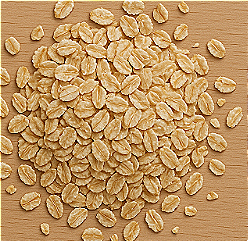
Morphologically, barley flakes appear as thin, compressed layers, obtained from decorticated or pearled whole grains flattened by mechanical rollers. Their colour ranges from beige to golden, and they retain a characteristic cereal aroma. The laminated structure ensures rapid water absorption, making the product suitable for instant or short-cooking preparations.
 | 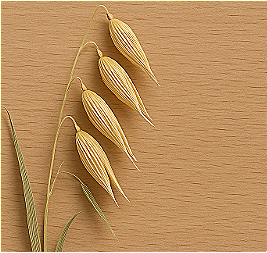 |
The plant Hordeum vulgare thrives in temperate climates, showing strong adaptability even in dry or cold environments. Barley grains may occur in hulled or hull-less forms, leading to diverse applications across human nutrition, animal feed, and malting. Flaking is especially widespread in the food sector because it preserves many of the cereal’s intrinsic nutritional qualities.
From a phytochemical perspective, barley flakes contain β-glucans, soluble fibres known for their effects on lipid metabolism and glycaemic regulation. Barley also provides complex carbohydrates, plant proteins, tocopherols (vitamin E), and minerals such as phosphorus, magnesium, and selenium, along with phenolic compounds with potential antioxidant activity.
Nutritionally, barley flakes are recognised as a functional food, primarily due to their content of soluble fibre, which promotes satiety, modulates carbohydrate absorption, and supports intestinal well-being. Their starch profile and digestibility make them suitable for sports nutrition and balanced dietary regimes. Compared with other cereals, barley flakes generally have a moderate glycaemic index, particularly when derived from wholegrain kernels.
From a culinary perspective, barley flakes are widely used in:
– porridge, muesli, and breakfast cereal mixes;
– soups and creamy dishes as a natural thickener;
– vegetable patties, protein-rich preparations, and meat substitutes;
– bases for energy bars and wholegrain baked goods.
Botanical classification (APG IV system)
| Category | Data |
|---|---|
| Common name | barley; barley flakes |
| Botanical name | Hordeum vulgare L. |
| Kingdom | Plantae |
| Clade | Angiosperms → monocots (Poaceae) |
| Order | Poales |
| Family | Poaceae |
| Genus | Hordeum |
| Species | Hordeum vulgare L. |
Indicative nutritional values per 100 g (dry barley flakes)
Average values refer to flakes produced from pearled or hulled barley, steam-rolled; data may vary according to variety, degree of refinement, and residual moisture.
| Component | Approximate value per 100 g |
|---|---|
| Energy | ~ 350–370 kcal |
| Water | ~ 8–10 g |
| Total carbohydrates | ~ 73–75 g |
| — of which sugars | ~ 1–1.5 g |
| Dietary fiber | ~ 10–11 g (rich in β-glucans) |
| Protein | ~ 10–12 g |
| Total lipids | ~ 2–2.5 g |
| — saturated fatty acids (SFA) | ~ 0.4 g |
| — monounsaturated fatty acids (MUFA) | ~ 0.3 g |
| — polyunsaturated fatty acids (PUFA) | ~ 1.0–1.1 g |
| Sodium | ~ 3–5 mg |
| Main minerals | phosphorus (≈ 280–300 mg), magnesium (≈ 100–110 mg), potassium (≈ 250–280 mg), iron, zinc |
| Relevant vitamins | B-vitamins (B1, B3, B6), small amounts of vitamin E |
Nutritional considerations
Barley flakes are a moderately energy-dense cereal with a high content of complex carbohydrates.
Their fiber, rich in β-glucans, supports digestive function and helps modulate post-meal blood glucose.
Low lipid content, with modest amounts of SFA, MUFA, and PUFA, with no significant impact on daily lipid intake.
Provide B-vitamins essential for energy metabolism, along with minerals such as magnesium, phosphorus, and potassium.
Suitable for porridge, soups, yogurt mixes, baked goods, and breakfast cereals.
Production process
Barley flakes are produced from pearled or hulled barley grains. After harvest, the grain is cleaned to remove stones, straw and foreign seeds and may be dehulled/pearled to take off part of the outer layers, depending on the final product.
For flaking, the barley (whole grains or groats) is usually hydro-conditioned: moisture is adjusted by steaming or soaking so that the kernels soften. The conditioned grains are then passed through smooth rollers that flatten them into flakes. The fresh flakes are dried with warm air to a safe, stable moisture level, cooled and finally packed.
The result is a product suitable for short cooking times (soups, porridges) or direct use as an ingredient in breakfast cereals and muesli mixes.
Applications
Barley flakes sit between breakfast cereals and ingredients for savoury dishes.
They are used:
At breakfast: in muesli, granola, porridge, mixed flake blends with nuts and seeds, or in cereal bars.
In soups and stews: added to broths, vegetable soups and one-pot dishes to increase texture, satiety and complex carbohydrate content.
In bakery products: in multigrain breads, crackers and flatbreads, often combined with oat, rye or spelt flakes.
Compared with whole barley grains, flakes have shorter cooking times and a softer texture, making them practical for quick preparations.
Nutrition & health
The nutritional profile of barley flakes depends on whether they are more “wholegrain” or more heavily pearled, but typical values for 100 g of dry barley flakes are approximately:
Energy: about 340–360 kcal
Carbohydrates: ~60–75 g
Fibre: ~6–17 g (higher in more wholegrain products, including beta-glucans)
Protein: ~8–12 g
Fat: ~1.5–3 g
Barley is well known for its soluble fibre, particularly beta-glucans, which can:
Help moderate carbohydrate absorption.
Support satiety.
Contribute, as part of an overall healthy diet, to maintaining a favourable blood lipid profile.
Barley flakes also supply B-group vitamins and minerals such as magnesium, phosphorus, potassium and zinc, with levels depending on how much of the grain’s outer layers are retained. Their energy density is moderate, so portion size should be considered within the daily calorie budget.
Portion note
A typical household portion of barley flakes for breakfast or as part of a main dish is about 30–50 g of dry product, adjusted to individual energy needs and the rest of the meal.
Allergens and intolerances
Barley is a gluten-containing cereal. Therefore:
Barley flakes are not suitable for people with coeliac disease or non-coeliac gluten sensitivity.
They may also be unsuitable for individuals with specific allergies or intolerances to gluten-containing cereals.
In composite products (muesli, cereal bars, multigrain bread, ready-made soups), other major allergens often present include tree nuts, soy, milk, sesame, etc., which must always be checked on the label.
Storage and shelf-life
Although barley flakes have a relatively low fat content, they can still undergo rancidity and lose flavour if poorly stored.
Store them in a cool, dry place, protected from light and heat, in well-closed containers.
Once the pack is opened, it is advisable to use the product within a few months, closing the bag carefully each time or transferring the flakes into airtight jars.
Under proper conditions, the commercial shelf-life of barley flakes is commonly 9–12 months from production (or as specified by the manufacturer).
Safety and regulatory aspects
Barley flakes are traditional cereal products and fall under general food-safety rules:
Compliance with limits for contaminants (mycotoxins, heavy metals, pesticide residues).
Adequate hygiene, microbiological quality and pest control throughout production and storage.
Application of GMP (Good Manufacturing Practices) and HACCP in processing and packing.
Nutrition and health claims such as “source of fibre” or “high in fibre” must be supported by the actual contents per 100 g or per serving, in line with nutrition and health claims regulations.
Labeling
On packaging, barley flakes typically appear as:
“fiocchi d’orzo” / “barley flakes”,
sometimes with additional descriptors (e.g. “wholegrain”, “organic”).
A nutrition declaration is mandatory for prepacked foods, including energy in kJ and kcal, macronutrients and, if claimed, fibre, vitamins and minerals. The presence of gluten is clear from the cereal name (barley), and other allergens in mixed products (e.g. nuts, milk, soy, sesame) must be highlighted according to the applicable legislation.
In breakfast mixes or baked products, ingredients are listed in descending order of weight.
Conclusion
Barley flakes offer a practical way to bring barley into everyday meals, with shorter cooking times than whole grains and easy incorporation into breakfast bowls, soups and baked goods. They provide a mix of complex carbohydrates, fibre (including beta-glucans), protein and micronutrients with a moderate calorie content, making them a good option for diversifying cereal sources beyond wheat, oats and rice.
Because they contain gluten, they are unsuitable for those who must avoid it, but for the general population they can contribute to a varied and balanced diet when portion size and overall dietary quality are taken into account.
Studies
In barley there are functional ingredients interesting for human health such as beta-glucans, polysaccarids, the main components of the soluble part of dietary fiber. Their characteristic is to facilitate the regular function of the gastrointestinal tract, the homeostasis of glucose and the regulation of energy in the human body (2). They can prevent oncogenesis due to the protective effect against powerful genotoxic carcinogens (3).
But while a high beta-glucan content is positive for human health, the brewing industry that uses malt, needs a low concentration of beta-glucans as high levels can negatively affect malt filtration.
In addition, phenolic compounds found in barley, as well as producing an antioxidant effect in the human body, have probiotic and gastroprotective effects (4).
Another interesting aspect of the other ingredients present in barley concerns the effect that fermented barley extract produces on the colon mucosa. It has been noted that this extract can relieve constipation (5).

