



San Marzano tomatoes
Description
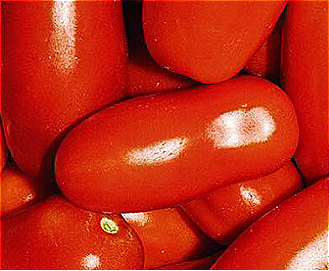
San Marzano tomatoes are a prized variety of Solanum lycopersicum (family Solanaceae), traditionally grown in the Agro Sarnese-Nocerino area of Campania (southern Italy). They are characterized by elongated, cylindrical fruits with thin skin, dense flesh, few seeds and a sweet, well-balanced acidic taste. In the PDO (Protected Designation of Origin) form they represent an icon of the Italian tomato-processing tradition, especially for sauces and canned whole peeled tomatoes.
Indicative nutritional values per 100 g (fresh or canned in juice)
Energy: 18–25 kcal
Water: ≈ 90–92%
Carbohydrates: 3–4.5 g
of which sugars: 3–4.3 g
Protein: 0.8–1.3 g
Total fat: 0.1–0.2 g
SFA (saturated fatty acids; excess intake may negatively affect cardiovascular health): traces
MUFA (monounsaturated fatty acids, generally considered heart-friendly): traces
PUFA (polyunsaturated fatty acids, involved in cellular and metabolic functions): traces
Dietary fibre: 1–2 g
Vitamin C: 10–20 mg
Provitamin A (β-carotene): 100–250 µg
Potassium: 230–260 mg
Values may vary according to cultivar, cultivation conditions, ripeness and processing (fresh vs canned).
Key constituents
Carotenoids: high lycopene content, β-carotene, lutein
Vitamins: vitamin C, provitamin A, small amounts of B-group vitamins
Minerals: potassium (predominant), magnesium, phosphorus, traces of calcium and iron
Phenolic compounds: chlorogenic acid, rutin, quercetin derivatives
Dietary fibre: pectins, hemicelluloses, cellulose
Natural sugars: glucose and fructose
Organic acids: citric and malic acids
Minor volatile compounds responsible for the characteristic tomato aroma
Production process
(Fresh product)
Varietal selection of authentic San Marzano lines (and, for PDO, specific approved lines)
Transplanting and cultivation in suitable soils, often of volcanic origin, well-drained and fertile
Irrigation management and integrated pest management to reduce chemical inputs
Manual harvesting in several passes, selecting fully ripe fruits
Sorting and packing for the fresh market
(For processing – peeled / canned San Marzano)
Reception and sorting of fresh tomatoes
Washing and removal of defective fruits
Blanching to loosen the skin
Peeling (mechanical and/or manual)
Filling of cans or jars with whole tomatoes and tomato juice
Sealing and heat treatment (pasteurisation/sterilisation)
Cooling, batch coding and storage until distribution
Physical properties
Shape: elongated, cylindrical to slightly prismatic
Length: typically 6–8 cm
Skin: thin, easily removable
Flesh: firm, rich in dry matter, low free water
Seeds: relatively few and small
Colour: uniform deep red when ripe
pH: about 4.2–4.5
Sensory and technological properties
Flavour: sweet, aromatic, with balanced acidity
Aroma: intense, fruity and characteristic of traditional Italian tomato sauces
Texture: compact, meaty pulp, little watery exudate
Technological behaviour:
excellent performance in long-cooked sauces and reductions
good shape retention during cooking
naturally high consistency thanks to dry matter and pectins
limited separation of water in sauces
Food uses
Fresh consumption (salads, bruschetta, traditional Italian dishes)
High-quality tomato sauces and ragù
Neapolitan-style pizza topping and other Mediterranean preparations
Oven- or pan-roasted tomatoes and confit preparations
Industrial and artisanal processing into whole peeled tomatoes, fillets and passata/purée
Premium “gourmet” products labelled as San Marzano or San Marzano PDO
Nutrition & health
High lycopene content provides antioxidant activity that supports cellular protection and may contribute to cardiovascular health.
Low energy density and good micronutrient density make San Marzano tomatoes suitable for weight-management diets.
Dietary fibre supports digestive health and contributes to satiety.
Potassium helps maintain normal blood pressure and fluid balance.
Thermal processing (as in canned products) increases lycopene bioavailability compared with raw tomato, while only moderately reducing heat-sensitive vitamin C.
Portion note
A reasonable portion is 100–150 g, equivalent to 1–2 medium San Marzano tomatoes (fresh) or about ½ can of a standard canned product.
Allergens and intolerances
Naturally free from the main allergens listed in EU legislation.
Belong to the Solanaceae family; individuals sensitive to this botanical family may experience reactions.
May be poorly tolerated by people with histamine intolerance, especially in processed or long-stored products.
Storage and shelf-life
Fresh San Marzano tomatoes
At cool room temperature: about 3–5 days.
In the refrigerator: up to 7–10 days, with potential loss of aroma and slight texture changes.
Canned / jarred San Marzano tomatoes
Unopened, at ambient temperature and away from heat and light: 24–36 months (according to label).
Once opened: transfer from metal to glass or food-grade container, refrigerate and consume within 2–3 days.
Safety and regulatory aspects
Fresh product must comply with EU marketing standards for fruit and vegetables (size, quality class, integrity).
Pesticide residues must remain below MRL (Maximum Residue Levels) established by EU legislation.
Processing plants must operate under GMP and HACCP systems to ensure hygiene and food safety.
Packaging materials must be suitable for food contact and compliant with EU regulations.
For San Marzano PDO, cultivation and processing must fully comply with the official PDO specification and are subject to third-party controls and certification.
Labelling
Name: typically “San Marzano tomatoes” or, for certified product, “Pomodoro San Marzano dell’Agro Sarnese-Nocerino PDO”.
Country (and, where applicable, specific area) of origin.
For PDO: PDO logo and mandatory mentions according to the specification.
Net weight and, for canned products, drained weight.
List of ingredients (for processed products): tomatoes, tomato juice, possible acidity regulator (e.g. citric acid), and salt if used.
Lot identification and best-before date.
Troubleshooting
Excessive water separation in sauces
Possible causes: fruits not true-to-type, low dry matter, or improper processing.
Weak flavour or aroma
Possible causes: unsuitable soil/climate, over-irrigation, or premature harvesting.
Too strong acidity
Possible causes: insufficient ripeness, high organic acid content.
Pulp disintegrates during cooking
Possible causes: excessive cooking intensity or non-authentic variety with lower structural integrity.
Metallic off-flavour after opening cans
Possible causes: prolonged storage of product in an opened metal can; recommended to transfer to glass.
Sustainability and supply chain
Cultivation often takes place in vocational areas with naturally fertile soils, which can reduce the need for synthetic inputs.
Integrated and/or organic farming systems can lower environmental impact (pesticides, fertilisers).
Precision irrigation reduces water consumption and limits nutrient leaching.
By-products (skins, seeds, pulp residues) can be re-used for compost, extracts or tomato seed oil production.
Metal (steel) and glass packaging have high recyclability rates, supporting circular-economy models.
For PDO products, full traceability from field to can improves transparency and supports sustainable branding.
Main INCI functions (cosmetics)
Cosmetic ingredients derived from San Marzano tomatoes (or from tomato pulp/skins/seed oil of similar varieties) may perform the following functions:
Antioxidant (due to lycopene and other carotenoids)
Skin-conditioning agent (supporting softness and smoothness)
Protective agent against environmental oxidative stress
Soothing agent (supporting comfort of sensitive skin in suitable formulations)
Refreshing agent in tonics, gels and after-sun products
Conclusion
San Marzano tomatoes are a flagship of Italian horticulture and tomato processing. Their distinctive morphology, intense flavour and favourable technological properties make them ideal for high-quality sauces, pizza toppings and traditional dishes. At the same time, their nutritional and phytochemical profile (especially lycopene and other antioxidants) offers interesting benefits for health-oriented products and cosmetic applications. When grown and processed within a controlled and certified supply chain, particularly under the PDO scheme, San Marzano tomatoes combine gastronomic excellence, nutritional value and strong identity linked to territory and tradition.
Mini-glossary
SFA – Saturated fatty acids; should be limited because excessive intake is associated with increased cardiovascular risk.
MUFA – Monounsaturated fatty acids; generally considered beneficial for blood lipid profile and heart health.
PUFA – Polyunsaturated fatty acids; important for cell membranes and anti-inflammatory pathways.
MRL – Maximum Residue Level; legal limit for pesticide residues in food.
GMP – Good Manufacturing Practices; hygienic and organisational rules ensuring proper food production.
HACCP – Hazard Analysis and Critical Control Points; preventive system for managing food-safety risks.
BOD/COD – Biochemical Oxygen Demand / Chemical Oxygen Demand; indicators of the organic load of wastewater, relevant to environmental impact of processing plants.
PDO – Protected Designation of Origin; EU quality scheme that protects products strongly linked to a specific geographical area and traditional know-how.
Studies
The tomato is rich in vitamins A and C and lycopene , the pigment that turns it red and is being studied for the prevention of many types of cancer, as it has antioxidant properties.
It is referred to by many studies as a prevention for prostate cancer (1).
Tomato varieties are many, including: Solanum arcanum, Solanum cheesmaniae, Solanum chilense, Solanum chmielewskii, Solanum corneliomuelleri, Solanum galapagense, Solanum habrochaites, Solanum huaylasense, Solanum neorickii, Solanum pennelli, Solanum perivianum, Solanum pimpinellifolium.
GMO tomatoes. Tomatoes have also been genetically modified, but European legislation requires that the term GMO be indicated on the label. There is no distinction in the USA. In terms of the components contained in the transgenic tomato Calcium and Magnesium are more abundant than the natural tomato.
Health Benefits
Tomatoes have been associated with various health benefits, including the prevention of chronic diseases such as cancer, cardiovascular, and neurodegenerative diseases. The presence of antioxidants like lycopene plays a key role in these benefits.
Tomatoes have been associated with various health benefits, including the prevention of chronic diseases such as cancer, cardiovascular and neurodegenerative diseases. The presence of antioxidants such as lycopene plays a key role in these benefits.
Tomatoes are rich in vitamins A and C and lycopene, the pigment that produces the characteristic red coloring and is being studied for the prevention of many types of cancer, as it has antioxidant properties and plays a protective role for cardiovascular disease (1).
It is indicated by many studies as a prevention for prostate cancer (2), inhibits serum lipid peroxide production by improving the lipid profile (3)

