

Hello, Guest!


  Objects Tiiips Categories
Whole peeled tomatoes
"Descrizione"
by Al222 (23258 pt)
2025-Nov-25 11:52

Whole peeled tomatoes


Description

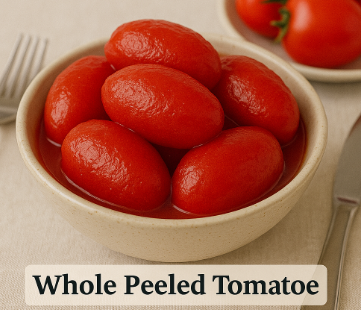
Whole peeled tomatoes are a preserved food product obtained from ripe Solanum lycopersicum tomatoes (family Solanaceae) that are blanched, peeled, and packed whole in tomato juice. They retain their elongated shape, soft yet firm flesh, and characteristic bright red color. They are a staple of traditional and industrial tomato processing.

Indicative nutritional values per 100 g

  • Energy: 20–30 kcal

  • Water: ≈90%

  • Carbohydrates: 3–5 g

    • Sugars: 2.5–4 g

  • Protein: 1–1.2 g

  • Total fat: 0.1–0.3 g

    • SFA (saturated fatty acids; excessive intake may have adverse effects): traces

    • MUFA (monounsaturated fats; generally associated with cardiovascular benefits): traces

    • PUFA (polyunsaturated fats; important for cellular functions): traces

  • Dietary fiber: 1–1.5 g

  • Vitamin C: 8–15 mg

  • Vitamin A (β-carotene): 100–200 µg

  • Potassium: 200–250 mg

Values vary according to tomato variety, processing, and maturity stage.


Key constituents

  • Carotenoids: especially lycopene, β-carotene

  • Vitamins: vitamin C, provitamin A, small amounts of B vitamins

  • Minerals: potassium, magnesium, phosphorus

  • Phenolic compounds: chlorogenic acid, rutin, quercetin derivatives

  • Pectins and dietary fibers

  • Natural sugars: glucose and fructose

  • Organic acids: citric and malic acids


Production process

  • Selection of varieties with high dry matter and firm flesh

  • Harvesting at optimal ripeness

  • Washing and sorting to remove defective fruit and impurities

  • Blanching to loosen the skin

  • Mechanical or manual peeling

  • Filling containers with whole tomatoes and tomato juice

  • Sealing in cans or glass jars

  • Heat treatment (pasteurization or sterilization) to ensure microbiological safety

  • Cooling and storage


Physical properties

  • Shape: whole, typically elongated or oval

  • Color: uniform bright red

  • Texture: soft but not overly watery

  • pH: 4.2–4.4

  • Drained weight: varies according to commercial standards


Sensory and technological properties

  • Flavor: sweet-acidic, rich, typical of ripe tomatoes

  • Aroma: fruity, intense

  • Texture: firm pulp, thick juice

  • Technological behavior:

    • excellent performance in slow-cooked sauces

    • maintains structure without excessive breakdown

    • high ability to bind flavors and water

    • ideal for reductions, ragù, and traditional Italian sauces


Food applications

  • Traditional tomato sauces

  • Ragù and slow-cooked preparations

  • Soups, stews, casseroles

  • Pizza and focaccia bases

  • Professional kitchens for long-simmering recipes


Nutrition & health

  • High lycopene content with antioxidant properties

  • Low-calorie, suitable for weight-control diets

  • Potassium supports blood pressure balance

  • Pectin-rich fibers support healthy digestion

  • Heat processing increases lycopene bioavailability


Portion note

Typical serving: 100–125 g (≈ half of a standard can).


Allergens and intolerances

  • Free from major EU-listed allergens

  • Belongs to Solanaceae—may cause reactions in sensitive individuals

  • May be problematic for people with histamine intolerance


Storage and shelf-life

  • Shelf-life (unopened): 24–36 months

  • Once opened: refrigerate and consume within 2–3 days

  • Avoid storing in opened metal cans; transfer to glass

  • Store in a cool, dry place away from direct light


Safety and regulatory aspects

  • Must comply with EU standards for preserved vegetables

  • Pesticide residues must remain below MRL (Maximum Residue Levels)

  • Processing must follow GMP and HACCP requirements

  • Packaging materials must be compliant with food-contact regulation

  • Heat treatments must guarantee microbiological stability


Labelling

  • Name: “Whole peeled tomatoes”

  • Ingredients: tomatoes, tomato juice (possibly acidity regulator)

  • Net weight and drained weight

  • Country of origin

  • Lot identification

  • Best-before date


Troubleshooting

  • Tomatoes too firm → early harvesting or unsuitable variety

  • Excessive acidity → insufficient ripeness

  • Watery juice → low dry matter content or inadequate concentration

  • Metallic taste → prolonged contact with opened metal can

  • Mold after opening → poor refrigeration or extended storage after opening


Sustainability and supply chain

  • Use of integrated agriculture reduces environmental impact

  • Seasonal processing optimizes yields and reduces waste

  • Steel and glass packaging have high recyclability

  • Tomato by-products can be valorized (compost, extracts, seed oil)

  • Precision irrigation helps reduce water consumption


Main INCI functions (cosmetics)

Derivatives of tomato used in cosmetic formulations:

  • Antioxidant (lycopene-rich extracts)

  • Skin-conditioning agent

  • Protective agent against oxidative stress

  • Soothing agent

  • Refreshing agent


Conclusion

Whole peeled tomatoes are a versatile, nutritious, and culturally important product in food processing. Their balanced sweetness, acidity, and robust texture make them ideal for a wide range of culinary applications. The production process enhances flavor concentration and lycopene availability, and the product offers interesting uses even in cosmetic formulation.


Mini-glossary

  • SFA – Saturated fatty acids; should be limited for cardiovascular health

  • MUFA – Monounsaturated fatty acids; generally beneficial for lipid profile

  • PUFA – Polyunsaturated fatty acids; essential for cellular and anti-inflammatory processes

  • GMP – Good Manufacturing Practices (hygienic and quality standards)

  • HACCP – Hazard Analysis and Critical Control Points (food safety system)

  • BOD/COD – Biochemical/Chemical Oxygen Demand; indicators of organic load in wastewater analysis

Studies

The tomato is rich in vitamins A and C and lycopene , the pigment that turns it red and is being studied for the prevention of many types of cancer, as it has antioxidant properties.

It is referred to by many studies as a prevention for prostate cancer (1).

Tomato varieties are many, including: Solanum arcanum, Solanum cheesmaniae, Solanum chilense, Solanum chmielewskii, Solanum corneliomuelleri, Solanum galapagense, Solanum habrochaites, Solanum huaylasense, Solanum neorickii, Solanum pennelli, Solanum perivianum, Solanum pimpinellifolium.

Carotenoid content in tomato

GMO tomatoes. Tomatoes have also been genetically modified, but European legislation requires that the term GMO be indicated on the label. There is no distinction in the USA. In terms of the components contained in the transgenic tomato Calcium and Magnesium are more abundant than the natural tomato.

Tomato studies

Health Benefits

Tomatoes have been associated with various health benefits, including the prevention of chronic diseases such as cancer, cardiovascular, and neurodegenerative diseases. The presence of antioxidants like lycopene plays a key role in these benefits.

Tomatoes have been associated with various health benefits, including the prevention of chronic diseases such as cancer, cardiovascular and neurodegenerative diseases. The presence of antioxidants such as lycopene plays a key role in these benefits.

Tomatoes are rich in vitamins A and C and lycopene, the pigment that produces the characteristic red coloring and is being studied for the prevention of many types of cancer, as it has antioxidant properties and plays a protective role for cardiovascular disease (1).

It is indicated by many studies as a prevention for prostate cancer (2), inhibits serum lipid peroxide production by improving the lipid profile (3)

References____________________________________________________________________

(1) Przybylska S, Tokarczyk G. Lycopene in the Prevention of Cardiovascular Diseases. Int J Mol Sci. 2022 Feb 10;23(4):1957. doi: 10.3390/ijms23041957. PMID: 35216071; PMCID: PMC8880080.

Abstract. Cardiovascular diseases (CVDs) are the leading cause of human mortality worldwide. Oxidative stress and inflammation are pathophysiological processes involved in the development of CVD. That is why bioactive food ingredients, including lycopene, are so important in their prevention, which seems to be a compound increasingly promoted in the diet of people with cardiovascular problems. Lycopene present in tomatoes and tomato products is responsible not only for their red color but also for health-promoting properties. It is characterized by a high antioxidant potential, the highest among carotenoid pigments. Mainly for this reason, epidemiological studies show a number of favorable properties between the consumption of lycopene in the diet and a reduced risk of cardiovascular disease. While there is also some controversy in research into its protective effects on the cardiovascular system, growing evidence supports its beneficial role for the heart, endothelium, blood vessels, and health. The mechanisms of action of lycopene are now being discovered and may explain some of the contradictions observed in the literature. This review aims to present the current knowledge in recent years on the preventive role of lycopene cardiovascular disorders.

(2) Salem S, Salahi M, Mohseni M, Ahmadi H, Mehrsai A, Jahani Y, Pourmand G. Major dietary factors and prostate cancer risk: a prospective multicenter case-control study. Nutr Cancer. 2011;63(1):21-7. doi: 10.1080/01635581.2010.516875.

Abstract. The association between diet and prostate cancer (PC) risk, although suggestive, still remains largely elusive particularly in the Asian population. This study sought to further evaluate the possible effects of different dietary factors on risk of PC in Iran. Using data from a prospective hospital-based multicenter case-control study, dietary intakes of red meat, fat, garlic, and tomato/tomato products, as well as thorough demographic and medical characteristics, were determined in 194 cases with the newly diagnosed, clinicopathologically confirmed PC and 317 controls, without any malignant disease, admitted to the same network of hospitals. Odds ratios (ORs) and corresponding 95% confidence intervals (CIs) were obtained after adjustment for major potential confounders, including age, body mass index, smoking, alcohol, education, occupation, family history of PC, and total dietary calories. Comparing the highest with the lowest tertile, a significant trend of increasing risk with more frequent consumption was found for dietary fat (OR: 1.79, 95% CI: 1.71-4.51), whereas inverse association was observed for tomato/tomato products (OR: 0.33, 95% CI: 0.16-0.65). A nonsignificant increase in PC risk was revealed for dietary red meat (OR: 1.69, 95% CI: 0.93-3.06). For garlic consumption, a borderline reduction in risk was observed (OR: 0.58, 95% CI: 0.32-1.01; P = 0.05). In conclusion, our study supports the hypothesis that total fat may increase PC risk and tomatoes/tomato products and garlic may protect patients against PC.

(3) Effect of 12-Week Daily Intake of the High-Lycopene Tomato (Solanum Lycopersicum), A Variety Named "PR-7", on Lipid Metabolism: A Randomized, Double-Blind, Placebo-Controlled, Parallel-Group Study.  Nishimura M, Tominaga N, Ishikawa-Takano Y, Maeda-Yamamoto M, Nishihira J.  Nutrients. 2019 May 25;11(5). pii: E1177. doi: 10.3390/nu11051177.

Abstract. Tomato (Solanum lycopersicum) is a rich source of lycopene, a carotenoid that confers various positive biological effects such as improved lipid metabolism. Here, we conducted a randomized, double-blind, placebo-controlled, parallel-group comparative study to investigate the effects of regular and continuous intake of a new high-lycopene tomato, a variety named PR-7, for 12 weeks, based on 74 healthy Japanese subjects with low-density lipoprotein cholesterol (LDL-C) levels ≥120 to <160 mg/dL. The subjects were randomly assigned to either the high-lycopene tomato or placebo (lycopene-free tomato) group. Each subject in the high-lycopene group ingested 50 g of semidried PR-7 (lycopene, 22.0-27.8 mg/day) each day for 12 weeks, while subjects in the placebo group ingested placebo semidried tomato. Medical interviews were conducted, vital signs were monitored, body composition was determined, and blood and saliva samples were taken at weeks 0 (baseline), 4, 8, and 12. The primary outcome assessed was LDL-C. The intake of high-lycopene tomato increased lycopene levels in this group compared to levels in the placebo group (p < 0.001). In addition, high-lycopene tomato intake improved LDL-C (p = 0.027). The intake of high-lycopene tomato, PR-7, reduced LDL-C and was confirmed to be safe.

(4) Salehi B, Sharifi-Rad R, Sharopov F, Namiesnik J, Roointan A, Kamle M, Kumar P, Martins N, Sharifi-Rad J. Beneficial effects and potential risks of tomato consumption for human health: An overview. Nutrition. 2019 Jun;62:201-208. doi: 10.1016/j.nut.2019.01.012. Epub 2019 Jan 25. PMID: 30925445.

Przybylska S, Tokarczyk G. Lycopene in the Prevention of Cardiovascular Diseases. Int J Mol Sci. 2022 Feb 10;23(4):1957. doi: 10.3390/ijms23041957. 

Abstract. Cardiovascular diseases (CVDs) are the leading cause of human mortality worldwide. Oxidative stress and inflammation are pathophysiological processes involved in the development of CVD. That is why bioactive food ingredients, including lycopene, are so important in their prevention, which seems to be a compound increasingly promoted in the diet of people with cardiovascular problems. Lycopene present in tomatoes and tomato products is responsible not only for their red color but also for health-promoting properties. It is characterized by a high antioxidant potential, the highest among carotenoid pigments. Mainly for this reason, epidemiological studies show a number of favorable properties between the consumption of lycopene in the diet and a reduced risk of cardiovascular disease. While there is also some controversy in research into its protective effects on the cardiovascular system, growing evidence supports its beneficial role for the heart, endothelium, blood vessels, and health. The mechanisms of action of lycopene are now being discovered and may explain some of the contradictions observed in the literature. This review aims to present the current knowledge in recent years on the preventive role of lycopene cardiovascular disorders.

Evaluate