



Cherry tomatoes
(Fruit of Solanum lycopersicum “cherry” group, family Solanaceae)
Description
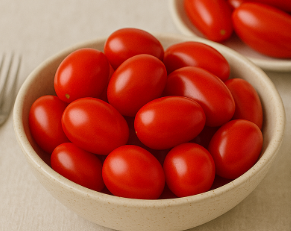
Cherry tomatoes are small spherical or slightly oval fruits of Solanum lycopersicum belonging to the “cherry” type group.
They are characterised by:
small size (typically 2–3 cm diameter),
thin but resilient skin,
very juicy, sweet pulp,
bright red colour (with yellow, orange and bicolour cultivars also existing).
They are mainly consumed fresh (salads, appetizers, snacks), but also cooked (roasted, sautéed, confit, quick sauces) and as a premium raw material for high-quality sauces, glass-packed products and frozen mixes.
Indicative nutritional values per 100 g
(raw cherry tomatoes – indicative average values)
Energy: 20–25 kcal
Carbohydrates: 3.5–5 g
sugars: 2.5–4 g
Fibre: 1–1.5 g
Protein: 0.8–1.2 g
Lipids: 0.1–0.3 g
SFA (first occurrence – saturated fatty acids): ~0.03 g (excess SFA intake is linked with increased cardiovascular risk, but cherry tomatoes contribute only negligible amounts)
MUFA: traces
PUFA: traces
TFA: not naturally present
Vitamins: vitamin C, provitamin A (β-carotene), vitamin K, folate
Minerals: potassium, magnesium, traces of calcium and phosphorus
Bioactives: lycopene and other carotenoids, phenolic acids
Values vary with cultivar, maturity, climate and farming practices.
Key constituents
Water (about 92–95%)
Carotenoids: lycopene, β-carotene, minor pigments
Vitamin C
Vitamin K and folate
Simple sugars: glucose, fructose (main drivers of sweetness)
Organic acids: citric acid, malic acid
Dietary fibre: cellulose, hemicellulose, pectins
Phenolic compounds: phenolic acids, flavonoids
Minerals: particularly potassium, with traces of Mg, Ca, P
Production process
Cultivation
grown in open field or protected cultivation (greenhouses/tunnels);
varieties selected for sweetness (°Brix), colour and texture;
agronomic management with controlled irrigation, pruning and support systems.
Harvest
usually manual or semi-mechanical to preserve the integrity of fruits and trusses;
harvested at commercial ripeness with uniform colour and firm skin.
Grading and washing
removal of damaged or defective fruit;
washing with potable water and, where needed, authorised sanitisers.
Fresh market preparation
packing in punnets or as whole trusses;
possible use of modified atmosphere packaging (MAP) to extend shelf-life.
Industrial processing (for sauces and preserves)
light scalding or pre-cooking;
optional peeling (depending on product type);
filling in glass jars/cans with juice or purée;
pasteurisation or sterilisation.
All operations are carried out under GMP/HACCP with full traceability from field to final product.
Physical properties
Shape: small spherical or slightly elongated “cherry” fruits.
Colour: typically bright, uniform red in classic types; yellow, orange and other colours exist for specialty products.
Skin: thin yet elastic and resistant, with a glossy surface.
Pulp: very juicy, with seed cavities rich in juice and seeds.
Texture: firm when fresh, with good integrity under short cooking (roasting, pan cooking).
Sensory and technological properties
Flavour: distinctly sweet with moderate acidity, often more aromatic than standard salad tomatoes; strong perception of fresh tomato.
Aroma: fruity, slightly green–herbaceous, fresh.
Technological behaviour:
excellent for fresh consumption (no need for peeling, easy handling and portioning);
ideal for short, high-temperature cooking (wok, oven, pan), where the skin helps maintain structure;
in processing, adds sweet, fruity notes to sauces and condiments;
suitable for freezing whole or halved for later use in cooked dishes.
Food applications
Fresh use:
mixed salads, caprese-style dishes, side salads;
finger food, appetisers, skewers with cheese and vegetables;
toppings for sandwiches, bruschetta, focaccia.
Cooked use:
oven-roasted cherry tomatoes (including confit), pan-sautéed with oil and herbs;
quick pasta sauces and condiments for grains/couscous;
side dishes with meat, fish or plant-based mains.
Industrial / foodservice:
premium ready sauces and “rustic” or “gourmet” formulations;
preserves of whole or halved cherry tomatoes in glass;
frozen ingredient mixes and ready-to-use vegetable bases.
Nutrition & health
Low in calories and fat, suitable for low-energy and balanced diets.
Source of vitamin C, folate, vitamin K and potassium.
Rich in lycopene and other carotenoids; bioavailability may increase when cherry tomatoes are cooked with oil as part of a varied diet.
High water content supports hydration.
Generally well tolerated; in individuals sensitive to Solanaceae or to organic acids, they may exacerbate heartburn or gastric discomfort.
Portion note
Typical serving as vegetable component or side dish: 80–100 g of fresh cherry tomatoes per person.
In mixed salads and composed dishes: often 50–80 g per serving.
Allergens & intolerances
Cherry tomatoes are not classified as major allergens, but:
may trigger reactions in individuals with nightshade (Solanaceae) sensitivity;
may contribute to oral allergy syndrome in some pollen-allergic subjects (e.g. birch cross-reactivity);
acidity can be problematic in people with gastritis or reflux.
They are naturally gluten-free and lactose-free, unless contamination or added ingredients introduce allergens in composite foods.
Storage & shelf-life
Fresh (whole in punnet or truss):
typically 5–10 days at cool ambient conditions with good ventilation;
can be refrigerated (around 8–12 °C) to extend shelf-life, with some trade-off in flavour and texture.
Preserved products (jars/cans):
18–36 months unopened, stored in a cool, dry place away from light and heat;
after opening: typically 2–3 days refrigerated in a non-metallic container.
Frozen products:
12–24 months at –18 °C in sealed packaging.
Safety & regulatory
Controls focus on:
pesticide residues (respecting legal maximum residue levels),
heavy metals where relevant (soil and irrigation dependent),
microbiological criteria for ready-to-eat/ready-to-cook products (fresh-cut, sauces, preserves).
For preserves and sauces:
validation of heat treatments (pasteurisation/sterilisation),
verification of pH, vacuum and container integrity.
The supply chain must operate under GMP/HACCP with full traceability.
Labeling
Typical denomination:
“cherry tomatoes”,
possible further detail such as “whole cherry tomatoes”, “cherry tomatoes in juice”, etc.
In multi-ingredient foods:
listed as “cherry tomatoes” in the ingredient list in descending order of weight;
any additives (acidity regulators, antioxidants, firming agents) must be declared according to legislation.
For preserved products:
storage instructions and “once opened, keep refrigerated and consume within …” are usually required.
Troubleshooting
Skin cracking in field or storage:
due to abrupt water fluctuations (heavy irrigation/rain after dry periods) or mechanical impacts → adjust irrigation management and gentle handling.
Loss of firmness (soft tomatoes):
overly long storage or inadequate temperature → shorten storage times, optimise cold chain (avoid too high or too low temperatures).
Watery or weak flavour:
early harvest or low-°Brix cultivars → prefer varieties with higher °Brix and harvest at full ripeness; limit excessive irrigation close to harvest.
Surface mould or browning spots:
excessive humidity and poor air circulation → improve ventilation, minimise condensation, control temperature and cleanliness.
Sustainability & supply chain
Main environmental aspects:
water use for irrigation,
use of fertilisers and plant protection products,
soil management (crop rotation, erosion control).
Improvement strategies:
drip irrigation and soil moisture monitoring,
integrated or organic pest management,
high-yield, disease-resistant cultivars.
During processing:
by-products (off-grade fruit, skins, seeds) can be upcycled as raw material for lycopene extracts, dietary fibre ingredients or biomass;
processing wastewater is managed and monitored using BOD/COD indicators.
Main INCI functions (cosmetics)
(typically as “Solanum Lycopersicum (Tomato) Fruit Extract”; cherry-specific origin is sometimes indicated in marketing, not always in INCI)
Antioxidant (lycopene, vitamin C and other phytochemicals)
Skin conditioning
Perceived revitalising and brightening effects in facial care products
Used in botanical-themed, antioxidant and “Mediterranean-inspired” cosmetic formulations.
Conclusion
Cherry tomatoes are a highly versatile, sweet and aromatic ingredient, ideal for both fresh consumption and high-quality culinary and industrial applications.
Their combination of low energy content, valuable vitamins and carotenoids and strong consumer appeal makes them well suited to modern, health-oriented and Mediterranean-style diets.
Within well-managed supply chains operating under GMP/HACCP, cherry tomatoes represent a safe, stable and high-value ingredient for foodservice, industry and home use.
Mini-glossary
SFA – Saturated fatty acids: dietary fats to be moderated; present only in very small amounts in cherry tomatoes.
MUFA – Monounsaturated fatty acids: present only in traces in cherry tomatoes.
PUFA – Polyunsaturated fatty acids: also present in traces.
TFA – Trans fatty acids: not naturally present in tomatoes.
GMP/HACCP – Good Manufacturing Practices / Hazard Analysis and Critical Control Points, systems ensuring hygiene, safety and quality in food production.
BOD/COD – Biological / Chemical Oxygen Demand, indicators of the organic and chemical load of industrial wastewater and its environmental impact.
Lycopene – Red carotenoid pigment typical of tomatoes, with antioxidant properties.
°Brix – Measure of soluble solids (mainly sugars) used to estimate sweetness and maturity in fruits and juices.
Studies
The tomato is rich in vitamins A and C and lycopene , the pigment that turns it red and is being studied for the prevention of many types of cancer, as it has antioxidant properties.
It is referred to by many studies as a prevention for prostate cancer (1).
Tomato varieties are many, including: Solanum arcanum, Solanum cheesmaniae, Solanum chilense, Solanum chmielewskii, Solanum corneliomuelleri, Solanum galapagense, Solanum habrochaites, Solanum huaylasense, Solanum neorickii, Solanum pennelli, Solanum perivianum, Solanum pimpinellifolium.
GMO tomatoes. Tomatoes have also been genetically modified, but European legislation requires that the term GMO be indicated on the label. There is no distinction in the USA. In terms of the components contained in the transgenic tomato Calcium and Magnesium are more abundant than the natural tomato.
Health Benefits
Tomatoes have been associated with various health benefits, including the prevention of chronic diseases such as cancer, cardiovascular, and neurodegenerative diseases. The presence of antioxidants like lycopene plays a key role in these benefits.
Tomatoes have been associated with various health benefits, including the prevention of chronic diseases such as cancer, cardiovascular and neurodegenerative diseases. The presence of antioxidants such as lycopene plays a key role in these benefits.
Tomatoes are rich in vitamins A and C and lycopene, the pigment that produces the characteristic red coloring and is being studied for the prevention of many types of cancer, as it has antioxidant properties and plays a protective role for cardiovascular disease (1).
It is indicated by many studies as a prevention for prostate cancer (2), inhibits serum lipid peroxide production by improving the lipid profile (3)

