



Unpeeled diced tomatoes
(From whole ripe tomatoes – Solanum lycopersicum, family Solanaceae)
Description
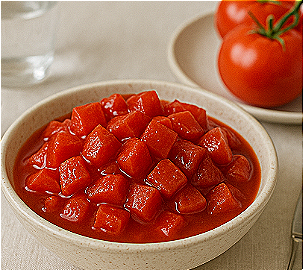
Unpeeled diced tomatoes are fresh, ripe tomatoes cut into uniform cubes while keeping the skin intact.
The product may be packed in tomato juice, in tomato purée, or in its own juices, and is used in industrial, foodservice, and retail applications as a ready-to-use vegetable ingredient.
Keeping the peel provides:
higher firmness and better cube integrity during cooking,
increased fibre content,
a more rustic texture and richer flavour profile.
They are common in sauces, stews, soups, ready meals, and canned products.
Indicative nutritional values per 100 g
(unpeeled diced tomatoes, canned or fresh, drained)
Energy: 20–30 kcal
Carbohydrates: 3–5 g
sugars: 2–3 g
Fibre: 1–2 g
Protein: 0.8–1.2 g
Lipids: 0.1–0.5 g
SFA (first occurrence – saturated fatty acids): ~0.03 g (excess dietary SFA is associated with increased cardiovascular risk, though tomatoes provide negligible quantities)
MUFA: traces
PUFA: traces
TFA: not naturally present
Vitamins: vitamin C, vitamin A (as carotenoids), folate
Minerals: potassium, magnesium, small amounts of calcium and phosphorus
Bioactives: lycopene, beta-carotene, phenolic acids
Values vary depending on ripeness and whether the product is canned or fresh.
Key constituents
Water (≈90–94%)
Carotenoids: lycopene (major), β-carotene
Vitamin C
Phenolic compounds (chlorogenic acid, caffeic acid)
Organic acids: citric acid, malic acid
Dietary fibre: cellulose, hemicellulose, pectin (higher due to peel retention)
Minerals: K, Mg, Ca
Production process
Raw material selection
ripe, firm tomatoes free from defects; varieties with good texture retention.
Washing & sorting
removal of soil, foreign matter, and damaged fruit.
Cutting / dicing
mechanical dicing into uniform cubes (typically 10×10 mm or similar).
peel is kept intact.
Optional heat treatment
light blanching for microbial stabilization (in fresh-cut lines).
Filling
packed in tomato juice, purée, or natural juices.
Thermal processing
canned products: pasteurisation or sterilisation.
fresh chilled products: maintained under refrigeration.
Packaging
cans, pouches, jars, or MAP trays.
All steps under GMP/HACCP requirements.
Physical properties
Appearance: uniform cubes with intact peel.
Colour: bright red; may range from deep red to scarlet.
Texture: firmer than peeled tomatoes; peel improves structural integrity.
Moisture: very high; cubes release juice upon heating.
Sensory and technological properties
Flavour: ripe tomato flavour, slight natural acidity, fresh and aromatic.
Aroma: characteristic tomato scent, mildly vegetal.
Technological behaviour:
retains shape better during simmering or baking;
peel provides better firmness but may give a rustic texture;
contributes colour, flavour, and moisture to dishes;
stable in canned and shelf-stable formats.
Food applications
Sauces: tomato sauces, pasta sauces, arrabbiata, ragù base.
Soups & stews: minestrone, vegetable soups, chili, curries.
Ready meals: lasagne, baked pasta, rice dishes, frozen meals.
Canned goods: canned vegetable mixes, pizza toppings, stew bases.
Foodservice: sautéed bases, Mediterranean dishes, rustic recipes.
Nutrition & health
Low in calories and fat.
Provides vitamin C, potassium, folate, and dietary fibre.
Rich in lycopene, a carotenoid of interest in nutrition science, especially when consumed as part of a varied diet.
Peel increases fibre content and antioxidant compounds.
Generally well tolerated; low FODMAP in moderate portions.
Portion note
Typical serving: 80–100 g as part of a cooked dish.
In industrial products: usage typically 15–40% of total formulation depending on recipe.
Allergens & intolerances
Tomatoes are not major allergens, but can trigger reactions in:
individuals with nightshade (Solanaceae) sensitivities,
people with oral allergy syndrome (birch-pollen cross-reactivity).
Product may contain added allergens only if included in the recipe (e.g., spices in compound canned foods).
Storage & shelf-life
Canned products:
shelf-life 18–36 months unopened.
after opening → refrigerate and consume within 2–3 days.
Fresh-cut in MAP:
5–10 days at 0–4 °C.
Frozen diced tomatoes:
12–24 months at –18 °C.
Store away from heat and direct light.
Safety & regulatory
Must comply with limits for:
pesticide residues,
microbiological criteria (especially for fresh-cut),
heavy metals,
pH and vacuum levels for canned tomatoes.
Additives permitted in some products include citric acid, calcium chloride (firming agent), ascorbic acid.
Production under GMP/HACCP, with full traceability.
Labeling
May appear as:
“unpeeled diced tomatoes”
“diced tomatoes with peel”
“diced tomatoes in juice / in purée”
Ingredients to declare: tomatoes, tomato juice/purée, salt (if added), acidity regulators, firming agents, herbs/spices (in compound products).
Troubleshooting
Excess liquid separation:
natural syneresis → adjust cut size or use purée as packing medium.
Softening during cooking:
overripe raw material → use firmer tomato varieties; adjust thermal processing.
Peel detachment:
mechanical stress or overcooking → reduce agitation or cooking intensity.
Browning or dull colour:
oxidation → ensure good vacuum in canned products; limit air exposure.
Sustainability & supply chain
Tomatoes require significant water; sustainability depends on irrigation management.
Waste streams (peels, seeds, trims) can be valorised into paste, fibre, lycopene extracts.
Processing plants must manage washing-water effluents, monitored via BOD/COD.
Local sourcing reduces transport emissions and improves freshness.
Main INCI functions (cosmetics)
(as “Solanum Lycopersicum Fruit Extract”)
Antioxidant
Skin conditioning
Revitalising due to natural acids and carotenoids
Used primarily in botanical skincare and antioxidant formulations.
Conclusion
Unpeeled diced tomatoes are a versatile, flavourful, nutrient-rich ingredient that provides structure, colour, and freshness to a wide range of food applications.
Keeping the peel improves texture, fibre content, and heat stability, making them ideal for sauces, stews, ready meals, and canned products.
When processed under GMP/HACCP, they represent a safe, stable and high-quality ingredient for both industry and household use.
Mini-glossary
SFA – Saturated fatty acids: dietary fats to moderate; tomatoes contain only negligible amounts.
MUFA – Monounsaturated fatty acids: traces in tomatoes.
PUFA – Polyunsaturated fatty acids: traces in tomatoes.
TFA – Trans fatty acids: not naturally present.
GMP/HACCP – Systems ensuring hygiene, safety and quality in food production.
BOD/COD – Indicators of organic and chemical load in wastewater.
Lycopene – Tomato carotenoid responsible for red colour and antioxidant properties.
Syneresis – Separation of liquid from cut or processed foods.
Studies
Tomatoes have been associated with various health benefits, including the prevention of chronic diseases such as cancer, cardiovascular, and neurodegenerative diseases. The presence of antioxidants like lycopene plays a key role in these benefits.
Tomatoes have been associated with various health benefits, including the prevention of chronic diseases such as cancer, cardiovascular and neurodegenerative diseases. The presence of antioxidants such as lycopene plays a key role in these benefits.
Tomatoes are rich in vitamins A and C and lycopene, the pigment that produces the characteristic red coloring and is being studied for the prevention of many types of cancer, as it has antioxidant properties and plays a protective role for cardiovascular disease (1).
It is indicated by many studies as a prevention for prostate cancer (2), inhibits serum lipid peroxide production by improving the lipid profile (3)
GMO tomatoes. Tomatoes have also been genetically modified, but European legislation requires that the term GMO be indicated on the label. There is no distinction in the USA. In terms of the components contained in the transgenic tomato Calcium and Magnesium are more abundant than the natural tomato.

