



Savoy cabbage
(From Brassica oleracea var. sabauda, family Brassicaceae)
Description
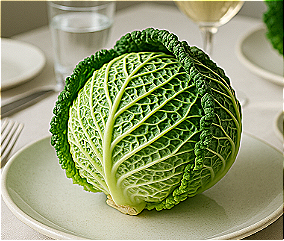
Savoy cabbage (Brassica oleracea var. sabauda) is a cabbage type with crinkled, blistered, loosely packed leaves forming a softer, less compact head than white/green head cabbage.
Colour ranges from light to dark green, sometimes with bluish tones. The flavour is mild, sweet-vegetal and slightly aromatic, generally less pungent than other brassicas.
It is eaten raw (salads, slaws) but is especially used cooked in soups, stews, braised dishes, stuffed cabbage rolls and traditional winter recipes.
Indicative nutritional values per 100 g
(raw Savoy cabbage, edible portion)
Energy: 25–35 kcal
Carbohydrates: 4–6 g
sugars: 2–3 g
Fibre: 2.5–4 g
Protein: 2–3 g
Lipids: 0.2–0.5 g
SFA (first occurrence – saturated fatty acids): ≈0.1 g (excess SFA in the diet is associated with higher cardiovascular risk, but the contribution from Savoy cabbage is minimal)
MUFA: traces
PUFA: traces
TFA: not naturally present
Vitamins: vitamin C, vitamin K, folate, small amounts of vitamin B6, carotenoids (mainly lutein)
Minerals: potassium, calcium, phosphorus, magnesium, traces of iron and manganese
Values vary with variety, soil, climate and processing (raw, cooked, stewed).
Key constituents
Glucosinolates typical of Brassicaceae
Isothiocyanates and other sulphur compounds (formed from glucosinolates)
Vitamin C
Vitamin K
Folate
Carotenoids (e.g. lutein)
Dietary fibre (cellulose, hemicellulose, pectins)
Minerals: K, Ca, Mg, P
Phenolic compounds with moderate antioxidant activity
Production process
Cultivation
Cool- to temperate-season crop, suited to autumn–winter production.
Grown in rotation to reduce soil-borne diseases.
Harvesting
Heads are cut at the stem when formed but not overly compact.
Outer damaged or yellow leaves are removed in the field or packing house.
Selection and washing
Removal of foreign matter, soil and defective leaves.
Washing with potable water, optionally with authorised sanitisers for fresh-cut lines.
Cutting and preparation
Whole heads, wedges, whole leaves (for cabbage rolls), strips or shreds for soups and ready-to-cook mixes.
Optional industrial processing
Freezing: blanching, cooling, IQF or block freezing and packaging.
Pasteurisation/sterilisation: in ready soups and cooked vegetable bases.
Fermentation: possible but less common than for white cabbage (used in mixed sauerkraut, kimchi-style products).
Packaging
Whole heads in crates or loose.
Cut products in bags or trays, often under modified atmosphere (MAP).
All steps under GMP/HACCP.
Physical properties
Appearance: loosely formed head with crinkled, blistered leaves.
Colour: light to dark green, sometimes with bluish tinge depending on variety and maturity.
Texture: crisp and juicy when raw; soft but still structured after short cooking or braising.
Moisture: around 90–92%.
Sensory and technological properties
Flavour: mild, slightly sweet and vegetal, less strong and sulphurous than some other cabbages.
Aroma: fresh, herbaceous; light sulphur notes that intensify with long cooking.
Technological behaviour:
large, flexible leaves are ideal for stuffed cabbage rolls;
good performance in stews, soups and braised dishes;
suitable for pan-frying and sautéing as a side dish;
shreds easily for fresh-cut mixes and frozen vegetables;
releases more sulphur volatiles and stronger odour if overcooked.
Food applications
Domestic and foodservice use:
minestrone and vegetable soups,
braised Savoy cabbage with meat or legumes,
stuffed Savoy cabbage rolls (meat or plant-based fillings),
sautéed or stir-fried as a side dish.
Industrial products:
fresh and frozen vegetable mixes,
ready-to-eat or chilled soups and stews,
fillings for ready meals (dumplings, pasta, stuffed dishes).
Fermented or mixed preparations:
component of mixed sauerkraut or kimchi-type products,
acidified vegetable mixes.
Nutrition & health
Low energy density, suitable for low-calorie diets.
Good source of vitamin C, contributing to antioxidant defence as part of a varied diet.
Provides vitamin K, important for blood clotting (intake should be considered in patients on vitamin K–sensitive anticoagulant therapy, following medical advice).
Supplies dietary fibre, which supports intestinal regularity when included in a balanced diet.
Contains glucosinolates and their degradation products (isothiocyanates), which are of nutritional and scientific interest.
May cause bloating and gas in individuals sensitive to FODMAPs or sulphur-containing compounds.
Portion note
Typical serving of cooked Savoy cabbage (stewed, sautéed, in soup):
80–100 g per person as vegetable portion.
In mixed products (soups, frozen blends):
usually 10–40% of total weight, depending on the recipe.
Allergens & intolerances
Savoy cabbage is not a major allergen under EU rules.
Possible cross-reactions in individuals allergic to other Brassicaceae (e.g. cauliflower, broccoli, white cabbage).
May cause gastrointestinal discomfort (bloating, gas) in FODMAP-sensitive individuals or those sensitive to sulphur compounds.
In processed foods, other allergens in the recipe (e.g. milk, gluten, soy) must be taken into account.
Storage & shelf-life
Whole fresh heads:
Refrigerated at 0–4 °C with high relative humidity;
typical shelf-life 1–3 weeks, depending on initial freshness.
Cut / fresh-cut (MAP) products:
Packaged in bags or trays under MAP;
indicative shelf-life 3–7 days at 0–4 °C.
Frozen Savoy cabbage:
stored at –18 °C;
shelf-life 12–24 months.
Cooked/pasteurised products (soups, ready meals):
shelf-life depends on treatment (from a few weeks refrigerated to several months if sterilised in cans or pouches).
Main issues are wilting and dehydration, as well as discolouration or strong odours if poorly stored.
Safety & regulatory
Controls required for:
pesticide residues (within legal maximum residue limits),
heavy metals (e.g. cadmium, lead) depending on soil and irrigation water,
pathogenic microorganisms (Listeria, Salmonella, STEC) particularly in fresh-cut and ready-to-eat lines.
For fermented products:
monitoring of pH, salt content, lactic acid bacteria counts, and absence of pathogens.
Production and processing should follow GMP/HACCP, with full traceability throughout the supply chain.
Labeling
Typical names:
“Savoy cabbage”,
“Savoy cabbage, shredded / sliced”.
In compound foods, Savoy cabbage must appear in the ingredient list in descending order of weight.
For fresh-cut products: indication of use-by date, storage conditions and any relevant handling instructions (e.g. “washed and ready to cook”).
In processed products: declaration of all additives (antioxidants, acidifiers, preservatives) and allergens in the recipe.
Troubleshooting
Wilting and leaf browning:
storage temperature too high or humidity too low → improve refrigeration and relative humidity; reduce storage times.
Very strong sulphur odour on cooking:
cooking time too long or at excessive temperature → use shorter or gentler cooking (steaming, light braising).
Loss of crunchiness in fresh-cut products:
excessive condensation and prolonged storage → optimise drainage, packaging design and cold chain management.
Texture defects after freezing (mushy on reheating):
inadequate blanching or freezing conditions → optimise blanching time/temperature and freezing process; avoid thaw–refreeze cycles.
Sustainability & supply chain
Savoy cabbage is a relatively robust crop with good yield in temperate climates.
Key environmental aspects:
water use,
plant protection products,
soil management and erosion control.
Improvements through:
integrated pest management and precision agriculture,
crop rotations with legumes and other species,
optimised irrigation.
In industrial processing:
washing water and process effluents are monitored (e.g. via BOD/COD);
vegetable by-products (outer leaves, cores) can be valorised as feed, compost or biomass.
Main INCI functions (cosmetics)
(often listed generically as “Brassica Oleracea Leaf Extract”; Savoy-specific naming is rare)
Antioxidant (thanks to vitamin C and phenolic compounds)
Skin conditioning
Mild soothing and purifying action in botanical formulations
Used mainly in natural or vegetable-themed cosmetic products.
Conclusion
Savoy cabbage is a versatile, nutritionally interesting winter vegetable, widely used in traditional dishes and industrial preparations.
Its combination of low calorie content, vitamin C, vitamin K, fibre and glucosinolates makes it suitable for modern diets focused on both taste and nutritional profile.
When produced in controlled supply chains under GMP/HACCP and stored correctly, Savoy cabbage represents a safe, stable and high-quality ingredient for home cooking, foodservice and food industry applications.
Mini-glossary
SFA – Saturated fatty acids: fats that should be moderated in the diet; Savoy cabbage contains very small amounts.
MUFA – Monounsaturated fatty acids: generally neutral or beneficial fats, present only in traces in Savoy cabbage.
PUFA – Polyunsaturated fatty acids: include essential fatty acids, present only in minimal amounts in this vegetable.
TFA – Trans fatty acids: industrial TFAs are linked with negative health effects; they are not naturally present in Savoy cabbage.
GMP/HACCP – Good Manufacturing Practices / Hazard Analysis and Critical Control Points, systems ensuring hygiene, safety and quality in food production.
BOD/COD – Biological / Chemical Oxygen Demand, indicators of the organic and chemical load of wastewater and its environmental impact.
FODMAPs – Fermentable Oligo-, Di-, Monosaccharides And Polyols; short-chain carbohydrates that can cause digestive symptoms in sensitive individuals.

