



Golden corn
(From Zea mays, family Poaceae)
Description
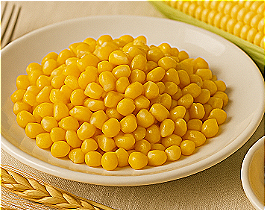
Golden corn refers to the yellow-kernel varieties of sweet corn, harvested at the milk stage, when kernels are tender, juicy and naturally sweet due to a high content of sucrose and simple sugars.
It is widely used in canned, frozen and fresh forms, as well as in soups, ready meals, snacks, baby food and plant-based formulations.
Golden corn is valued for its pleasant sweet flavour, bright yellow colour, and functional starches that contribute viscosity and texture in processed foods.
Indicative nutritional values per 100 g
(cooked golden sweet corn, drained)
Energy: 85–100 kcal
Carbohydrates: 18–21 g
sugars: 5–7 g
starch: 10–12 g
Fibre: 2–3 g
Protein: 3–4 g
Lipids: 1–2 g
SFA (first occurrence – saturated fatty acids): 0.2–0.4 g
MUFA: 0.3–0.5 g
PUFA: 0.5–1 g
TFA: not naturally present
Vitamins: B1, B3, B5, folate, small amounts of A (carotenoids) and C
Minerals: potassium, magnesium, phosphorus, small amounts of manganese and zinc
Values vary with variety and processing (fresh, canned, frozen).
Key constituents
Starch (amylose + amylopectin)
Simple sugars (sucrose, glucose, fructose)
Dietary fibre (cellulose, hemicellulose)
Carotenoids (lutein, zeaxanthin, β-carotene)
Vitamins B-group, vitamin C
Minerals (K, Mg, P)
Volatile aroma compounds that contribute to sweetness and fresh flavour
Production process
Cultivation and harvesting at the milk stage when sugars are at their peak.
Husking and sorting to remove husks and under-grade ears.
Cutting or kernel removal (for loose kernels) or cob trimming (for whole cob products).
Blanching to inactivate enzymes and preserve colour/flavour.
Processing route:
Canned: filling with brine, sealing, retorting.
Frozen: rapid cooling and IQF freezing.
Fresh/ready-to-eat: vacuum-packed, cooked, or tray-sealed.
Packaging under appropriate conditions (e.g., brine, modified atmosphere, freezer-grade).
Distribution and storage under controlled temperature.
All processing steps follow GMP/HACCP with full traceability.
Physical properties
Colour: bright yellow to golden.
Texture: juicy, crisp-tender kernels when cooked properly.
Moisture: 70–78% in prepared kernels.
Water activity: high unless dried or extruded.
Density: depends on cut size and processing (whole kernels vs. purée).
Sensory and technological properties
Flavour: sweet, slightly buttery, mild vegetal notes.
Aroma: fresh, grassy-sweet.
Colour stability: good when blanched; carotenoids provide natural yellow hue.
Functional behaviour:
contributes viscosity and body in soups and purees,
helps binding in patties and plant-based products,
provides moisture retention,
suitable for extrusion (snacks, cereals).
Food applications
Canned and frozen vegetables (whole kernels, cut corn).
Ready meals and soups: chowders, stews, curries.
Baby food: smooth purées and mixed vegetable blends.
Bakery and snacks: corn muffins, extruded snacks, fritters.
Salads and side dishes: grain bowls, vegetable mixes.
Plant-based products: natural sweetness and bulk in patties, burgers, nuggets.
Ingredients: corn purée, corn cream, corn mash.
Nutrition & health
Provides complex carbohydrates for steady energy.
Natural antioxidants (lutein and zeaxanthin) support eye health.
Low in fat and contains only trace SFA, with modest MUFA and PUFA.
Good source of fibre, supportive of digestive health.
Contains essential vitamins and minerals that contribute to a balanced diet.
Glycaemic impact depends on portion size and preparation method.
Portion note
Typical serving size:
80–100 g (drained kernels) as a vegetable portion.
In processed products:
5–40% depending on recipe (soups, fillings, plant-based patties).
Allergens & intolerances
Golden corn is not a major allergen.
Naturally gluten-free.
Rare cases of corn protein allergy exist but are uncommon.
Cross-contamination may occur in multi-ingredient production; must be checked via technical sheets.
Storage & shelf-life
Fresh: 1–3 days refrigerated.
Canned: 2–4 years unopened; 2–3 days refrigerated after opening.
Frozen IQF: 12–24 months at –18 °C.
Ready-to-eat vacuum-packed: 7–21 days refrigerated (depending on pasteurisation).
Sensitive to microbial growth if temperature abused.
Safety & regulatory
Must comply with limits for:
pesticide residues,
mycotoxins (rare in sweet corn compared to field corn),
heavy metals,
microbial safety in processed forms.
Production under GMP/HACCP.
Labelling of origin and processing method required where applicable.
Labeling
Accepted ingredient names:
“golden corn”
“sweet corn”
“yellow sweet corn”
“corn kernels” (for cut kernels)
For canned products: must list brine components (water, salt, sugar if added).
For frozen products: “sweet corn (kernels)”.
Troubleshooting
Loss of sweetness:
enzymatic conversion of sugars to starch → control with rapid blanching and cooling.
Tough or rubbery kernels:
overmature harvest → ensure correct maturity stage.
Colour fading:
oxidation → improve blanching, packaging, or oxygen barrier.
Excess syneresis in purées:
insufficient starch gelatinisation → adjust cook time/temperature.
Sustainability & supply chain
Sweet corn cultivation has moderate water needs and efficient yields.
Sustainability measures:
integrated pest management,
efficient fertiliser use,
reduction of post-harvest waste.
Processing plants must manage water usage and effluents (monitored by BOD/COD indicators).
By-products (husks, cobs) can be valorised as feed, compost, or biomass fuel.
Main INCI functions (cosmetics)
(as “Zea Mays Kernel Extract”, “Zea Mays Starch”, etc.)
Skin conditioning
Absorbent (corn starch)
Bulking and viscosity control
Film forming in some formulations
Conclusion
Golden corn is a versatile, nutritious and flavourful ingredient, widely used in fresh, canned and frozen forms and across numerous industrial applications.
Its sweet flavour, bright colour, natural antioxidants and functional starches make it valuable in both traditional and modern food product development.
Produced under GMP/HACCP, golden corn is a safe, stable and high-quality ingredient with broad consumer acceptance.
Mini-glossary
SFA – Saturated fatty acids: should be moderated in the diet; sweet corn contains very small amounts.
MUFA – Monounsaturated fatty acids: present in low amounts in corn.
PUFA – Polyunsaturated fatty acids: include essential fatty acids, present in modest quantities.
TFA – Trans fatty acids: not naturally present in corn.
GMP/HACCP – Systems ensuring safety, hygiene and quality in food production.
BOD/COD – Wastewater impact indicators used in evaluating food processing effluents.
Carotenoids – Natural pigments with antioxidant activity responsible for golden corn’s colour.
Studies
The results of this study suggest that even though there were pigment losses, creole maize pigments show antioxidant and antimutagenic activities after nixtamalization process (1).
From corn they are industrially extracted:
- Fructose syrup or HFCS (High Fructose Corn Syrup)
- Glucose syrup
- Glucose-fructose syrup
- Maize syrup (unusual diction as the content should be specified, whether fructose or glucose. Glucose is sugar, so a component to be taken in moderation. Fructose is a low-calorie carbohydrate sweetener that, frankly, would be best avoided )
It has a low caloric content.
Suitable for coeliacs.
Also used for animal feed.
Genetically modified crops (GMCs) were first introduced to commercial agriculture in 1996, and approximately 181.5 million hectares of GMCs were grown worldwide in 2014. These GMCs have produced significant benefits over the past two decades (Clive, 2015). A recent meta-analysis by Klumper and Qaim concluded that the wide adoption of GM technology has reduced the usage of chemical pesticides, in addition to increasing crop yields to improve farmers' profits (Wilhelm and Matin, 2014). Despite the obvious positive effects of GMCs, public controversy over on the unintended, unexpected, and uncontrolled negative effects of GMCs are still ongoing. There is considerable concern that the introduction of exogenous DNA sequences and enzymes into the target plant genome in GMCs might result in unintended effects, and these negative effects may affect both human health and the environmental safety (Ioset et al., 2006). Therefore, determination of these potential unintended effects necessary and scientists should perform bio-assessment analyses to guarantee the safety of GMCs (1).

