Sweet potatoes
(From Ipomoea batatas, family Convolvulaceae)
Description
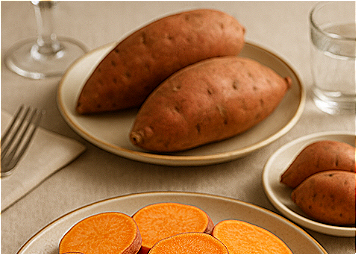
Sweet potatoes are the edible storage roots of Ipomoea batatas, with flesh colours ranging from white and yellow to deep orange and purple.
They have a sweet, aromatic, slightly nutty flavour and a soft, creamy texture when cooked.
They are widely used in bakery, snacks, purées, ready meals, baby food and functional products thanks to their content of complex carbohydrates, fibre, vitamins and natural antioxidants (especially provitamin A carotenoids in orange varieties and anthocyanins in purple types).
Indicative nutritional values per 100 g
(fresh, raw sweet potato)
Energy: 85–100 kcal
Carbohydrates: 19–24 g
Fibre: 3–4 g
Protein: 1–2 g
Lipids: 0.1–0.3 g
Vitamins: vitamin A (as provitamin A carotenoids, especially in orange-fleshed types), vitamin C, vitamin B6
Minerals: potassium, manganese, copper
Values vary with variety, growing conditions and cooking method.
Key constituents
Starch and complex carbohydrates
Dietary fibre (mainly insoluble, some soluble fractions)
Provitamin A carotenoids (e.g. beta-carotene in orange varieties)
Anthocyanins (in purple-fleshed varieties)
Vitamin C and B-group vitamins
Minerals: potassium, manganese, copper
Phenolic compounds with antioxidant activity
Production process
Cultivation and harvesting: grown in field; roots harvested mechanically or manually at maturity.
Curing: short storage at warm, humid conditions to promote skin healing, improve sweetness and shelf-life.
Washing and sorting: removal of soil, foreign matter, damaged roots.
Primary processing:
trimming, peeling (optional), cutting (cubes, slices, fries),
or mashing to produce purées.
Thermal processing: steaming, boiling, baking, roasting or blanching depending on end use; drying for flours or flakes.
Further processing:
Packaging and storage (fresh, chilled, frozen or dried).
All steps under GMP/HACCP.
Physical properties
Colour: flesh white, cream, yellow, orange or purple, depending on variety; skin colour also variable.
Texture: firm when raw; soft, creamy and slightly fibrous when cooked.
Moisture content: 60–75% (raw roots).
Bulk density: variety- and cut-size dependent.
Stability: good if stored in cool, dry, well-ventilated conditions; sensitive to cold damage below ≈ 10–12 °C.
Sensory and technological properties
Flavour: sweet, earthy, slightly nutty; sweetness increases with curing and cooking (starch-to-sugar conversion).
Texture contributions: provides body, creaminess and viscosity in purées, soups and bakery products.
Colouring ability: orange varieties give warm yellow–orange tones; purple types provide violet to red hues.
Processing behaviour:
good roasting and caramelisation properties,
suitable for frying (fries, chips),
contributes moisture retention and softness in baked goods.
Food applications
Bakery and confectionery: breads, muffins, cakes, cookies, pancakes, fillings.
Side dishes and ready meals: roasted sweet potatoes, mash, gratins, stews, soups and pureed dishes.
Snacks: chips, fries (baked or fried), extruded snacks, bars with sweet potato flakes/flour.
Baby food: single-ingredient or mixed vegetable/fruit purées.
Gluten-free and functional products: sweet potato flour in blends, gnocchi, pasta alternatives.
Ingredients for natural colouring and flavouring in soups, sauces, dips and spreads.
Nutrition & health
Source of complex carbohydrates for sustained energy release.
Orange-fleshed varieties provide provitamin A carotenoids (beta-carotene), contributing to vitamin A intake when consumed with some dietary fat.
Purple-fleshed varieties contain anthocyanins with antioxidant properties.
Provide fibre, which supports digestive regularity as part of a balanced diet.
Rich in potassium, contributing to electrolyte balance.
Overall nutritional impact depends on portion size and cooking method (e.g. frying vs baking/steaming).
Portion note
Allergens & intolerances
Sweet potatoes are not a major allergen.
Naturally gluten-free, suitable for gluten-free formulations when handled to avoid cross-contamination.
Idiosyncratic intolerances are rare; always review full recipe and processing for other allergens.
Storage & shelf-life
Fresh roots:
store in a cool (≈ 12–16 °C), dry, well-ventilated area;
typical shelf-life: 2–6 weeks, depending on temperature, humidity and variety.
Processed products:
chilled purées: 3–7 days at 0–4 °C,
frozen purées or pieces: 6–12 months at –18 °C,
dried flakes/flours: 12–24 months in moisture-barrier packaging.
Sensitive to: bruising, sprouting, mould growth under high humidity, and chilling injury at too low temperatures.
Safety & regulatory
Must comply with limits for:
Production under GMP/HACCP with traceability from field to final ingredient.
In baby foods and special products, additional regulatory requirements may apply (e.g. stricter contaminant limits).
Labeling
Typical declarations:
In compound foods, ingredients must be listed in descending order of weight.
Colour (e.g. “orange sweet potato”, “purple sweet potato”) may be indicated for product differentiation and marketing.
Troubleshooting
Sustainability & supply chain
Sweet potatoes typically have good yield and relatively low water requirements compared to some other crops.
Agronomic advantages:
Sustainability can be enhanced through:
Processing plants must manage peels, off-cuts and wash water; wastewater impact is monitored using indicators such as BOD/COD.
By-products (peels, downgraded roots) can be used for animal feed or compost.
Main INCI functions (cosmetics)
(as “Ipomoea Batatas Root Extract”, “Ipomoea Batatas Root Powder”, etc.)
Skin conditioning (due to sugars, minerals and natural antioxidants).
Soothing properties for sensitive skin in some formulations.
Antioxidant activity (especially from carotenoids and anthocyanins in coloured varieties).
Used in creams, masks, scrubs and “natural” cosmetic lines.
Conclusion
Sweet potatoes are a versatile, nutrient-dense root ingredient, suitable for a wide range of applications from traditional side dishes to modern snacks, baby foods and functional products.
Their combination of complex carbohydrates, fibre, vitamins and natural pigments makes them particularly interesting for health-oriented and clean label formulations. When grown in well-managed supply chains and processed under GMP/HACCP, sweet potatoes provide a safe, stable and high-quality ingredient for both industrial and artisanal use.
Mini-glossary
SFA – Saturated fatty acids: a class of fats that should be moderated in the diet; sweet potatoes contain only negligible amounts.
MUFA – Monounsaturated fatty acids: generally considered neutral or beneficial fats; present only in trace amounts here.
PUFA – Polyunsaturated fatty acids: essential fats more prone to oxidation; also present only in traces in sweet potatoes.
TFA – Trans fatty acids: associated with negative health effects when industrial; not naturally present in sweet potatoes.
GMP/HACCP – Good Manufacturing Practices / Hazard Analysis and Critical Control Points, systems ensuring hygiene, safety and quality in food production.
BOD/COD – Biological / Chemical Oxygen Demand, indicators used to assess the environmental impact of processing wastewater.
Anthocyanins – Water-soluble pigments responsible for purple/blue colours in foods, with antioxidant properties.
References__________________________________________________________________________
Escobar-Puentes AA, Palomo I, Rodríguez L, Fuentes E, Villegas-Ochoa MA, González-Aguilar GA, Olivas-Aguirre FJ, Wall-Medrano A. Sweet Potato (Ipomoea batatas L.) Phenotypes: From Agroindustry to Health Effects. Foods. 2022 Apr 6;11(7):1058. doi: 10.3390/foods11071058.
Abstract. Sweet potato (SP; Ipomoea batatas (L.) Lam) is an edible tuber native to America and the sixth most important food crop worldwide. China leads its production in a global market of USD 45 trillion. SP domesticated varieties differ in specific phenotypic/genotypic traits, yet all of them are rich in sugars, slow digestible/resistant starch, vitamins, minerals, bioactive proteins and lipids, carotenoids, polyphenols, ascorbic acid, alkaloids, coumarins, and saponins, in a genotype-dependent manner. Individually or synergistically, SP's phytochemicals help to prevent many illnesses, including certain types of cancers and cardiovascular disorders. These and other topics, including the production and market diversification of raw SP and its products, and SP's starch as a functional ingredient, are briefly discussed in this review.
Rosell MLÁ, Quizhpe J, Ayuso P, Peñalver R, Nieto G. Proximate Composition, Health Benefits, and Food Applications in Bakery Products of Purple-Fleshed Sweet Potato (Ipomoea batatas L.) and Its By-Products: A Comprehensive Review. Antioxidants (Basel). 2024 Aug 6;13(8):954. doi: 10.3390/antiox13080954.
Abstract. Ipomoea batatas (L.) Lam is a dicotyledonous plant originally from tropical regions, with China and Spain acting as the main producers from outside and within the EU, respectively. The root, including only flesh, is the edible part, and the peel, leaves, stems, or shoots are considered by-products, which are generated due to being discarded in the field and during processing. Therefore, this study aimed to perform a comprehensive review of the nutritional value, phytochemical composition, and health-promoting activities of purple-fleshed sweet potato and its by-products, which lead to its potential applications in bakery products for the development of functional foods. The methodology is applied to the selected topic and is used to conduct the search, review abstracts and full texts, and discuss the results using different general databases. The studies suggested that purple-fleshed sweet potato parts are characterized by a high content of essential minerals and bioactive compounds, including anthocyanins belonging to the cyanidin or the peonidin type. The flesh and leaves are also high in phenolic compounds and carotenoids such as lutein and β-carotene. The high content of phenolic compounds and anthocyanins provides the purple-fleshed sweet potato with high antioxidant and anti-inflammatory power due to the modulation effect of the transcription factor Nrf2 and NF-kB translocation, which may lead to protection against hepatic and neurological disorders, among others. Furthermore, purple-fleshed sweet potato and its by-products can play a dual role in food applications due to its attractive color and wide range of biological activities which enhance its nutritional profile. As a result, it is essential to harness the potential of the purple-fleshed sweet potato and its by-products that are generated during its processing through an appropriate agro-industrial valorization system.
Boukhers I, Morel S, Kongolo J, Domingo R, Servent A, Ollier L, Kodja H, Petit T, Poucheret P. Immunomodulatory and Antioxidant Properties of Ipomoea batatas Flour and Extracts Obtained by Green Extraction. Curr Issues Mol Biol. 2023 Aug 22;45(9):6967-6985. doi: 10.3390/cimb45090440.
Abstract. Sweet potato (SP), Ipomoea batatas Lam, belongs to the Convolvulaceae family. It produces edible storage roots. Currently, orange varieties contribute to improving food systems and managing vitamin A deficiency. Processing of this food crop into flour allows better conservation. However, nutrition health data regarding SP flour obtained by green extraction remains scarce. In this study, we therefore explored its phytochemistry and its associated bioactivity potential for human health. We analyzed the nutritional composition of orange flesh sweet potato (OFSP) flour and assessed the antioxidant (free radical scavenging) and immunomodulatory (on inflammatory murine macrophages) properties of the extract. More specifically, we measured the impact of OFSP flour extract on mediators such as Nitric Oxide (NO) and the production of pro-inflammatory cytokines such as Interleukin-6 (IL-6), Tumor Necrosis Factor alpha (TNF-alpha), Monocyte Chemoattractant Protein-1 (MCP-1), and Prostaglandin-E2 (PGE-2). Our results indicated significant fiber, mineral, beta-carotene, and polyphenols content in the extracts, and antioxidant and immunomodulatory bioactivities were also demonstrated with a concentration-dependent inhibition of cytokine production. Taken together, our results suggest that Ipomoea batatas flour could, in addition to being a good source of energy and beta-carotene provitamin A, constitute a food of interest for the prophylaxis of metabolic diseases associated with an underlying low-grade inflammatory state.
Arisanti CIS, Wirasuta IMAG, Musfiroh I, Ikram EHK, Muchtaridi M. Mechanism of Anti-Diabetic Activity from Sweet Potato (Ipomoea batatas): A Systematic Review. Foods. 2023 Jul 24;12(14):2810. doi: 10.3390/foods12142810.
Abstract. This study aims to provide an overview of the compounds found in sweet potato (Ipomoea batatas) that contribute to its anti-diabetic activity and the mechanisms by which they act. A comprehensive literature search was conducted using electronic databases, such as PubMed, Scopus, and Science Direct, with specific search terms and Boolean operators. A total of 269 articles were initially retrieved, but after applying inclusion and exclusion criteria only 28 articles were selected for further review. Among the findings, four varieties of sweet potato were identified as having potential anti-diabetic properties. Phenolic acids, flavonols, flavanones, and anthocyanidins are responsible for the anti-diabetic activity of sweet potatoes. The anti-diabetic mechanism of sweet potatoes was determined using a combination of components with multi-target actions. The results of these studies provide evidence that Ipomoea batatas is effective in the treatment of type 2 diabetes.
Naomi R, Bahari H, Yazid MD, Othman F, Zakaria ZA, Hussain MK. Potential Effects of Sweet Potato (Ipomoea batatas) in Hyperglycemia and Dyslipidemia-A Systematic Review in Diabetic Retinopathy Context. Int J Mol Sci. 2021 Oct 6;22(19):10816. doi: 10.3390/ijms221910816.
Abstract. Hyperglycemia is a condition with high glucose levels that may result in dyslipidemia. In severe cases, this alteration may lead to diabetic retinopathy. Numerous drugs have been approved by officials to treat these conditions, but usage of any synthetic drugs in the long term will result in unavoidable side effects such as kidney failure. Therefore, more emphasis is being placed on natural ingredients due to their bioavailability and absence of side effects. In regards to this claim, promising results have been witnessed in the usage of Ipomoea batatas (I. batatas) in treating the hyperglycemic and dyslipidemic condition. Thus, the aim of this paper is to conduct an overview of the reported effects of I. batatas focusing on in vitro and in vivo trials in reducing high glucose levels and regulating the dyslipidemic condition. A comprehensive literature search was performed using Scopus, Web of Science, Springer Nature, and PubMed databases to identify the potential articles on particular topics. The search query was accomplished based on the Boolean operators involving keywords such as (1) Beneficial effect OR healing OR intervention AND (2) sweet potato OR Ipomoea batatas OR traditional herb AND (3) blood glucose OR LDL OR lipid OR cholesterol OR dyslipidemia. Only articles published from 2011 onwards were selected for further analysis. This review includes the (1) method of intervention and the outcome (2) signaling mechanism involved (3) underlying mechanism of action, and the possible side effects observed based on the phytoconstiuents isolated. The comprehensive literature search retrieved a total of 2491 articles using the appropriate keywords. However, on the basis of the inclusion and exclusion criteria, only 23 articles were chosen for further review. The results from these articles indicate that I. batatas has proven to be effective in treating the hyperglycemic condition and is able to regulate dyslipidemia. Therefore, this systematic review summarizes the signaling mechanism, mechanism of action, and phytoconstituents responsible for those activities of I. batatas in treating hyperglycemic based on the in vitro and in vivo study.
Cordeiro N, Freitas N, Faria M, Gouveia M. Ipomoea batatas (L.) Lam.: a rich source of lipophilic phytochemicals. J Agric Food Chem. 2013 Dec 18;61(50):12380-4. doi: 10.1021/jf404230z.
Abstract. The lipophilic extracts from the storage root of 13 cultivars of sweet potato (Ipomoea batatas (L.) Lam.) were evaluated by gas chromatography-mass spectrometry with the aim to valorize them and offer information on their nutritional properties and potential health benefits. The amount of lipophilic extractives ranged from 0.87 to 1.32% dry weight. Fatty acids and sterols were the major families of compounds identified. The most abundant saturated and unsaturated fatty acids were hexadecanoic acid (182-428 mg/kg) and octadeca-9,12-dienoic acid (133-554 mg/kg), respectively. β-Sitosterol was the principal phytosterol, representing 55.2-77.6% of this family, followed by campesterol. Long-chain aliphatic alcohols and α-tocopherol were also detected but in smaller amounts. The results suggest that sweet potato should be considered as an important dietary source of lipophilic phytochemicals.
Jia R, Tang C, Chen J, Zhang X, Wang Z. Total Phenolics and Anthocyanins Contents and Antioxidant Activity in Four Different Aerial Parts of Leafy Sweet Potato (Ipomoea batatas L.). Molecules. 2022 May 12;27(10):3117. doi: 10.3390/molecules27103117.
Abstract. Leafy sweet potato (Ipomoea batatas L.) is an excellent source of nutritious greens and natural antioxidants, but reports on antioxidants content and activity at buds, leaves, petioles, and stems are scarce. Therefore, the total phenolics content (TPC), total anthocyanins content (TAC), and antioxidant activity (assessed by DPPH and ABTS radical scavenging activities and ferric reducing antioxidant power (FRAP)) were investigated in four aerial parts of 11 leafy sweet potato varieties. The results showed that varieties with pure green aerial parts, independently of the part analyzed, had higher TPC, FRAP, and ABTS radical scavenging activities. The green-purple varieties had a significantly higher TAC, while variety GS-17-22 had the highest TAC in apical buds and leaves, and variety Ziyang in petioles and stems. Among all parts, apical buds presented the highest TPC and antioxidant capacity, followed by leaves, petioles, and stems, while the highest TAC level was detected in leaves. The TPC was positively correlated with ABTS radical scavenging activity and FRAP in all parts studied, whereas the TAC was negatively correlated with DPPH radical scavenging activity. Collectively, the apical buds and leaves of sweet potato had the higher levels of nutritional values. These results would provide reference values for further breeding of leafy sweet potatoes.
Garner T, Ouyang A, Berrones AJ, Campbell MS, Du B, Fleenor BS. Sweet potato (Ipomoea batatas) attenuates diet-induced aortic stiffening independent of changes in body composition. Appl Physiol Nutr Metab. 2017 Aug;42(8):802-809. doi: 10.1139/apnm-2016-0571.
Abstract. We hypothesized a sweet potato intervention would prevent high-fat (HF) diet-induced aortic stiffness, which would be associated with decreased arterial oxidative stress and increased mitochondrial uncoupling. Young (8-week old) C57BL/6J mice were randomly divided into 4 groups: low fat (LF; 10% fat), HF (60% fat), low-fat sweet potato (LFSP; 10% fat containing 260.3 μg/kcal sweet potato), or high-fat sweet potato diet (HFSP; 60% fat containing 260.3 μg/kcal sweet potato) for 16 weeks. Compared with LF and LFSP, HF- and HFSP-fed mice had increased body mass and percent fat mass with lower percent lean mass (all, P < 0.05). Sweet potato intervention did not influence body composition (all, P > 0.05). Arterial stiffness, assessed by aortic pulse wave velocity and ex vivo mechanical testing of the elastin region elastic modulus (EEM) was greater in HF compared with LF and HFSP animals (all, P < 0.05). Advanced glycation end products and nitrotyrosine abundance were greater in aortic segments from HF mice compared with LF and HFSP animals (all, P < 0.05). Aortic elastin and uncoupling protein 2 expressions, however, were reduced in HF compared with LF and HFSP mice (all, P < 0.05). Aortic segments cultured with 2,4-dinitrophenol (DNP), a mitochondrial uncoupler, for 72 h reduced the EEM of HF arteries compared with nontreated HF segments (P < 0.05). DNP had no effect on the EEM of aortic segments from HFSP mice. In conclusion, sweet potato attenuates diet-induced aortic stiffness independent of body mass and composition, which is associated with a normalization of arterial oxidative stress possibly due to mitochondrial uncoupling.




