Patate dolci
(Da Ipomoea batatas, famiglia Convolvulaceae)
Descrizione
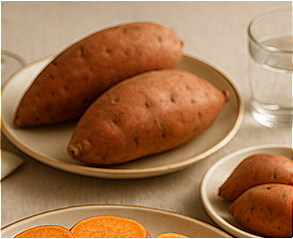
Le patate dolci sono i tuberi commestibili della pianta Ipomoea batatas, caratterizzate da polpa variabile dal giallo all’arancione fino al viola, con sapore dolce, aromatico e leggermente nocciolato.
Sono ampiamente utilizzate in prodotti da forno, snack, puree, piatti pronti, miscele per baby food e formulazioni funzionali grazie al contenuto di carboidrati complessi, fibre, vitamine (soprattutto vitamina A nelle varietà arancioni) e antiossidanti.
Valori nutrizionali indicativi per 100 g
(prodotto fresco crudo)
Energia: 85–100 kcal
Carboidrati: 19–24 g
Fibre: 3–4 g
Proteine: 1–2 g
Lipidi: 0,1–0,3 g
Vitamine: vitamina A (beta-carotene), C, B6
Minerali: potassio, manganese, rame
I valori cambiano in base alla varietà e al metodo di cottura.
Principali sostanze contenute
Amido e carboidrati complessi
Fibre (prevalentemente insolubili)
Beta-carotene (nelle varietà arancioni)
Antociani (nelle varietà viola)
Vitamina C e vitamine del gruppo B
Minerali: potassio, manganese, rame
Composti fenolici antiossidanti
Processo di produzione
Coltivazione in campo con raccolta manuale o meccanica.
Cura post-raccolta (curing) per migliorare dolcezza e conservabilità.
Lavaggio e selezione dei tuberi.
Taglio e trasformazione secondo destinazione (chips, puree, cubetti, farine).
Trattamenti termici (cottura, vapore, essiccazione).
Eventuale macinazione per farine o polveri.
Confezionamento e stoccaggio.
Il tutto gestito secondo GMP/HACCP.
Proprietà fisiche
Colore: arancione, giallo, bianco o viola a seconda della varietà.
Consistenza: soda da cruda, morbida e cremosa da cotta.
Umidità: 60–75%
Densità: variabile in funzione del contenuto di amido
Stabilità: buona se conservate in ambiente fresco e asciutto
Proprietà sensoriali e tecnologiche
Sapore dolce e aromatico, più o meno intenso secondo la varietà.
Alta capacità di addensare puree, zuppe e prodotti da forno.
Ottima caramellizzazione e formazione di aromi in cottura.
Aumentano l’umidità e la morbidezza in impasti e prodotti bakery.
Buona resistenza alla frittura (chips e fries).
Impieghi alimentari
Prodotti bakery: pane, muffin, biscotti, pancake.
Piatti pronti: puree, contorni, vellutate.
Snack: chips, bastoncini al forno, barrette.
Baby food: puree e miscele di cereali/verdure.
Bevande funzionali (in polvere).
Paste e gnocchi a base di patata dolce.
Ingredienti coloranti naturali (varietà arancioni/viola).
Nutrizione e salute
Fonte di energia a rilascio moderato grazie ai carboidrati complessi.
Le varietà arancioni contengono molto beta-carotene, precursore della vitamina A.
Le varietà viola apportano antociani antiossidanti.
Ricche di potassio, utili per l’equilibrio elettrolitico.
Buone quantità di fibre, utili per la regolarità intestinale.
Gli effetti benefici dipendono dalla quantità e dalla modalità di consumo.
Nota porzione
Allergeni e intolleranze
Le patate dolci non contengono allergeni maggiori.
Naturalmente senza glutine, adatte anche a formulazioni GF.
Possibili contaminazioni crociate durante la lavorazione industriale (da controllare nelle schede tecniche).
Conservazione e shelf-life
Tuberi freschi: luogo fresco, asciutto e ventilato; durata 2–6 settimane.
Prodotti trasformati:
puree refrigerate: 3–7 giorni
puree congelate: 6–12 mesi
farine/fiocchi: 12–24 mesi (in confezioni barriera all’umidità)
Sensibili a: umidità, germinazione e ammaccature.
Sicurezza e regolatorio
Devono rispettare i limiti per:
Produzione nel rispetto di GMP/HACCP.
Etichettatura obbligatoria dell’origine (Paese di coltivazione, se richiesta).
Etichettatura
Denominazioni ammesse:
Nei prodotti composti: indicare in ordine decrescente di peso.
Può essere indicato il colore (arancione, viola).
Troubleshooting
Imbrunimento eccessivo in cottura: temperatura troppo alta → ridurre T° o aggiungere antiossidanti naturali (es. acido ascorbico).
Purea troppo liquida: varietà poco amidacea o cottura eccessiva → scegliere varietà più adatte o ridurre acqua.
Farina che fa grumi: elevata igroscopicità → migliorare confezionamento o pregelatinizzare.
Durezza dopo cottura: varietà ad alto contenuto di amido → allungare i tempi di cottura.
Sostenibilità e filiera
La coltura della patata dolce richiede poca acqua e ha buona resa per ettaro.
Le filiere possono essere implementate con:
Gli scarti possono essere usati per feed o compost.
Le industrie di trasformazione devono gestire i reflui (monitoraggio BOD/COD).
Principali funzioni INCI (cosmesi)
(come Ipomoea Batatas Root Extract o polveri derivate)
Skin conditioning
Lenitive
Antiossidanti (varietà ricche di antociani)
Impiegate in creme nutrienti, maschere e prodotti per pelli sensibili.
Conclusione
Le patate dolci sono un ingrediente versatile, nutriente e funzionale, adatto a numerose applicazioni alimentari grazie al contenuto di carboidrati complessi, fibre, vitamine e pigmenti naturali.
Ben gestite in filiera e trasformate secondo GMP/HACCP, rappresentano un ingrediente sicuro, stabile e di alta qualità per prodotti freschi, trasformati e funzionali.
Mini-glossario
SFA – Saturated Fatty Acids (acidi grassi saturi): presenti in quantità minime nelle patate dolci; un eccesso nella dieta è associato a maggior rischio cardiovascolare, ma qui non costituiscono una preoccupazione.
MUFA – acidi grassi monoinsaturi: presenti solo in tracce.
PUFA – acidi grassi polinsaturi: presenti solo in tracce.
TFA – acidi grassi trans: assenti naturalmente.
GMP/HACCP – sistemi di gestione per la sicurezza e qualità alimentare.
BOD/COD – indicatori usati per valutare l’impatto ambientale dei reflui.
Bibliografia__________________________________________________________________________
Escobar-Puentes AA, Palomo I, Rodríguez L, Fuentes E, Villegas-Ochoa MA, González-Aguilar GA, Olivas-Aguirre FJ, Wall-Medrano A. Sweet Potato (Ipomoea batatas L.) Phenotypes: From Agroindustry to Health Effects. Foods. 2022 Apr 6;11(7):1058. doi: 10.3390/foods11071058.
Abstract. Sweet potato (SP; Ipomoea batatas (L.) Lam) is an edible tuber native to America and the sixth most important food crop worldwide. China leads its production in a global market of USD 45 trillion. SP domesticated varieties differ in specific phenotypic/genotypic traits, yet all of them are rich in sugars, slow digestible/resistant starch, vitamins, minerals, bioactive proteins and lipids, carotenoids, polyphenols, ascorbic acid, alkaloids, coumarins, and saponins, in a genotype-dependent manner. Individually or synergistically, SP's phytochemicals help to prevent many illnesses, including certain types of cancers and cardiovascular disorders. These and other topics, including the production and market diversification of raw SP and its products, and SP's starch as a functional ingredient, are briefly discussed in this review.
Rosell MLÁ, Quizhpe J, Ayuso P, Peñalver R, Nieto G. Proximate Composition, Health Benefits, and Food Applications in Bakery Products of Purple-Fleshed Sweet Potato (Ipomoea batatas L.) and Its By-Products: A Comprehensive Review. Antioxidants (Basel). 2024 Aug 6;13(8):954. doi: 10.3390/antiox13080954.
Abstract. Ipomoea batatas (L.) Lam is a dicotyledonous plant originally from tropical regions, with China and Spain acting as the main producers from outside and within the EU, respectively. The root, including only flesh, is the edible part, and the peel, leaves, stems, or shoots are considered by-products, which are generated due to being discarded in the field and during processing. Therefore, this study aimed to perform a comprehensive review of the nutritional value, phytochemical composition, and health-promoting activities of purple-fleshed sweet potato and its by-products, which lead to its potential applications in bakery products for the development of functional foods. The methodology is applied to the selected topic and is used to conduct the search, review abstracts and full texts, and discuss the results using different general databases. The studies suggested that purple-fleshed sweet potato parts are characterized by a high content of essential minerals and bioactive compounds, including anthocyanins belonging to the cyanidin or the peonidin type. The flesh and leaves are also high in phenolic compounds and carotenoids such as lutein and β-carotene. The high content of phenolic compounds and anthocyanins provides the purple-fleshed sweet potato with high antioxidant and anti-inflammatory power due to the modulation effect of the transcription factor Nrf2 and NF-kB translocation, which may lead to protection against hepatic and neurological disorders, among others. Furthermore, purple-fleshed sweet potato and its by-products can play a dual role in food applications due to its attractive color and wide range of biological activities which enhance its nutritional profile. As a result, it is essential to harness the potential of the purple-fleshed sweet potato and its by-products that are generated during its processing through an appropriate agro-industrial valorization system.
Boukhers I, Morel S, Kongolo J, Domingo R, Servent A, Ollier L, Kodja H, Petit T, Poucheret P. Immunomodulatory and Antioxidant Properties of Ipomoea batatas Flour and Extracts Obtained by Green Extraction. Curr Issues Mol Biol. 2023 Aug 22;45(9):6967-6985. doi: 10.3390/cimb45090440.
Abstract. Sweet potato (SP), Ipomoea batatas Lam, belongs to the Convolvulaceae family. It produces edible storage roots. Currently, orange varieties contribute to improving food systems and managing vitamin A deficiency. Processing of this food crop into flour allows better conservation. However, nutrition health data regarding SP flour obtained by green extraction remains scarce. In this study, we therefore explored its phytochemistry and its associated bioactivity potential for human health. We analyzed the nutritional composition of orange flesh sweet potato (OFSP) flour and assessed the antioxidant (free radical scavenging) and immunomodulatory (on inflammatory murine macrophages) properties of the extract. More specifically, we measured the impact of OFSP flour extract on mediators such as Nitric Oxide (NO) and the production of pro-inflammatory cytokines such as Interleukin-6 (IL-6), Tumor Necrosis Factor alpha (TNF-alpha), Monocyte Chemoattractant Protein-1 (MCP-1), and Prostaglandin-E2 (PGE-2). Our results indicated significant fiber, mineral, beta-carotene, and polyphenols content in the extracts, and antioxidant and immunomodulatory bioactivities were also demonstrated with a concentration-dependent inhibition of cytokine production. Taken together, our results suggest that Ipomoea batatas flour could, in addition to being a good source of energy and beta-carotene provitamin A, constitute a food of interest for the prophylaxis of metabolic diseases associated with an underlying low-grade inflammatory state.
Arisanti CIS, Wirasuta IMAG, Musfiroh I, Ikram EHK, Muchtaridi M. Mechanism of Anti-Diabetic Activity from Sweet Potato (Ipomoea batatas): A Systematic Review. Foods. 2023 Jul 24;12(14):2810. doi: 10.3390/foods12142810.
Abstract. This study aims to provide an overview of the compounds found in sweet potato (Ipomoea batatas) that contribute to its anti-diabetic activity and the mechanisms by which they act. A comprehensive literature search was conducted using electronic databases, such as PubMed, Scopus, and Science Direct, with specific search terms and Boolean operators. A total of 269 articles were initially retrieved, but after applying inclusion and exclusion criteria only 28 articles were selected for further review. Among the findings, four varieties of sweet potato were identified as having potential anti-diabetic properties. Phenolic acids, flavonols, flavanones, and anthocyanidins are responsible for the anti-diabetic activity of sweet potatoes. The anti-diabetic mechanism of sweet potatoes was determined using a combination of components with multi-target actions. The results of these studies provide evidence that Ipomoea batatas is effective in the treatment of type 2 diabetes.
Naomi R, Bahari H, Yazid MD, Othman F, Zakaria ZA, Hussain MK. Potential Effects of Sweet Potato (Ipomoea batatas) in Hyperglycemia and Dyslipidemia-A Systematic Review in Diabetic Retinopathy Context. Int J Mol Sci. 2021 Oct 6;22(19):10816. doi: 10.3390/ijms221910816.
Abstract. Hyperglycemia is a condition with high glucose levels that may result in dyslipidemia. In severe cases, this alteration may lead to diabetic retinopathy. Numerous drugs have been approved by officials to treat these conditions, but usage of any synthetic drugs in the long term will result in unavoidable side effects such as kidney failure. Therefore, more emphasis is being placed on natural ingredients due to their bioavailability and absence of side effects. In regards to this claim, promising results have been witnessed in the usage of Ipomoea batatas (I. batatas) in treating the hyperglycemic and dyslipidemic condition. Thus, the aim of this paper is to conduct an overview of the reported effects of I. batatas focusing on in vitro and in vivo trials in reducing high glucose levels and regulating the dyslipidemic condition. A comprehensive literature search was performed using Scopus, Web of Science, Springer Nature, and PubMed databases to identify the potential articles on particular topics. The search query was accomplished based on the Boolean operators involving keywords such as (1) Beneficial effect OR healing OR intervention AND (2) sweet potato OR Ipomoea batatas OR traditional herb AND (3) blood glucose OR LDL OR lipid OR cholesterol OR dyslipidemia. Only articles published from 2011 onwards were selected for further analysis. This review includes the (1) method of intervention and the outcome (2) signaling mechanism involved (3) underlying mechanism of action, and the possible side effects observed based on the phytoconstiuents isolated. The comprehensive literature search retrieved a total of 2491 articles using the appropriate keywords. However, on the basis of the inclusion and exclusion criteria, only 23 articles were chosen for further review. The results from these articles indicate that I. batatas has proven to be effective in treating the hyperglycemic condition and is able to regulate dyslipidemia. Therefore, this systematic review summarizes the signaling mechanism, mechanism of action, and phytoconstituents responsible for those activities of I. batatas in treating hyperglycemic based on the in vitro and in vivo study.
Cordeiro N, Freitas N, Faria M, Gouveia M. Ipomoea batatas (L.) Lam.: a rich source of lipophilic phytochemicals. J Agric Food Chem. 2013 Dec 18;61(50):12380-4. doi: 10.1021/jf404230z.
Abstract. The lipophilic extracts from the storage root of 13 cultivars of sweet potato (Ipomoea batatas (L.) Lam.) were evaluated by gas chromatography-mass spectrometry with the aim to valorize them and offer information on their nutritional properties and potential health benefits. The amount of lipophilic extractives ranged from 0.87 to 1.32% dry weight. Fatty acids and sterols were the major families of compounds identified. The most abundant saturated and unsaturated fatty acids were hexadecanoic acid (182-428 mg/kg) and octadeca-9,12-dienoic acid (133-554 mg/kg), respectively. β-Sitosterol was the principal phytosterol, representing 55.2-77.6% of this family, followed by campesterol. Long-chain aliphatic alcohols and α-tocopherol were also detected but in smaller amounts. The results suggest that sweet potato should be considered as an important dietary source of lipophilic phytochemicals.
Jia R, Tang C, Chen J, Zhang X, Wang Z. Total Phenolics and Anthocyanins Contents and Antioxidant Activity in Four Different Aerial Parts of Leafy Sweet Potato (Ipomoea batatas L.). Molecules. 2022 May 12;27(10):3117. doi: 10.3390/molecules27103117.
Abstract. Leafy sweet potato (Ipomoea batatas L.) is an excellent source of nutritious greens and natural antioxidants, but reports on antioxidants content and activity at buds, leaves, petioles, and stems are scarce. Therefore, the total phenolics content (TPC), total anthocyanins content (TAC), and antioxidant activity (assessed by DPPH and ABTS radical scavenging activities and ferric reducing antioxidant power (FRAP)) were investigated in four aerial parts of 11 leafy sweet potato varieties. The results showed that varieties with pure green aerial parts, independently of the part analyzed, had higher TPC, FRAP, and ABTS radical scavenging activities. The green-purple varieties had a significantly higher TAC, while variety GS-17-22 had the highest TAC in apical buds and leaves, and variety Ziyang in petioles and stems. Among all parts, apical buds presented the highest TPC and antioxidant capacity, followed by leaves, petioles, and stems, while the highest TAC level was detected in leaves. The TPC was positively correlated with ABTS radical scavenging activity and FRAP in all parts studied, whereas the TAC was negatively correlated with DPPH radical scavenging activity. Collectively, the apical buds and leaves of sweet potato had the higher levels of nutritional values. These results would provide reference values for further breeding of leafy sweet potatoes.
Garner T, Ouyang A, Berrones AJ, Campbell MS, Du B, Fleenor BS. Sweet potato (Ipomoea batatas) attenuates diet-induced aortic stiffening independent of changes in body composition. Appl Physiol Nutr Metab. 2017 Aug;42(8):802-809. doi: 10.1139/apnm-2016-0571.
Abstract. We hypothesized a sweet potato intervention would prevent high-fat (HF) diet-induced aortic stiffness, which would be associated with decreased arterial oxidative stress and increased mitochondrial uncoupling. Young (8-week old) C57BL/6J mice were randomly divided into 4 groups: low fat (LF; 10% fat), HF (60% fat), low-fat sweet potato (LFSP; 10% fat containing 260.3 μg/kcal sweet potato), or high-fat sweet potato diet (HFSP; 60% fat containing 260.3 μg/kcal sweet potato) for 16 weeks. Compared with LF and LFSP, HF- and HFSP-fed mice had increased body mass and percent fat mass with lower percent lean mass (all, P < 0.05). Sweet potato intervention did not influence body composition (all, P > 0.05). Arterial stiffness, assessed by aortic pulse wave velocity and ex vivo mechanical testing of the elastin region elastic modulus (EEM) was greater in HF compared with LF and HFSP animals (all, P < 0.05). Advanced glycation end products and nitrotyrosine abundance were greater in aortic segments from HF mice compared with LF and HFSP animals (all, P < 0.05). Aortic elastin and uncoupling protein 2 expressions, however, were reduced in HF compared with LF and HFSP mice (all, P < 0.05). Aortic segments cultured with 2,4-dinitrophenol (DNP), a mitochondrial uncoupler, for 72 h reduced the EEM of HF arteries compared with nontreated HF segments (P < 0.05). DNP had no effect on the EEM of aortic segments from HFSP mice. In conclusion, sweet potato attenuates diet-induced aortic stiffness independent of body mass and composition, which is associated with a normalization of arterial oxidative stress possibly due to mitochondrial uncoupling.




