



Colby-Jack cheese
(Blend of Colby and Monterey Jack cheeses)
Description
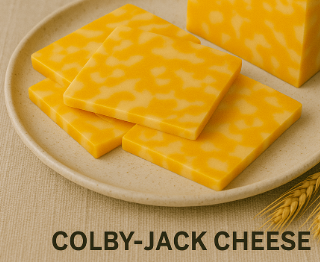
Colby-Jack cheese is a marbled, semi-hard cheese produced by blending two American cheeses: Colby and Monterey Jack.
The characteristic orange-and-white marbling comes from mixing curds from the two cheeses before pressing.
It has a mild, creamy, slightly sweet and buttery flavour with a soft, open texture and good meltability.
Widely used in snacks, sandwiches, shredded blends, Tex-Mex dishes, pizzas.
Indicative nutritional values per 100 g
(standard full-fat Colby-Jack cheese)
Energy: 350–400 kcal
Carbohydrates: 1–2 g
sugars: <1 g
Protein: 22–25 g
Lipids: 27–33 g
SFA (first occurrence – saturated fatty acids): 15–20 g
MUFA: 7–9 g
PUFA: 0.5–1 g
TFA: small natural amounts (from ruminant milk)
Minerals: calcium, phosphorus, sodium, zinc
Vitamins: A, B2, B12, small amounts of D
Values vary by milk source and fat content.
Key constituents
Milk proteins (caseins, whey proteins)
Milk fat (triglycerides, natural SFA, MUFA, PUFA)
Salt
Natural colour (annatto, for Colby portion)
Water (reduced during pressing and aging)
Production process
Standardisation of cow’s milk (fat/protein adjustment).
Pasteurisation (or thermisation for artisan versions).
Addition of starter cultures (lactic cultures).
Coagulation with rennet.
Cutting of curd and cooking at moderate temperature.
Washing of curd (specific to Colby, reduces acidity and yields milder flavour).
Colouring: annatto is added to the Colby curd only.
Mixing Colby curds with Monterey Jack curds to create marbling.
Moulding and pressing.
Salting (dry salt or brine).
Aging: short aging (4–8 weeks) for mild flavour.
Packaging as blocks, slices, shreds or cubes.
Production carried out under GMP/HACCP.
Physical properties
Appearance: marbled orange and white blocks.
Texture: semi-hard, slightly elastic, smooth, open.
Moisture: ~40%
Melting behaviour: melts evenly with good stretch.
pH: 5.2–5.4
Sensory and technological properties
Flavour: mild, buttery, slightly sweet, not sharp.
Aroma: creamy, fresh dairy notes.
Meltability: excellent; suitable for hot dishes, sauces and toppings.
Functional behaviour:
good sliceability and shreddability,
browns moderately on heating,
retains moisture without becoming oily.
Food applications
Snacking: cheese cubes, sliced cheese, cheese sticks.
Sandwiches and burgers.
Pizza and Tex-Mex: quesadillas, nachos, tacos, enchiladas.
Casseroles and baked dishes.
Cheese blends: shredded mixes with Cheddar, Jack, Mozzarella.
Sauces, dips and creamy fillings.
Nutrition & health
Good source of high-quality protein and calcium.
Contains SFA, which should be moderated as part of a balanced diet, but also beneficial MUFA/PUFA and natural conjugated fatty acids (CLA trace amounts).
Contains sodium from salting.
Lactose level is low (<1 g), often tolerated better than milk by some individuals.
Not suitable for individuals with milk-protein allergy.
Portion note
Typical consumption:
28 g (1 oz) per serving in snacks and recipes.
50–100 g in cooked dishes depending on use.
Allergens & intolerances
Contains milk → major allergen (must be declared).
Contains lactose in low amounts.
Unsuitable for people with cow’s milk allergy.
Suitable for vegetarians only if rennet used is microbial or vegetarian.
Storage & shelf-life
Keep refrigerated at 2–6 °C.
Shelf-life:
45–120 days for packaged blocks and slices,
shorter once opened (7–14 days).
Avoid exposure to air (risk of drying, mould growth).
Freezing possible but may affect texture.
Safety & regulatory
Must comply with dairy hygiene regulations and compositional standards.
Monitoring required for:
pathogens (Listeria, Salmonella),
moisture, fat content, pH,
contaminants (antibiotic residues, mycotoxins in feed).
Production must follow GMP/HACCP, with full traceability.
Labeling
Declared as “Colby Jack cheese” or “marbled Colby and Monterey Jack cheese”.
Must include MILK as allergen.
Optional: “made with pasteurised milk”, “vegetarian rennet”, “natural cheese”.
Troubleshooting
Excess oiling when melting: moisture too low or fat too high → adjust formulation.
Weak marbling pattern: insufficient mixing of curds → adjust blending time.
Crumbly texture: high acidity or insufficient moisture → check pH and curd washing.
Blowholes/gas defects: unwanted fermentation → improve sanitation/culture control.
Sustainability & supply chain
Environmental considerations tied to dairy farming:
greenhouse gas emissions,
water use,
manure management.
Processing plant effluents must be monitored (e.g., BOD/COD).
Certifications available: Animal Welfare Approved, Organic, Non-GMO feed, etc.
Main INCI functions (cosmetics)
(rare in cosmetics; when used, generally as “Lactis Proteinum” or milk-derived extracts)
Skin conditioning
Film forming
Nourishing (due to proteins and lipids)
Conclusion
Colby-Jack cheese is a versatile, mild, and melty American cheese, ideal for snacking, cooking, baked dishes and cheese blends.
Its balanced flavour, good meltability and attractive marbling make it a popular ingredient in retail, foodservice and industrial applications. When produced under GMP/HACCP, it is a safe, stable and high-quality dairy ingredient.
Mini-glossary
SFA – Saturated fatty acids: high in cheese; moderation recommended.
MUFA – Monounsaturated fatty acids: present in milk fat.
PUFA – Polyunsaturated fatty acids: small fraction of milk fat.
TFA – Natural trans fatty acids from ruminant fat, present in small amounts.
GMP/HACCP – Food safety and quality management systems.
BOD/COD – Environmental indicators used for wastewater assessment.

