



Malt extract
Description
Malt extract is a concentrated product obtained from malted cereals, most commonly barley malt (Hordeum vulgare), less frequently wheat or other grains.
It is produced by mashing milled malt with water to convert starches into fermentable sugars, followed by clarification and concentration.
It is available as:
liquid malt extract (LME) – viscous syrup,
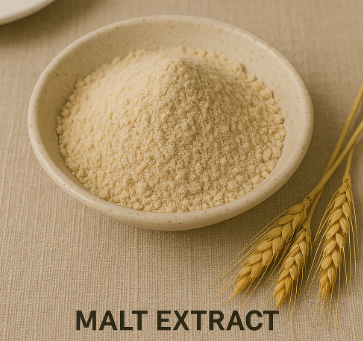
dried malt extract (DME) – spray-dried powder.
Malt extract provides fermentable sugars, colour, flavour, and nutrients, and is widely used in bakery, brewing, breakfast cereals, confectionery, beverages and nutritional products.
Indicative nutritional values per 100 g
(liquid barley malt extract, ≈ 75–80 °Brix – values indicative)
Energy: 300–330 kcal
Carbohydrates: 70–80 g
sugars (maltose, glucose, maltotriose, residual dextrins): 60–75 g
Protein: 4–7 g
Lipids: 0.5–1.5 g
SFA (first occurrence – saturated fatty acids): very low, typically <0.3 g; high SFA intake is generally negative for cardiovascular health, but here the contribution is negligible
MUFA: traces
PUFA: traces
TFA: not expected
Fibre: typically <1 g
Minerals: small amounts of potassium, magnesium, phosphorus and trace elements
Values are higher on a dry-matter basis and vary with raw material and concentration.
Key constituents
Carbohydrates:
maltose, glucose, maltotriose (main fermentable sugars),
limit dextrins and longer-chain carbohydrates (provide body and mouthfeel).
Proteins and peptides:
soluble proteins, peptides and free amino acids derived from malted grain.
Minor components:
colour compounds from Maillard reactions,
B-group vitamins (partially retained from malt),
minerals.
If produced from barley, malt extract may contain gluten.
Production process
Malting (of barley or other grains):
steeping, germination and kilning to activate enzymes and develop flavour.
Milling and mashing:
milled malt mixed with water at controlled temperatures;
enzymatic conversion of starch into fermentable sugars.
Lautering / filtration:
separation of sweet wort from spent grain.
Clarification:
removal of insoluble particles (trub, grain fines).
Concentration:
vacuum evaporation to desired solids content (for LME).
Spray-drying (for DME):
atomisation of concentrated wort into a hot air stream to form powder.
Cooling and packaging under GMP/HACCP.
Physical properties
Liquid malt extract (LME):
Appearance: viscous syrup, golden to dark brown.
Brix: typically 75–80 °Brix.
Density: ~1.3–1.45 g/mL (Brix-dependent).
Solubility: fully soluble/dispersible in water.
Dried malt extract (DME):
Appearance: free-flowing powder, light to medium brown.
Moisture: usually <5%.
Highly hygroscopic; readily soluble in water.
Sensory and technological properties
Flavour: malty, sweet, cereal-like, with caramel and toasted notes (stronger in darker grades).
Colour: ranges from light amber to dark brown; used as a natural colour and flavour contributor.
Provides body, mouthfeel and viscosity in beverages and foods.
Source of fermentable extract in brewing (maltose, maltotriose, glucose).
Helps improve browning and crust colour in baked goods via Maillard reactions.
Contributes to flavour complexity in breads, cookies, cereals and bars.
Food applications
Brewing: key extract source in beer production, especially in all-extract brewing and homebrewing.
Bakery: breads, malted breads, rolls, biscuits, cakes for colour, flavour and improved crust.
Breakfast cereals & bars: granola, cereal clusters, cereal bars, energy bars.
Beverages: malted drinks (non-alcoholic malt beverages, malted milk drinks, chocolate-malt beverages).
Dairy & desserts: ice cream, malted milk shakes, puddings.
Confectionery: caramels, toffees, fillings, coatings to add malty/caramel notes.
Sports and nutritional products: as a carbohydrate and flavour source in some formulations.
Nutrition & health
Malt extract is a source of carbohydrates, mainly as maltose, glucose and related sugars, providing quick energy.
Contains small amounts of protein, minerals and B-group vitamins, but at typical use levels these contribute modestly to overall intake.
Because of its high sugar content, excessive use may contribute to:
increased caloric intake,
dental caries,
less favourable glycaemic profile for some individuals.
Can be included in a balanced diet when used in moderation and within recommended limits for added sugars.
Portion note
Typical usage levels:
Bakery: 1–10% of flour weight (as syrup or powder), depending on flavour and colour desired.
Brewing: variable; LME/DME can replace part or all of the malt grist (in homebrew, often 1.5–3 kg extract per 20 L batch).
Breakfast cereals / bars: 2–15% of total recipe.
Beverages: 1–10%, depending on sweetness and malt flavour intensity.
Allergens & intolerances
Malt extract from barley or other gluten-containing cereals contains gluten unless specially processed and validated as low-gluten.
Not suitable for individuals with coeliac disease or gluten-related disorders unless certified to meet regulatory gluten limits.
Naturally lactose-free and egg-free.
Sulphites or other processing aids may be present in some industrial processes and must be declared where applicable.
Storage & shelf-life
Liquid malt extract (LME):
Store in cool, dry conditions, protected from heat and direct sunlight.
Keep containers tightly closed to minimise moisture uptake and oxidation.
Typical shelf-life: 6–12 months unopened; viscosity may increase with time.
Dried malt extract (DME):
Store in airtight, moisture-barrier packaging.
Highly hygroscopic; exposure to humidity leads to caking and quality loss.
Typical shelf-life: 12–24 months unopened under proper storage.
Main deterioration mechanisms:
Maillard browning and flavour changes during prolonged storage or high temperature.
Oxidation of minor lipids and flavour compounds.
Caking or hardening (DME) due to moisture.
Safety & regulatory
Classified as a cereal-based food ingredient.
Must comply with:
cereal and malt quality standards;
limits for mycotoxins, pesticide residues, heavy metals;
microbiological criteria appropriate for low-water-activity ingredients.
Production must follow GMP/HACCP, with full traceability from grain to finished extract.
In some jurisdictions, malt extract may be considered both a flavouring and a nutritive ingredient depending on usage.
Labeling
Possible ingredient declarations:
“malt extract”,
“barley malt extract” (recommended when barley is source),
“wheat malt extract” or other cereal source if relevant.
In composite foods, must be listed in descending order of weight.
Where gluten labelling is required, the cereal source (e.g., barley) must be clearly identified.
If used mainly as a flavouring component, may also be indicated in connection with “malt flavour”.
Troubleshooting
Too strong colour or flavour:
use a lighter-colour grade or reduce dosage.
Insufficient malty character:
increase inclusion level or choose a darker/more flavourful extract.
Caking of powder (DME):
moisture exposure → improve packaging and storage; consider anti-caking measures.
Variable fermentability in brewing:
check degree of fermentability and solids; some extracts are formulated for specific beer styles.
Thick handling (LME):
warm slightly (within safe limits) to reduce viscosity; dilute with water if permitted by formulation.
Sustainability & supply chain
Derived mainly from barley and other cereals grown in temperate regions.
Key sustainability aspects:
responsible grain cultivation (soil conservation, fertiliser and pesticide management),
efficient water and energy use in malting and evaporation,
management of by-products (spent grain) for feed or other uses,
treatment of process wastewater, often monitored via BOD/COD.
Malt and malt extract can be sourced from certified sustainable, organic or local supply chains.
Main INCI functions (cosmetics)
(e.g., “Hordeum Vulgare Extract”, “Malt Extract”)
Skin conditioning (due to sugars, amino acids and minerals).
Humectant – helps retain moisture.
Mild antioxidant properties from polyphenols and Maillard products.
Used in some shampoos, skin-care products and “beer/malt” themed cosmetics.
Conclusion
Malt extract is a versatile, functional cereal ingredient that contributes flavour, colour, body and fermentable extract to a wide range of foods and beverages, particularly bakery products, breakfast cereals and beer.
When produced from quality malt under GMP/HACCP and stored correctly as liquid or powder, it offers a safe, stable and high-performance ingredient suitable for both industrial and artisanal applications.
Mini-glossary
SFA – Saturated fatty acids: a class of fats linked with cardiovascular risk when consumed in excess; present only at very low levels in malt extract and nutritionally negligible at typical use levels.
MUFA – Monounsaturated fatty acids: generally neutral or beneficial fats; present only in traces in malt extract.
PUFA – Polyunsaturated fatty acids: essential fats more prone to oxidation; present only in traces here.
TFA – Trans fatty acids: fats associated with negative health effects; not expected in malt extract as a primary component.
GMP/HACCP – Good Manufacturing Practices / Hazard Analysis and Critical Control Points, systems to ensure hygiene, safety and process control in food production.
BOD/COD – Biological / Chemical Oxygen Demand, indicators of the organic and chemical load of wastewater, used to assess environmental impact.
Brix – Measure of soluble solids (mainly sugars) in a solution; used to define malt extract concentration.

