



Liquid whole eggs
Description
Liquid whole eggs are obtained by breaking, mixing and filtering whole shell eggs (yolk + white) under controlled conditions.
They are typically pasteurised to ensure microbiological safety and to extend shelf-life, while preserving the main functional properties of fresh eggs.
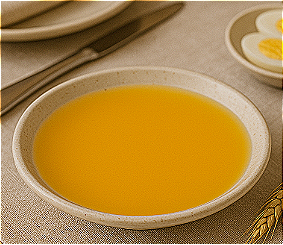
The product is a homogeneous yellow liquid used widely in bakery, pastry, gastronomy, industrial food production and catering.
Indicative nutritional values per 100 g
(pasteurised liquid whole egg, no additives)
Energy: 130–150 kcal
Carbohydrates: 0.7–1.5 g
sugars: 0.2–1 g
Protein: 10–12 g
Lipids: 9–11 g
SFA (first occurrence – saturated fatty acids): 2.5–3.5 g
MUFA: 3.5–4.5 g
PUFA: 1.5–2.5 g
TFA: absent
Cholesterol: 350–400 mg
Vitamins: A, D, E, K, B2, B12, folate
Minerals: phosphorus, selenium, iron, zinc, iodine
Exact values depend on hens’ diet and production system.
Key constituents
High biological value proteins (ovalbumin, ovotransferrin, ovomucin, others)
Egg lipids (triglycerides, phospholipids, cholesterol)
Lecithins with strong emulsifying properties
Carotenoids (lutein, zeaxanthin)
Fat- and water-soluble vitamins
Essential minerals and trace elements
Production process
Selection and washing of fresh shell eggs.
Mechanical breaking and separation from shell and membranes.
Filtering to remove shell fragments and coarse particles.
Blending/homogenisation to obtain a uniform liquid.
Pasteurisation (typically 63–68 °C for a defined time, depending on process).
Rapid cooling to refrigeration temperature.
Filling and packaging in food-grade cartons, bottles, bag-in-box or industrial containers.
All steps are carried out under GMP/HACCP conditions.
Physical properties
Appearance: homogeneous, free-flowing yellow liquid.
Density: approx. 1.03–1.05 g/mL
pH: 7.0–8.0
Stability: good after pasteurisation under chilled storage; sensitive to prolonged heat.
Sensory and technological properties
Flavour and aroma typical of fresh whole eggs.
Excellent emulsifying properties (due to lecithins and proteins).
Strong foaming capacity for meringues, sponges and aerated products.
Thermal coagulation provides structure, binding and firmness.
Contributes colour, richness, volume and tenderness in baked goods.
Facilitates dosing, standardisation and hygiene compared with shell eggs.
Food applications
Bakery/pastry: cakes, sponge cakes, biscuits, brioche, custards, creams.
Gastronomy: omelettes, frittatas, quiches, sauces, savoury creams.
Food industry: fresh pasta, breaded products, ready meals, sauces, dessert bases.
Ice cream/gelato: custard bases, semifreddo, enriched desserts.
HoReCa/catering: large-scale cooking, where convenience and safety are critical.
Nutrition & health
Provides complete proteins with all essential amino acids.
Source of vitamins A, D, E, B12 and choline, and antioxidants such as lutein and zeaxanthin.
Contains cholesterol; its impact must be evaluated in the context of overall diet and health status.
Pasteurised liquid eggs reduce the microbiological risks associated with raw shell eggs when properly handled.
Portion note
Approximate equivalence: 50 g ≈ 1 medium egg.
In recipes, usage typically ranges from 5–25% of total formula weight, depending on product type (bakery, sauces, etc.).
Allergens & intolerances
Egg is a major food allergen and must be declared as such (e.g., under EU and many international regulations).
Not suitable for individuals allergic to egg white and/or yolk proteins.
Naturally gluten-free and lactose-free (barring cross-contamination).
Storage & shelf-life
Store refrigerated at 0–4 °C for chilled products.
Typical shelf-life: 7–30 days unopened, depending on process and packaging.
Frozen liquid whole eggs: up to 12 months at –18 °C (once thawed, do not refreeze).
Avoid temperature abuse and strong temperature fluctuations to maintain functionality and safety.
Safety & regulatory
Subject to strict controls on:
Salmonella and other pathogenic bacteria,
total plate count and hygiene indicators,
residues and contaminants according to egg regulations.
Pasteurisation is mandatory for liquid egg products in many jurisdictions.
Full traceability from farm to finished product is required.
Production must comply with GMP/HACCP and any specific national regulations for egg products.
Labeling
Typical names:
“liquid whole eggs”,
“pasteurised liquid whole eggs”.
Ingredient list:
“whole eggs” (or “100% whole eggs”) plus any added ingredients (salt, sugar, stabilisers, etc.).
The allergen EGG must be clearly highlighted according to local labelling rules (e.g., bold, caps or separate statement).
Troubleshooting
Premature coagulation / lumps:
excessive heat during storage or processing → check cold chain and process temperatures.
Phase separation/settling:
insufficient mixing → shake or stir well before use.
Pale colour:
natural variability in yolk pigmentation related to hens’ diet; not necessarily a quality defect.
Off-flavours (sulphurous, rancid):
oxidation or poor storage → use fresh batches and improve storage (temperature, oxygen/light exposure).
Sustainability & supply chain
Impact mainly linked to egg production systems (cage-free, barn, free-range, organic).
Key aspects:
feed and water use,
animal welfare,
manure management and emissions,
processing plant effluents (often monitored by BOD/COD indices).
Products may be available with organic, free-range or animal welfare certifications.
Main INCI functions (cosmetics)
(as “Egg Extract”, “Ovum Extract”, “Hydrolyzed Egg Protein”, etc.)
Conditioning for hair and skin.
Film forming for protective layers on hair/skin.
Emollient and nourishing effect.
Used in hair masks, restructuring treatments, skin masks and some “natural” cosmetic formulations.
Conclusion
Liquid whole eggs are a versatile, safe and standardised egg ingredient, offering all the functional, nutritional and sensory properties of shell eggs with improved convenience, hygiene and process control.
They are essential in professional bakery, gastronomy and food industry applications, where consistent quality, microbiological safety and ease of use are critical.
Mini-glossary
SFA – Saturated fatty acids: a class of fats; in eggs they contribute to total fat and should be moderated as part of a balanced diet.
MUFA – Monounsaturated fatty acids: generally considered neutral or beneficial fats present in egg yolk.
PUFA – Polyunsaturated fatty acids: include essential fatty acids; present in smaller amounts in eggs.
TFA – Trans fatty acids: not naturally present in significant amounts in eggs.
GMP/HACCP – Good Manufacturing Practices / Hazard Analysis and Critical Control Points, systems that ensure hygiene, safety and quality in food production.
BOD/COD – Biological / Chemical Oxygen Demand, indicators used to assess the environmental impact of processing wastewater.
Studies
Regarding the intake of chicken eggs as its impact on human health, in recent decades, there are conflicting views.

Doubts focus on the cholesterol content and its potential role in cardio-metabolic outcomes.
A whole or boiled chicken egg contains about 15 micrograms of selenium and in addition iron, Vitamin B2, B12, D, E
It also contains lutein, a carotenoid that can be protective against diseases such as age-related macular degeneration (1) and choline, a cellular and nervous restructurer and anti-inflammatory.(2)
Recent studies have also shown that the egg, due to its vitamin D content, helps protect the eyes from cataracts and other degenerative diseases due to ageing.
On the other hand, health recommendations indicate that dietary cholesterol should be limited to less than 200 mg per day; a single large egg yolk contains about 275 mg of cholesterol (3), so taking even a single egg increases LDL cholesterol.

The consumption of whole egg in the middle-aged and elderly population has long been discussed in the scientific literature. The impact on the cardiovascular system with possibility of disease has been under observation for several years. However, this study considers that the intake of whole egg does not affect the risk of cardiovascular disease (4).
This study, on the other hand, considers that a high consumption of eggs is significantly associated with a higher risk of contracting incidental cardiovascular diseases (5).

