



Brown sugar syrup
Description
Brown sugar syrup is a concentrated aqueous solution of sucrose obtained by dissolving and concentrating cane sugar in potable water.
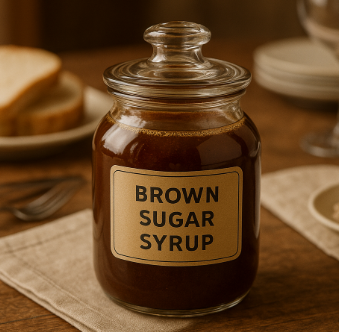
It appears as a viscous, clear to slightly amber liquid with a clean sweet taste and mild caramel notes, depending on concentration and heating conditions.
It is widely used as a liquid sweetener in beverages, desserts, ice cream, bakery products, confectionery and as a carrier/base for flavors and professional syrups.
Indicative nutritional values per 100 g
(standard cane sugar syrup at ≈ 60–70% dissolved solids)
Energy: 260–310 kcal
Carbohydrates: 65–75 g
sugars (sucrose, glucose, fructose): 65–75 g
Protein: 0 g
Lipids: 0 g
SFA (first occurrence – saturated fatty acids): not applicable
MUFA: not applicable
PUFA: not applicable
TFA: not applicable
Fibre: 0 g
Minerals: trace amounts of potassium, calcium, magnesium (depending on refining level)
Energy contribution is typical of simple sugars (≈ 4 kcal/g of sugar).
Key constituents
Sucrose (main component)
Glucose and fructose (minor amounts, especially if partial inversion is used)
Trace minerals from cane sugar (more in less refined grades)
Process-related caramelisation products (light, depending on heating)
Production process
Dissolution of refined or partially refined cane sugar in potable water under controlled agitation.
Clarification/filtration to remove insoluble impurities if needed.
Concentration by heating/evaporation to reach the target solids content (typically 60–70 °Brix).
Optional controlled inversion (acid or enzymatic) to convert part of sucrose to glucose and fructose, improving crystallisation stability and sweetness perception.
Cooling and adjustment of density and clarity.
Filling and packaging into suitable containers (bottles, PET, bag-in-box, drums), providing protection against contamination and moisture uptake.
Production under GMP/HACCP, with monitoring of water quality, sugar purity and microbiological status.
Physical properties
Appearance: viscous, clear to slightly amber liquid.
Density: typically 1.25–1.35 g/mL (depending on Brix and temperature).
Viscosity: high; increases with solids content and decreases with temperature.
Solubility: fully miscible in water.
pH: usually around 5–7 (depending on water and processing).
Sensory and technological properties
Provides a clean, rounded sweetness and mild body.
Adds mouthfeel and viscosity to beverages, sauces and desserts.
Less prone to crystallisation than dry sugar in many applications.
Improves flavor dispersion and stability in liquid systems (e.g., flavored syrups, RTD drinks).
Acts as a humectant, helping to maintain softness in baked goods and to control water activity in some formulations.
Food applications
Cold and hot beverages: tea, herbal infusions, lemonades, soft drinks, coffee drinks, cocktails.
Ice cream and desserts: gelato/ice cream bases, sorbets, toppings, dessert sauces.
Bakery: cakes, muffins, soft cookies, glazes and icings.
Confectionery: soft candies, fillings, marshmallows, dessert sauces.
Industrial uses: ready-made syrups, flavor bases, bar and snack coatings, sweet sauces.
HoReCa/bar use: standard “simple syrup” for cocktails and coffee drinks.
Nutrition & health
Main effect is as a source of simple carbohydrates (sugars) and calories.
It does not provide significant amounts of vitamins, fibre or micronutrients.
Excessive intake of added sugars can contribute to:
weight gain and increased caloric load,
dental caries,
adverse effects on glycaemic control in susceptible individuals.
Within a balanced diet, cane sugar syrup can be used as a sweetener, respecting dietary guidelines on added sugar intake.
Portion note
Typical end-product usage:
5–10 g per serving in beverages (≈ 1–2 teaspoons).
5–20 mL per cocktail or specialty drink.
In ice cream/bakery formulations:
typically 3–20% of the total recipe, depending on sweetness and texture targets.
Allergens and intolerances
Cane sugar syrup is not a major allergen.
Naturally gluten-free and lactose-free, unless cross-contamination occurs during processing.
Check for possible cross-contact with other allergens if the syrup is manufactured in shared facilities.
Storage & shelf-life
Store in tightly closed containers, protected from dust, insects and moisture ingress.
Recommended storage temperature: 15–25 °C, away from direct sunlight and strong heat sources.
Typical shelf-life: 12–24 months when unopened and stored correctly.
Main deterioration risks:
fermentation if contaminated and/or diluted,
colour darkening due to further caramelisation or oxidation,
rare crystallisation if concentration, temperature or inversion level are not well controlled.
Safety & regulatory
Classified as a standard food ingredient (mixture of sugar and water).
Must comply with:
potable water requirements;
purity criteria and contaminant limits for sugar;
microbiological criteria for the final syrup.
Manufactured under GMP/HACCP, with full traceability from sugar batch to finished syrup.
Labeling
Possible declarations in ingredients lists:
“cane sugar syrup”,
or “sugar, water” when declared as a compound ingredient.
If it is important to highlight origin (e.g., for marketing):
“cane sugar syrup” vs generic “sugar syrup”.
In compound foods, must be listed in descending order of weight.
Troubleshooting
Crystallisation:
solids content too high or low inversion → adjust Brix, temperature profile or level of inversion;
seed crystal contamination → gentle warming and dissolution, improved filtration.
Haze or turbidity:
fine particulate or air bubbles → filtration, degassing or standing time.
Fermentation/off-odours:
microbial contamination → improve hygiene, packaging, and handling; avoid extended storage after opening.
Too dark / cooked flavour:
excessive heating during concentration → lower process temperature or time.
Sustainability & supply chain
Linked to the sugarcane industry, with key sustainability aspects:
water use and irrigation practices;
land use and potential deforestation in tropical regions;
fertiliser and pesticide inputs;
management of mill by-products and effluents, often monitored via BOD/COD indicators.
Organic, Fair Trade and other certified cane sugars can be used to produce value-added, sustainable cane sugar syrups.
Main INCI functions (cosmetics)
(when used in cosmetic products, not as a flavor)
Humectant – helps retain moisture in skin and hair products.
Solvent – for water-soluble actives and flavors.
Viscosity modifier – contributes to thickness and rheology.
May appear as “Cane Sugar Syrup”, “Saccharum Officinarum Extract” or similar, depending on the specific cosmetic grade and form.
Conclusion
Brown sugar syrup is a simple yet highly versatile sweetening ingredient, offering easy dosing, rapid solubility, body and flavor-carrying capacity in a wide variety of food and beverage applications. When produced from good quality cane sugar, under controlled GMP/HACCP conditions and stored appropriately, it is a stable, safe and high-quality ingredient suitable for industrial, foodservice and home use.
Mini-glossary
SFA – Saturated fatty acids: a category of fats associated with increased cardiovascular risk when consumed in excess; not relevant in cane sugar syrup, which contains no fat.
MUFA – Monounsaturated fatty acids: another fat class; not applicable here.
PUFA – Polyunsaturated fatty acids: oxidation-prone dietary fats; not present in this ingredient.
TFA – Trans fatty acids: a fat type associated with negative health effects; not present in cane sugar syrup.
GMP/HACCP – Good Manufacturing Practices / Hazard Analysis and Critical Control Points, systems ensuring hygienic, safe and controlled food production.
BOD/COD – Biological / Chemical Oxygen Demand, key indicators of the environmental impact of wastewater from processing.
Brix – A measure of dissolved solids (mainly sugars) in a solution, used to control concentration in syrups.
Studies
It has many interesting components, such as caffeic acid, cinnamic acid, chlorogenic acid, phenolic acid, hydroxycinnamic acid, synapic acid, apigenin, phenols, phytosterols, flavonoids, luteolin, policosanols, superior terpenoids (1).
Recently, as previously for fat and protein, there has been negative discussion about carbohydrate, including blaming it for the rise of obesity and related metabolic conditions, even though overconsumption and sedentary lifestyles are more defined contributors. In many parts of the world, natural sugar (sucrose) from sugar cane is the main dietary source of carbohydrate. Considerable misinformation about sugar is in the public domain with the average consumer being unaware of (i) the critical need of body cells, particularly brain cells, for sugar to function, (ii) the multitude of functionalities other than sweetening that sugar imparts, and (iii) micronutrients delivered with many sugar products (2).
References_________________________________________________________________________
(1) Singh A, Lal UR, Mukhtar HM, Singh PS, Shah G, Dhawan RK. Phytochemical profile of sugarcane and its potential health aspects. Pharmacogn Rev. 2015 Jan-Jun;9(17):45-54. doi: 10.4103/0973-7847.156340. Review.
Abstract. Sugarcane (Saccharum officinarum Linn.) is an important perennial grass of Poaceae family, indigenous to tropical South Asia and Southeast Asia. It is cultivated worldwide due to the economical and medicinal value of its high yielding products. Sugarcane juice is well known as a raw material for the production of refined sugar and its wax is considered as a potential substitute for the expensive carnauba wax, which is of cosmetic and pharmaceutical interest. Refined sugar is the primary product of sugarcane juice, but during its processing, various other valuable products are also obtained in an unrefined form, such as, brown sugar, molasses, and jaggery. Sugarcane juice is widely used in India in the treatment of jaundice, hemorrhage, dysuria, anuria, and other urinary diseases. Herein, we have summarized the different phytoconstituents and health benefits of sugarcane and its valuable products. The phytochemistry of sugarcane wax (obtained from the leaves and stalks of sugarcane), leaves, juice, and its products has revealed the presence of various fatty acid, alcohol, phytosterols, higher terpenoids, flavonoids, -O- and -C-glycosides, and phenolic acids. The future prospective of some of the sugarcane products has been discussed, which needs a phytopharmacological study and has a great potential to be a valuable medicinal product.
(2) Eggleston G J Positive Aspects of Cane Sugar and Sugar Cane Derived Products in Food and Nutrition. Agric Food Chem. 2018 Apr 25;66(16):4007-4012. doi: 10.1021/acs.jafc.7b05734.
Abstract. Recently, as previously for fat and protein, there has been negative discussion about carbohydrate, including blaming it for the rise of obesity and related metabolic conditions, even though overconsumption and sedentary lifestyles are more defined contributors. In many parts of the world, natural sugar (sucrose) from sugar cane is the main dietary source of carbohydrate. Considerable misinformation about sugar is in the public domain with the average consumer being unaware of (i) the critical need of body cells, particularly brain cells, for sugar to function, (ii) the multitude of functionalities other than sweetening that sugar imparts, and (iii) micronutrients delivered with many sugar products.

