Seme di cardamomo
Descrizione
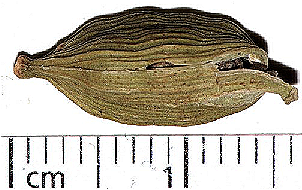
I semi di cardamomo provengono dalle capsule essiccate di Elettaria cardamomum (cardamomo verde) o Amomum subulatum (cardamomo nero). Sono piccoli semi aromatici, contenuti all’interno di capsule trilobate, con un aroma speziato, caldo, fresco e leggermente agrumato. Sono utilizzati come spezia in preparazioni dolci e salate, in bevande e in miscele aromatiche tradizionali.
Valori nutrizionali indicativi per 100 g
(semi essiccati; valori medi indicativi)
Energia: 300–310 kcal
Proteine: 10–11 g
Carboidrati: 65–70 g
Lipidi: 6–7 g
Fibre alimentari: 20–30 g
Minerali: potassio, magnesio, fosforo, calcio (quantità variabili)
I dosaggi d’uso tipici (1–3 g per ricetta) comportano un contributo nutrizionale modesto.
Principali sostanze contenute
Olio essenziale (principale frazione attiva), contenente:
Terpeni e monoterpeni aromatici
Tannini e composti fenolici
Fibre e carboidrati complessi
Tracce di minerali
Processo di produzione
Raccolta delle capsule quando ancora verdi.
Essiccazione al sole o in essiccatoi controllati per stabilizzare il prodotto.
Apertura o selezione delle capsule per l’estrazione dei semi (in alcune filiere i semi sono venduti ancora all’interno della capsula).
Pulizia, eventuale setacciatura e separazione da corpi estranei.
Stoccaggio in condizioni protette da luce, umidità e contaminazioni.
Produzione conforme a GMP/HACCP, con controlli su microbiologia, metalli pesanti e residui di pesticidi.
Proprietà fisiche
Aspetto: semi piccoli, brunastro-neri, rugosi.
Aroma: fresco, speziato, balsamico, leggermente dolce.
Sapore: caldo, aromatico, leggermente agrumato.
Umidità: tipicamente inferiore al 12%.
Solubilità: i semi sono insolubili; i composti volatili si estraggono con calore o macinazione.
Proprietà sensoriali e tecnologiche
Conferiscono profumo intenso anche in piccole quantità.
Possono essere utilizzati interi, schiacciati o macinati.
L’olio essenziale apporta una nota fresca e verde, caratteristica dei prodotti orientali e delle miscele “chai”.
La macinazione fine migliora la distribuzione aromatica ma accelera la perdita di aroma.
Impieghi alimentari
Dolci e pasticceria: torte, biscotti, creme, pane dolce, dessert al cucchiaio.
Bevande: tè chai, infusi, caffè aromatizzato, tisane, punch, bevande invernali.
Piatti salati: curry, riso basmati, piatti mediorientali, marinature, carni bianche.
Miscele di spezie: garam masala, curry powder, masala chai mix.
Prodotti lattiero-caseari: yogurt aromatizzati, creme, gelati.
Industria alimentare: aromatizzazioni per snack, prodotti da forno e bevande.
Nutrizione e salute
Ingrediente ricco di terpeni aromatici e composti fenolici, con potenziale attività antiossidante (a livelli d’uso tipici l’effetto è modesto).
L’elevato contenuto di fibra è rilevante solo a dosaggi elevati, non tipici dell’uso culinario.
Tradizionalmente associato a effetti su digestione, freschezza dell’alito e benessere gastrointestinale, ma tali aspetti rientrano nel campo delle indicazioni erboristiche e non sono validi come claim alimentari standard.
Generalmente ben tollerato, purché consumato nelle normali quantità culinarie.
Nota porzione
Allergeni e intolleranze
Non è un allergene maggiore.
Possibili rare sensibilità individuali ai composti aromatici dell’olio essenziale.
Naturalmente privo di glutine, salvo contaminazioni crociate in fase di lavorazione.
Le miscele di spezie possono contenere altri allergeni da dichiarare separatamente.
Conservazione e shelf-life
Conservare in luogo fresco, asciutto, lontano da calore, luce e umidità.
Preferire contenitori ermetici per preservare gli oli essenziali.
Shelf-life:
Principali rischi:
volatilizzazione degli aromi;
infestazioni da insetti se stoccati in condizioni non idonee;
perdita di aroma per ossidazione.
Sicurezza e regolatorio
Considerato sicuro alle normali dosi culinarie.
Soggetto ai requisiti generali per spezie:
limiti per micotossine, metalli pesanti, residui di pesticidi;
criteri microbiologici per spezie essiccate.
Produzione secondo GMP/HACCP.
Per estratti concentrati o impieghi in integratori valgono normative specifiche.
Etichettatura
Troubleshooting
Aroma debole: semi vecchi o conservati male → utilizzare semi freschi, schiacciarli poco prima dell’uso.
Gusto troppo intenso o canforato: dosaggio eccessivo → ridurre quantità o utilizzare varietà meno pungenti.
Perdita di aroma nei prodotti cotti: volatilizzazione durante cottura → aggiungere parte della spezia a fine preparazione.
Grumi nelle miscele in polvere: assorbimento di umidità → migliorare imballaggio e condizioni di stoccaggio.
Sostenibilità e filiera
La coltivazione del cardamomo avviene spesso in sistemi agroforestali tropicali.
Aspetti di sostenibilità:
gestione del suolo e tutela della biodiversità;
condizioni di lavoro nei paesi produttori;
uso razionale di acqua ed energia in essiccazione.
Gli stabilimenti devono gestire correttamente reflui e lavaggi, monitorati tramite indicatori come BOD/COD se necessario.
Principali funzioni INCI (cosmesi)
(come “Elettaria Cardamomum Seed Extract” o simili)
Componente fragrante con nota speziata e fresca.
Condizionante cutaneo in formulazioni botaniche.
Utilizzato a bassa concentrazione in creme, saponi, deodoranti e prodotti aromatici.
Conclusione
I semi di cardamomo sono una spezia pregiata dall’aroma fresco, balsamico e complesso, largamente utilizzata in pasticceria, cucina etnica, bevande speziate e prodotti trasformati. Forniscono note aromatiche intense anche in piccole quantità e sono considerati sicuri nelle normali preparazioni alimentari. Una corretta gestione della filiera, lo stoccaggio adeguato e la freschezza del prodotto garantiscono un ingrediente stabile, aromatico e di alta qualità.
Mini-glossario
SFA – Saturated Fatty Acids (acidi grassi saturi): componente della frazione lipidica dei semi, con impatto minimo ai dosaggi d’uso.
MUFA – acidi grassi monoinsaturi presenti in minor quantità.
PUFA – acidi grassi polinsaturi, più sensibili all’ossidazione.
TFA – acidi grassi trans, generalmente assenti.
GMP/HACCP – sistemi di buona produzione e controllo igienico-sanitario della filiera.
BOD/COD – indicatori dell’impatto ambientale dei reflui industriali.
Studi
La coltivazione intensiva può avere un impatto sull'ambiente, soprattutto se le pratiche agricole non sono sostenibili. Tuttavia, ci sono iniziative per promuovere la coltivazione sostenibile del cardamomo.
Ha proprietà antiossidanti (1), contribuisce all'abbassamento della pressione sanguigna (2) e proprietà sedative (3).
Sostanze presenti : Limonene, Fenchone, Valerianol (4), Kaempferol, Quercetin (5).
L'olio di cardamomo funge da potenziale proteico del grano uccidendo varie fasi di vita degli insetti che attaccano il grano, come Tribolium castaneum e Sitophilus zeamais , tramite contatto e azione fumigante (6).
Cardamomo studi
Bibliografia_________________________________________________________________________
(1) Das I, Acharya A, Berry DL, Sen S, Williams E, Permaul E, Sengupta A, Bhattacharya S, Saha T. Antioxidative effects of the spice cardamom against non-melanoma skin cancer by modulating nuclear factor erythroid-2-related factor 2 and NF-κB signalling pathways. Br J Nutr. 2012 Sep 28;108(6):984-97. doi: 10.1017/S0007114511006283.
Abstract. The role of dietary factors in inhibiting or delaying the development of non-melanoma skin cancer (NMSC) has been investigated for many years. Cardamom, which is a dietary phytoproduct, has been commonly used in cuisines for flavour and has numerous health benefits, such as improving digestion and stimulating metabolism and having antitumorigenic effects. We have investigated the efficacy of dietary cardamom against 7,12-dimethylbenz[a]anthracene (DMBA)-induced skin papillomatogenesis in Swiss albino mice that closely resembles human NMSC. Mice were grouped into normal wild type (untreated), vehicle-treated (acetone), carcinogen-treated (DMBA), and DMBA and cardamom-treated (DMBA+CARD) to delineate the role of cardamom against DMBA-induced papillomatogenesis. Oral administration of cardamom to DMBA-treated mice up-regulated the phase II detoxification enzymes, such as glutathione-S-transferase and glutathione peroxidase, probably via activation of nuclear factor erythroid-2-related factor 2 transcription factor in 'DMBA+CARD' mice. Furthermore, reduced glutathione, glutathione reductase, superoxide dismutase and catalase were also up-regulated by cardamom in the same 'DMBA+CARD' group of mice compared with DMBA-treated mice. Cardamom ingestion in DMBA-treated mice blocked NF-κB activation and down-regulated cyclo-oxygenase-2 expression. As a consequence, both the size and the number of skin papillomas generated on the skin due to the DMBA treatment were reduced in the 'DMBA+CARD' group. Thus, the results from the present study suggest that cardamom has a potential to become a pivotal chemopreventive agent to prevent papillomagenesis on the skin.
(2) Verma SK, Jain V, Katewa SS. Blood pressure lowering, fibrinolysis enhancing and antioxidant activities of cardamom (Elettaria cardamomum). Indian J Biochem Biophys. 2009 Dec;46(6):503-6.
Abstract. Elettaria cardamomum (L.) Maton. (Small cardamom) fruit powder was evaluated for its antihypertensive potential and its effect on some of the cardiovascular risk factors in individuals with stage 1 hypertension. Twenty, newly diagnosed individuals with primary hypertension of stage 1 were administered 3 g of cardamom powder in two divided doses for 12 weeks. Blood pressure was recorded initially and at 4 weeks interval for 3 months. Blood samples were also collected initially and at 4 weeks interval for estimation of lipid profile, fibrinogen and fibrinolysis. Total antioxidant status, however, was assessed initially and at the end of the study. Administration of 3 g cardamom powder significantly (p<0.001) decreased systolic, diastolic and mean blood pressure and significantly (p<0.05) increased fibrinolytic activity at the end of 12th week. Total antioxidant status was also significantly (p<0.05) increased by 90% at the end of 3 months. However, fibrinogen and lipid levels were not significantly altered. All study subjects experienced a feeling of well being without any side-effects. Thus, the present study demonstrates that small cardamom effectively reduces blood pressure, enhances fibrinolysis and improves antioxidant status, without significantly altering blood lipids and fibrinogen levels in stage 1 hypertensive individuals.
(3) Gilani AH, Jabeen Q, Khan AU, Shah AJ. Gut modulatory, blood pressure lowering, diuretic and sedative activities of cardamom. J Ethnopharmacol. 2008 Feb 12;115(3):463-72.
Abstract. Ethnopharmacological relevance: Cardamom (Elettaria cardamomum) is traditionally used in various gastrointestinal, cardiovascular and neuronal disorders. Aim of the study: To rationalize cardamom use in constipation, colic, diarrhea, hypertension and as diuretic. Materials and methods: Cardamom crude extract (Ec.Cr) was studied using in vitro and in vivo techniques. Results: Ec.Cr caused atropine-sensitive stimulatory effect in isolated guinea-pig ileum at 3-10mg/ml. In rabbit jejunum preparations, Ec.Cr relaxed spontaneous and K+ (80 mM)-induced contractions as well as shifted Ca++ curves to right, like verapamil. Ec.Cr (3-100mg/kg) induced fall in the arterial blood pressure (BP) of anaesthetized rats, partially blocked in atropinized animals. In endothelium-intact rat aorta, Ec.Cr relaxed phenylephrine (1 microM)-induced contractions, partially antagonized by atropine and also inhibited K+ (80 mM) contractions. In guinea-pig atria, Ec.Cr exhibited a cardio-depressant effect. Ec.Cr (1-10mg/kg) produced diuresis in rats, accompanied by a saluretic effect. It enhanced pentobarbital-induced sleeping time in mice. Bio-assay directed fractionation revealed the separation of spasmogenic and spasmolytic components in the aqueous and organic fractions respectively. Conclusion: These results indicate that cardamom exhibits gut excitatory and inhibitory effects mediated through cholinergic and Ca++ antagonist mechanisms respectively and lowers BP via combination of both pathways. The diuretic and sedative effects may offer added value in its use in hypertension and epilepsy.
(4) Asakawa Y, Ludwiczuk A, Sakurai K, Tomiyama K, Kawakami Y, Yaguchi Y. Comparative Study on Volatile Compounds of Alpinia japonica and Elettaria cardamomum. J Oleo Sci. 2017 Aug 1;66(8):871-876. doi: 10.5650/jos.ess17048.
Abstract. The volatile compounds obtained from the ether extracts, headspace gases and steam distillates of Alpinia japonica and Elettaria cardamomum were analyzed by GC/MS. Both species were rich sources of naturally rare fenchane-type monoterpenoids, fenchene, fenchone, fenchyl alcohol and its acetate, together with 1,8-cineole. The distributions of volatile sesquiterpenoids were very poor in both species. Chiralities of fenchone in A. japonica and E. cardamomum were 99% of (1S,4R)-(+)-form. Camphor in A. japonica is composed of a mixture of (1R,4R)-(+)-form (94.3%) and (1S,4S)-(-)-form (5.7%). On the other hand, E. cardamomum produced only (1R,4R)-(+)-camphor (99%).
(5) Masoumi-Ardakani Y, Mandegary A, Esmaeilpour K, Najafipour H, Sharififar F, Pakravanan M, Ghazvini H. - Chemical Composition, Anticonvulsant Activity, and Toxicity of Essential Oil and Methanolic Extract of Elettaria cardamomum. - Planta Med. 2016 Nov;82(17):1482-1486.
Abstract. Elettaria cardamomum is an aromatic spice (cardamom) native to the humid Asian areas, which contains some compounds with a potential anticonvulsant activity. Various pharmacological properties such as anti-inflammatory, analgesic, antioxidant, and antimicrobial effects have been related to this plant. This research was conducted to examine the probable protective impact of the essential oil and methanolic extract of E. cardamomum against chemically (pentylentetrazole)- and electrically (maximal electroshock)-induced seizures in mice. In addition, neurotoxicity, acute lethality, and phytochemistry of the essential oil and methanolic extract were estimated. The TLC method showed the presence of kaempferol, rutin, and quercetin in the extract, and the concentration of quercetin in the extract was 0.5 µg/mL. The major compounds in the essential oil were 1,8-cineole (45.6 %), α-terpinyl acetate (33.7 %), sabinene (3.8 %), 4-terpinen-4-ol (2.4 %), and myrcene (2.2 %), respectively. The extract and essential oil showed significant neurotoxicity in the rotarod test at the doses of 1.5 g/kg and 0.75 mL/kg, respectively. No mortalities were observed up to the doses of 2 g/kg and 0.75 mL/kg for the extract and essential oil. The essential oil was effective in both the pentylentetrazole and maximal electroshock models; however, the extract was only effective in the pentylentetrazole model. The study suggested that E. cardamomum methanolic extract had no significant lethality in mice. Both the essential oil and methanolic extract showed movement toxicity. Anticonvulsant effects of E. cardamomum were negligible against the seizures induced by pentylentetrazole and maximal electroshock. Georg Thieme Verlag KG Stuttgart · New York.
(6) Abbasipour H, Mahmoudvand M, Rastegar F, Hosseinpour MH. - Fumigant toxicity and oviposition deterrency of the essential oil from cardamom, Elettaria cardamomum, against three stored–product insects. - J Insect Sci. 2011;11:165. doi: 10.1673/031.011.16501.
Abstract. Use of insecticides can have disruptive effects on the environment. Replacing the chemical compounds in these insecticides with plant materials, however, can be a safe method with low environmental risk. In the current study, chemical composition and insecticidal activities of the essential oil from cardamom, Elettaria cardamomum L. (Maton) (Zingiberales: Zingiberaceae) on the adults of three stored product pests was investigated. Results indicated that essential oil of E. cardamomum toxic to the bruchid beetle, Callosobruchus maculatus Fabricius (Coleoptera: Bruchidae), the red flour beetle, Tribolium castaneum Herbst (Coleoptera: Tenebrionidae), and the flour moth, Ephestia kuehniella Zeller (Lepidoptera: Pyralidae). Adults of E. kuehniella were more sensitive than the Coleoptera. Also, the highest mortality of these insects was seen after 12 hours. Results of the LT₅₀ tests showed that the lethal time of mortality occurred between 10-20 hours in various test concentrations. Essential oil of E. cardamomum had a good efficacy on oviposition deterrence of C. maculatus females, too. The chemical constituents of the essential oils were analyzed by gas chromatography-mass spectrometry. The major constituents of cardamom were identified as 1,8-cineol, α-terpinyl acetate, terpinene and fenchyl alcohol. These results suggest that essential oil of E. cardamomum is a good choice for control of stored product pests.




